Disclosure: We publish chiangmaigotours.com and operate Chiang Rai day trips ourselves. We've reviewed Viator's and GetYourGuide's public Chiang Rai day-trip pricing as a cross-reference for this post as of 2026-04-19. We don't pay either platform for placement.
Leave Chiang Mai at 06:30, drive 3 hours via Route 118, hit the white temple first (before tour buses), then Baan Dam, then the blue temple in late-afternoon light. Back to Chiang Mai by 18:30. Total ~12 hours, 6 hours driving, 3 hours on foot at temples. ฿1,200–฿1,800 per person on a group tour or ฿3,500–฿5,500 for a private driver split between your group. If you can spare two nights instead, overnighting unlocks the Golden Triangle and the hill tribes. Below: the full route, the time-of-day calculus, and the case for staying longer.
What does a one-day Chiang Rai trip from Chiang Mai actually look like?
A 12-hour, 380km round-trip covering three iconic temples and roughly 3 hours of actual on-foot sightseeing. Doable, but tight.
The Chiang Rai day trip is one of northern Thailand's most-booked excursions because it concentrates three visually striking temples within a 30km radius around Chiang Rai city. Our white, blue and black house day tour follows exactly this route from Chiang Mai. The trade-off is the drive — 3 hours each way on Route 118, the mountain road that connects the two provincial capitals. You'll spend roughly half your day in a vehicle.
A typical 06:30–18:30 day looks like:
- 06:30 Pickup from your Chiang Mai hotel
- 06:45–09:45 Drive to Wat Rong Khun (white temple), with one rest stop
- 09:45–11:00 White temple visit and photos
- 11:00–11:45 Drive to lunch in Chiang Rai city (typical group tour stop)
- 11:45–13:00 Lunch
- 13:00–13:20 Drive to Baan Dam (black house)
- 13:20–14:30 Baan Dam visit
- 14:30–14:45 Drive to Wat Rong Suea Ten (blue temple)
- 14:45–15:30 Blue temple visit
- 15:30–18:30 Drive back to Chiang Mai
Why visit the white temple first?
Wat Rong Khun gets 5,000+ visitors on peak days, with tour buses arriving 11:00–12:30. The 09:30–10:30 window is the only one where you can photograph it without crowds.
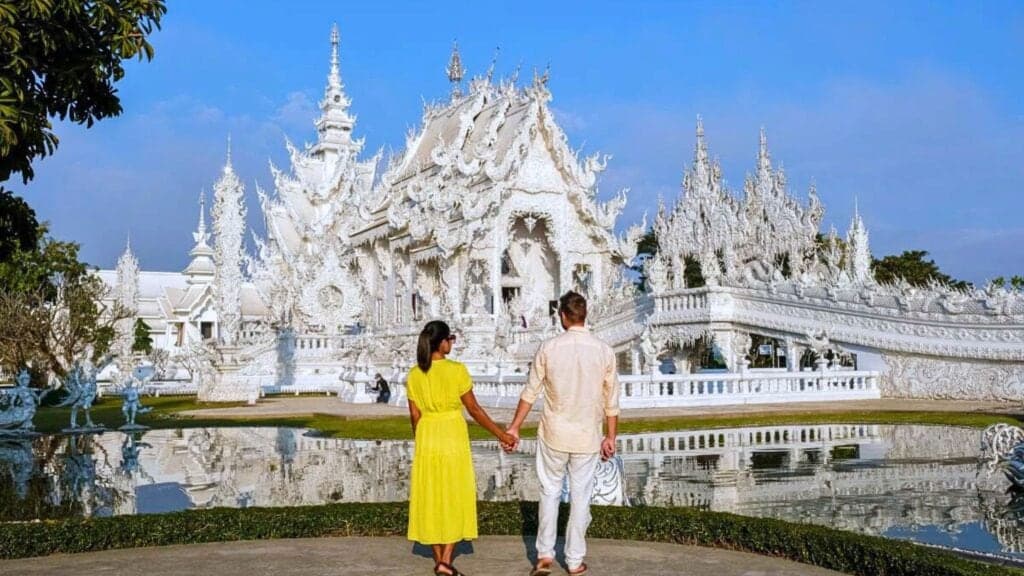
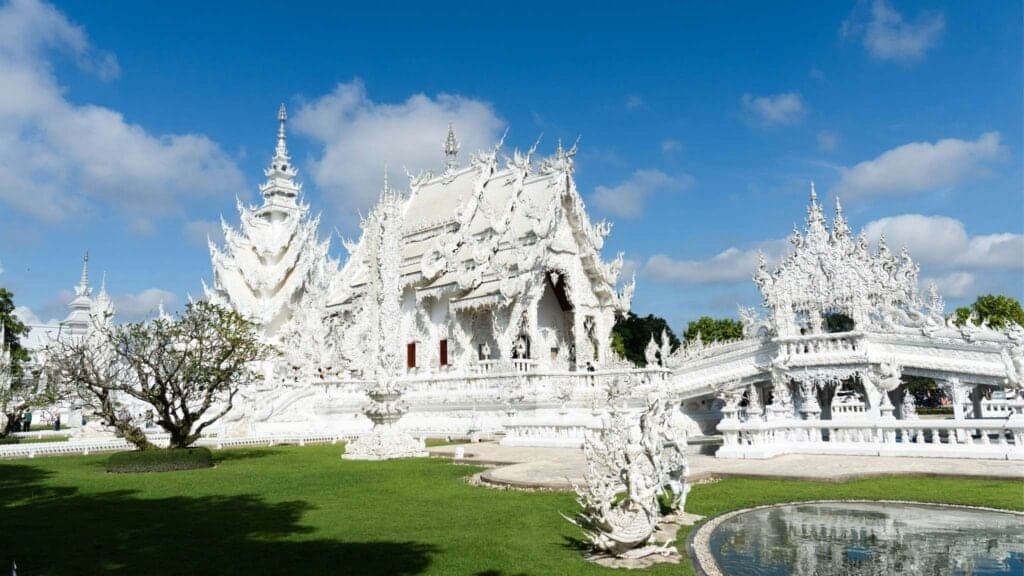
Wat Rong Khun (the "white temple") is the most photographed temple in northern Thailand. It's not a historical site — it was begun in 1997 by artist Chalermchai Kositpipat and is still being built. The white-and-silver mosaic facades, the hand-of-the-damned crossing, and the surreal mural inside the main hall draw international tour-bus crowds.
That popularity is the constraint. From 11:00 onward, the queue to enter the main hall stretches 30–60 minutes, the bridge over the "hands of hell" pond becomes a slow-moving line, and the photo angles all have other tourists in them. The fix is to arrive at opening (08:00) or in the 09:30–10:30 sweet spot before the buses peak.
The entry fee is ฿100 for foreign visitors. Modest dress (shoulders and knees covered) is required for the main hall.
How does Baan Dam compare to the temples?
Baan Dam (the "black house") isn't a temple — it's the legacy compound of artist Thawan Duchanee, full of black-painted Lanna-style buildings filled with bones, hides, and ritual objects. It's a 45-minute counterpoint to the white-temple sweetness.
Baan Dam confuses first-time visitors who expect a temple. It's a museum-cum-art-installation built across 40 buildings by Thawan Duchanee, a Thai artist who died in 2014. The compound is full of buffalo skulls, snakeskins, elephant bones and Lanna folk-art arrangements. It's a working contemplation of death, animals and the body — and it's a useful counter-weight to the white temple's spiritual purity.
Entry is ฿80. Most visitors spend 60–90 minutes here. There's a cafe at the entrance and a small souvenir shop selling Thawan's prints.
What's special about the blue temple?
Wat Rong Suea Ten is the newest of the three big sights (opened 2016), painted entirely in cobalt blue with gold leaf, and best visited in late-afternoon light when the gold flickers.
Wat Rong Suea Ten (the "blue temple") sits 5 minutes from Baan Dam in the northern outskirts of Chiang Rai. It's a young temple — the murals were finished by a student of the white temple's Chalermchai Kositpipat, and the cobalt-and-gold palette is its signature.
What you actually see: a single brilliant blue hall with gold detailing inside and out, a large white Buddha at the back, and a courtyard of smaller blue-and-gold sculptures. Entry is free, photos are allowed inside the main hall (a notable exception in northern Thailand). Total visit time: 30–45 minutes.
The late-afternoon light (15:00–16:30) hits the gold leaf at an angle that makes it glow. It's a small detail but the difference between an 11:00 visit and a 15:30 visit is noticeable in photos.
How does a day trip compare to overnighting in Chiang Rai?
| Trip style | Total days | Hours driving | Sights covered | Per-person cost | Best for |
|---|---|---|---|---|---|
| Day trip from CM | 1 | 6 hours | 3 temples + lunch | ฿1,200–฿1,800 group / ฿3,500–฿5,500 private (split) | Tight schedules, single-destination focus |
| 1-night Chiang Rai | 2 | 6 hours total | 3 temples + Singha Park or Mae Sai border | ฿2,800–฿4,500 inc. hotel | Time pressure but more variety |
| 2-night Chiang Rai | 3 | 8–10 hours total | 3 temples + Golden Triangle + hill tribes + Mae Salong | ฿4,500–฿7,500 inc. 2 nights hotel | The 'do Chiang Rai right' option |
| 3-night Chiang Rai | 4 | 10–12 hours total | Everything above + slow days, cafe city | ฿6,500–฿10,000 inc. 3 nights hotel | Honeymooners or slow travel |
The economic argument for overnighting is real: an extra night in Chiang Rai unlocks the Golden Triangle (90-minute drive north), Mae Salong (a 4-hour round trip into the Yunnan-Chinese tea hills), and a slower pace at the temples. If the Golden Triangle is the draw, our full-day private Chiang Rai temples and Golden Triangle boat ride adds the river meeting point to the three temples in a single day. For 9 out of 10 travellers who do the day trip, the feedback we hear is "we wished we'd stayed a night".
What about hiring a private driver vs joining a group tour?
For solo or couples, group tours are cheaper. For 3+ travellers, a private driver works out the same price or less and gives flexibility.
Group tours run ฿1,200–฿1,800 per person and include a 12-seat van, English-speaking guide, all three entrance fees, lunch and hotel pickup. The trade-off is the fixed schedule — you can't add a 30-minute coffee stop in Chiang Rai city or extend at Baan Dam.
A private driver runs ฿3,500–฿5,500 for the day depending on vehicle size (sedan vs van vs minivan). That's the cost of the driver plus vehicle plus fuel — entrance fees and lunch are extra. For two adults: ฿1,800–฿2,800 per person plus ~฿500 for entrances and lunch = ฿2,300–฿3,300 per person. For four adults: ฿900–฿1,400 per person plus extras = ฿1,400–฿1,900 per person, on par with the group tour.
If you want that flexibility, our private Chiang Rai city tour from Chiang Mai lets you set the order, the lunch stop, and the pace. Private wins on: flexibility, comfort, no other tourists in your van, and the ability to swap the lunch stop for somewhere you actually want to eat. Group wins on: cost-for-solos, social atmosphere, and guides who narrate the drive.
What about lunch?
Chiang Rai city has roughly 6 strong lunch spots within a 5-minute drive of the temples. Most group tours stop at Khao Soi Phor Jai or Lung Eed Local Food. Both are good. Avoid the buffet-style "tourist restaurants" the cheaper tours sometimes default to.
Khao Soi Phor Jai is a long-running Chiang Rai khao soi specialist — the Chiang Rai version of the dish runs slightly different than the Chiang Mai one, with thinner broth and more curry-paste hit. Lung Eed Local Food is a more casual northern Thai diner specialising in larb (the spiced minced-meat salad). Both are ฿80–฿150 per person, busy with locals at lunch, and unlikely to disappoint.
If you're on a private driver, ask to skip the buffet stop and head to one of these. Most drivers know both.
When should I avoid the day trip?
In peak burning season (mid-February to mid-April), and on full-rain days during September. Both make the drive miserable.
The drive through the mountains is the highlight when conditions are good — tea plantations, bamboo forest, rolling green hills. In burning season, the view is replaced by smoke haze that obscures the hills entirely and makes the air visibly unhealthy. PM2.5 readings in March often hit "very unhealthy" or "hazardous" along this route. For travellers with respiratory issues, skip the day trip during burning season.
On rainy-day September drives, the route is wet, the photos are flat, and the mountain section can have slow-moving traffic. October's tail-end of rains is fine. December–February is the peak window for the drive.
How does the Chiang Rai day trip compare to other Chiang Mai day trips?
| Day trip | Round-trip drive | Hours on foot | Difficulty | Best for |
|---|---|---|---|---|
| Chiang Rai (3 temples) | 6 hours | 3 hours | Easy | Iconic temples, time-pressed travellers |
| Doi Inthanon (highest peak) | 3 hours | 4 hours | Moderate hikes | Nature, waterfalls, summit |
| Pai (boutique mountain town) | 3 hours each way (overnight better) | Town wandering | Easy | Better as 2 nights |
| Mae Hong Son loop (3-day) | 10+ hours total over 3 days | Variable | Moderate | Adventure travel |
| Mae Wang (rural day) | 1.5 hours each way | 4 hours | Easy | Quiet local feel |
If the three Chiang Rai temples are your specific priority, the day trip works. If they're not, Doi Inthanon is a closer alternative with more nature, and Pai is a softer, longer trip.
Book the white, blue and black house Chiang Rai dayHotel pickup, all three iconic sights, lunch in Chiang Rai cityRelated reading:
- Wat Rong Khun (white temple) visitor guide
- Chiang Rai vs Pai: which side-trip is right for your week?
- Best time to visit Chiang Mai (and Chiang Rai)
Frequently asked questions
Is one day enough for Chiang Rai from Chiang Mai?
It's enough for the three big sights — Wat Rong Khun (white temple), Wat Rong Suea Ten (blue temple), and Baan Dam (the black house) — plus lunch. It is not enough for the Golden Triangle, the Mae Sai border, the hill-tribe villages, the Singha Park area, or the Mae Salong tea hills. If your priority is just the three iconic sights, a day trip works. If you want any of the surrounding region, overnight.
What's the best route — clockwise or counter-clockwise?
Counter-clockwise wins on most days. Drive Chiang Mai → white temple (south of Chiang Rai city) first, arrive 09:30–10:00 before tour buses peak. Then to Baan Dam (north of the city) for lunch nearby, then blue temple (also north, 5 minutes from Baan Dam) in the late afternoon when the gold-paint catches the light. Head back to Chiang Mai by 17:30. Total driving ~6 hours; total on-foot temple time ~3 hours; total elapsed ~12 hours door-to-door.
Should I hire a private driver or join a group tour?
Depends on travel style and group size. A group tour runs ฿1,200–฿1,800 per person, picks up from your hotel at 06:30–07:00, and follows a fixed route. A private driver runs ฿3,500–฿5,500 for a 12-hour day (depending on vehicle size) and lets you pick the order, the lunch stop, and how long you spend at each temple. For groups of 3+, private becomes cheaper per person. For solo or couples, group tours win on price unless you specifically want flexibility.
Is it worth overnighting in Chiang Rai instead?
Yes, if you have 2–3 nights to spare. Overnighting unlocks the Golden Triangle (Thailand-Laos-Myanmar river meeting point, 90 minutes north of Chiang Rai city), the hill tribe villages around Mae Suai and Mae Chan, the Mae Salong Chinese-Yunnanese tea hills, and the Singha Park area. Chiang Rai city itself is small (about 50,000 people) but has a strong cafe scene and a more local feel than Chiang Mai. A 2-night/3-day Chiang Rai trip covers all of the above plus the three iconic temples comfortably.
What time should I leave Chiang Mai for the day trip?
06:30 if you want to beat the tour-bus peak at Wat Rong Khun (which arrives 11:00–12:30). 07:00–07:30 if you're fine with the crowds. The drive is ~3 hours via Route 118 (Doi Saket → Wiang Pa Pao → Chiang Rai), so a 06:30 departure gets you to the white temple by 09:30. Anything later than 08:00 and you'll arrive in mid-crowds — the photo opportunity is meaningfully worse. Group tours typically pick up between 06:30 and 07:00 for this reason.
Is the drive safe and what does it look like?
The drive is safe — Route 118 is a sealed two-lane mountain road with good signage and standard traffic patterns. It's curvy in stretches, especially around Wiang Pa Pao, but not technical. Total distance is ~190km. The route passes Doi Saket reservoir, then climbs through tea plantations and bamboo forest before descending into Chiang Rai province. Stop at the rest stop near kilometre 100 for coffee and a stretch — most drivers do. If you're prone to motion sickness, sit in the front and take a tablet before the curvier middle hour.
Frequently asked questions
Is one day enough for Chiang Rai from Chiang Mai?
It's enough for the three big sights — Wat Rong Khun (white temple), Wat Rong Suea Ten (blue temple), and Baan Dam (the black house) — plus lunch. It is not enough for the Golden Triangle, the Mae Sai border, the hill-tribe villages, the Singha Park area, or the Mae Salong tea hills. If your priority is just the three iconic sights, a day trip works. If you want any of the surrounding region, overnight.
What's the best route — clockwise or counter-clockwise?
Counter-clockwise wins on most days. Drive Chiang Mai → white temple (south of Chiang Rai city) first, arrive 09:30–10:00 before tour buses peak. Then to Baan Dam (north of the city) for lunch nearby, then blue temple (also north, 5 minutes from Baan Dam) in the late afternoon when the gold-paint catches the light. Head back to Chiang Mai by 17:30. Total driving ~6 hours; total on-foot temple time ~3 hours; total elapsed ~12 hours door-to-door.
Should I hire a private driver or join a group tour?
Depends on travel style and group size. A group tour runs ฿1,200–฿1,800 per person, picks up from your hotel at 06:30–07:00, and follows a fixed route. A private driver runs ฿3,500–฿5,500 for a 12-hour day (depending on vehicle size) and lets you pick the order, the lunch stop, and how long you spend at each temple. For groups of 3+, private becomes cheaper per person. For solo or couples, group tours win on price unless you specifically want flexibility.
Is it worth overnighting in Chiang Rai instead?
Yes, if you have 2–3 nights to spare. Overnighting unlocks the Golden Triangle (Thailand-Laos-Myanmar river meeting point, 90 minutes north of Chiang Rai city), the hill tribe villages around Mae Suai and Mae Chan, the Mae Salong Chinese-Yunnanese tea hills, and the Singha Park area. Chiang Rai city itself is small (about 50,000 people) but has a strong cafe scene and a more local feel than Chiang Mai. A 2-night/3-day Chiang Rai trip covers all of the above plus the three iconic temples comfortably.
What time should I leave Chiang Mai for the day trip?
06:30 if you want to beat the tour-bus peak at Wat Rong Khun (which arrives 11:00–12:30). 07:00–07:30 if you're fine with the crowds. The drive is ~3 hours via Route 118 (Doi Saket → Wiang Pa Pao → Chiang Rai), so a 06:30 departure gets you to the white temple by 09:30. Anything later than 08:00 and you'll arrive in mid-crowds — the photo opportunity is meaningfully worse. Group tours typically pick up between 06:30 and 07:00 for this reason.
Is the drive safe and what does it look like?
The drive is safe — Route 118 is a sealed two-lane mountain road with good signage and standard traffic patterns. It's curvy in stretches, especially around Wiang Pa Pao, but not technical. Total distance is ~190km. The route passes Doi Saket reservoir, then climbs through tea plantations and bamboo forest before descending into Chiang Rai province. Stop at the rest stop near kilometre 100 for coffee and a stretch — most drivers do. If you're prone to motion sickness, sit in the front and take a tablet before the curvier middle hour.