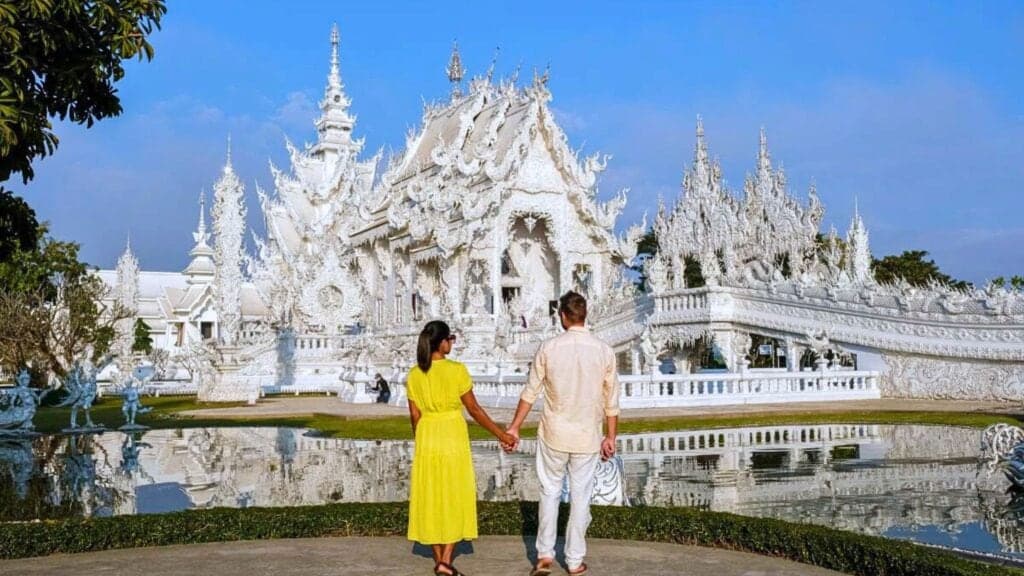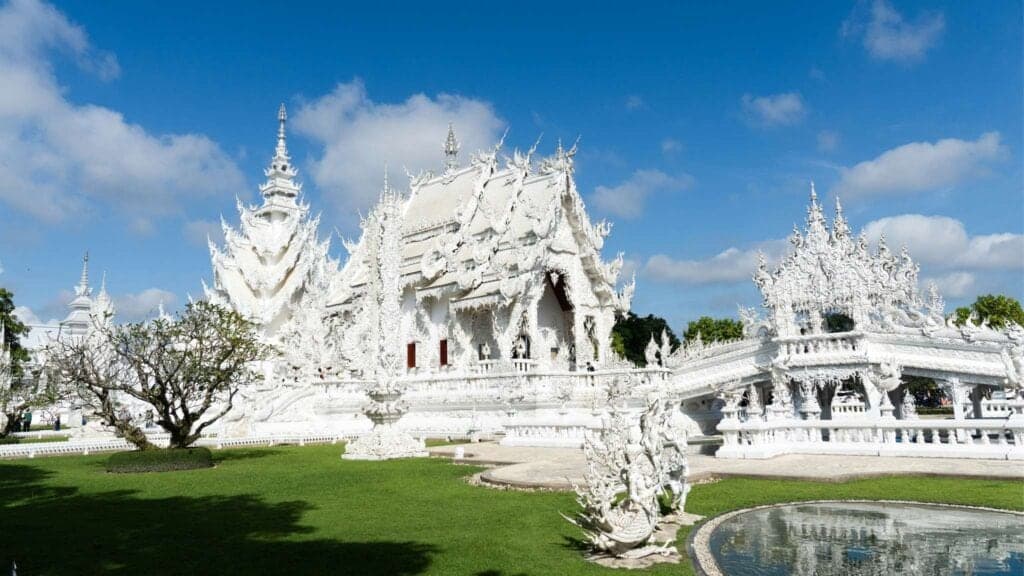
Wat Rong Khun, designed by Thai artist Chalermchai Kositpipat in 1997, is a contemporary Buddhist temple where the famous reaching-hands scene represents souls in hell grasping for salvation, the murals inside include Spider-Man and Hello Kitty as modern demons, and the entire 90-year construction project is funded by the artist's personal art sales. Entry costs ฿100 for foreigners, the temple opens 8am-5pm daily, and the best time to visit is before 9:30am to avoid tour buses. Below is the full story behind what most visitors mistake for a tourist trap.
What is Wat Rong Khun and why does it look like that?
Wat Rong Khun is a privately-funded contemporary Buddhist temple by the Chiang Rai-born artist Chalermchai Kositpipat, built since 1997 as a 90-year art project on the site of a small dilapidated village temple.
The "White Temple" is the marketing name. The real name is Wat Rong Khun. The "khun" in the name refers to a type of cassia tree and a colloquial honorific — the original village temple was named for the tree, not for the color.
Chalermchai is a real artist with serious credentials. He studied at Silpakorn University in Bangkok, exhibited internationally before starting the temple, and continues to fund the construction from his personal painting sales — he sells works for $20,000-100,000 internationally and channels the income back into the temple.
The temple is the second-most-visited site in Chiang Rai Province after Wat Phra Kaew Chiang Rai (the original home of the Emerald Buddha now in Bangkok).
What does the reaching-hands scene actually mean?
The bridge over the field of hands represents the crossing from the realm of suffering (samsara) to enlightenment. The hands grasping upward are souls trapped in hell, reaching for salvation but unable to reach the bridge themselves.
The walk across the bridge is the central ritual of visiting Wat Rong Khun. You enter the temple grounds, pass the white guard figures with the snake heads, and approach the bridge from the south. You cannot turn back once you've started crossing — staff genuinely enforce this — because the symbolism is one-way.
The field of hands below you is the Hell Realm. Most hands grasp upward, some hold weapons or skulls, a few hold begging bowls. The detail is deliberate — Chalermchai meant the visitor to look closely at each desire being grasped at and recognize themselves.
After the bridge, you arrive at the entrance flanked by the figures of Rahu (the demon who swallows the moon) and a depiction of the artist himself in monk's robes. You then enter the ubosot (the main building).
The whole sequence is designed as a guided emotional journey, not a passive sightseeing stop. Most tour groups walk it in 90 seconds without context. We tell guests to slow down and read the symbolism.
Why is there Hello Kitty and Spider-Man in the mural?
Because Chalermchai is arguing that contemporary popular culture is the modern equivalent of the demons in traditional Thai temple murals — symbols of distraction, desire, violence, and the obstacles to enlightenment.
The interior mural of the ubosot is the temple's most controversial element. Traditional Thai Buddhist temple murals show scenes from the life of the Buddha, the Ten Jataka tales, and various hell-realm and heaven-realm depictions populated by demons, gods, and mythological figures.
Chalermchai kept the format and updated the content:
- Demons traditionally show greed, anger, ignorance. The new mural shows missiles, planes hitting the World Trade Center, and a Predator figure.
- Tempters traditionally show worldly desires. The new mural shows Michael Jackson, Hello Kitty, and Spider-Man.
- Modern technology appears as smartphones, computers, satellites — all framed as objects of attachment.
- Political figures appear as the new powerful beings — George W. Bush riding a missile, Saddam Hussein, Osama Bin Laden.
The mural reads as either provocative or profound depending on what you bring to it. Photography is not allowed inside the ubosot — partly to protect the painting, partly because Chalermchai wants visitors to spend time looking rather than snapping.
What other buildings are on the site?
The main bridge and ubosot are most-photographed, but the site has nine planned structures including the gold building (toilets), a contemplation hall, and the artist's gallery.
Six of nine planned buildings are complete as of 2026. The gold building is the public toilets — gold associated with worldly attachment and the body, white with the mind and spiritual ascension. Putting the toilet in gold is the joke and the philosophy. Also worth seeing: the wishing well, the artist's gallery (Chalermchai's paintings displayed and some for sale), and the cremation hall under construction.
What does the visit actually cost?
฿100 entry fee for foreigners (Thais free), plus transport from Chiang Mai or Chiang Rai. Self-organized day trip from Chiang Mai runs ฿800-1,500 per person. Guided day-tour ฿1,200-2,500.
| Trip type | Cost per person | Time | Includes |
|---|---|---|---|
| Self-drive from Chiang Mai | ฿600-1,000 + fuel | 8-12 hours | Just the driving and entry |
| Greenbus + Chiang Rai taxi | ฿800-1,200 | 10-12 hours | Bus, local transport, entry |
| Group day-tour from Chiang Mai | ฿1,200-1,800 | 11-13 hours | Transport, guide, lunch, entry, 2-3 other sites |
| Private day-tour from Chiang Mai | ฿2,500-4,500 | 11-13 hours | Private car, guide, lunch, entry, customizable |
| From Chiang Rai (overnighting) | ฿200-400 | Half-day | Local transport, entry |
Most visitors do the group day-tour from Chiang Mai because the alternative (the bus + local transport combo) is logistically tiring for a 3-hour drive each way. The day-tour bundles the White Temple with the Black House (Baan Dam) and often the Blue Temple (Wat Rong Suea Ten) plus lunch, which is the standard Chiang Rai loop.
When is the worst time to visit?
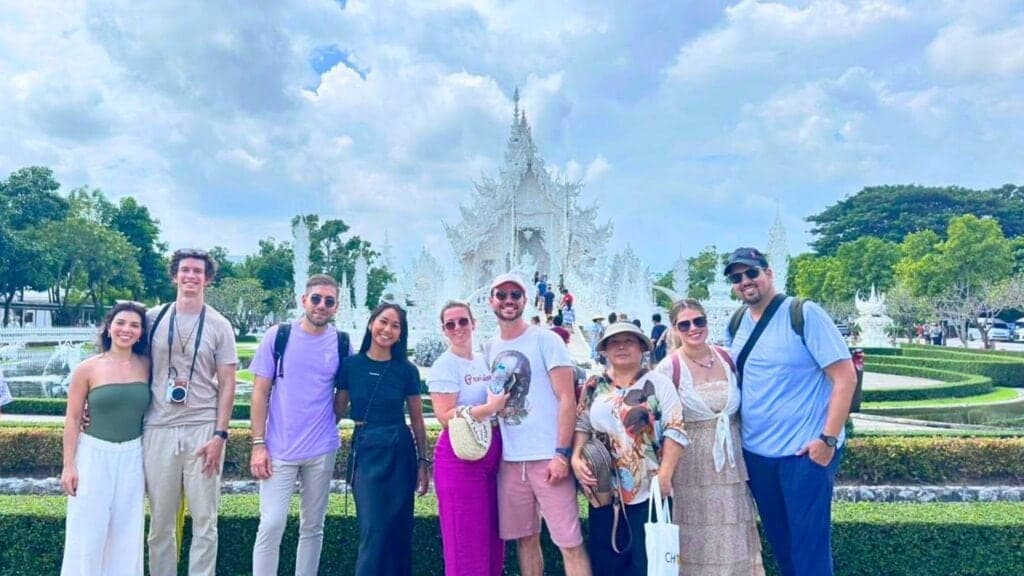
10:30am to 2:00pm. The Chinese-market tour buses arrive in this window and the bridge becomes a slow shuffling queue.
The temple sees most of its daily visitor flow in a four-hour midday window. The buses come from Chiang Rai hotels (a 20-minute drive), from the Mae Sai border crossing (90 minutes), and from Chiang Mai (3 hours). The result is roughly 60-70% of the day's visitors moving through a 30% time slot.
What you give up by visiting in peak hours:
- Photos with empty bridge (impossible after 10am).
- Quiet contemplation of the murals (impossible after 11am).
- Easy parking (lot full from 11am-1pm).
- Time inside the ubosot (queue 15-30 minutes).
The fix is early arrival. The temple opens at 8:00am and the first hour is the best of the day. From a Chiang Mai base, that means a 5:00am start. From Chiang Rai it means 7:30am.
Should I combine the White Temple with the Black House and Blue Temple?
Yes. The three are roughly 20-40 minutes apart by car and form the standard Chiang Rai art-temples loop. Each makes the others more interesting by contrast.
The Chiang Rai art-temple triangle:
- Wat Rong Khun (White Temple) — Chalermchai Kositpipat, contemporary white. The salvation theme.
- Baan Dam (Black House) — Thawan Duchanee (deceased 2014), contemporary black. The death theme.
- Wat Rong Suea Ten (Blue Temple) — Putha Kabkaew (Chalermchai's student), contemporary blue. The cosmos theme.
Visit all three and you get a representative sweep of Chiang Rai's contemporary religious art scene over the last 30 years. None alone tells the full story. A guided day-tour from Chiang Mai covering the White and Blue Temples plus the Black House Museum will include all three.
Baan Dam (Black House) is a useful counterpoint — Duchanee's vision of death and the body is the opposite of Chalermchai's vision of salvation. Visiting both in one day is the way to understand the conversation between them.
What should I wear and how should I behave?
Cover shoulders and knees. Shoes off in the ubosot. No photography inside the main temple. No turning back on the bridge. Quiet voices throughout.
Wat Rong Khun is an active Buddhist temple as well as an art destination, so traditional temple etiquette applies:
- Shoulders covered. T-shirts are fine, sleeveless tops are not.
- Knees covered. Long trousers, long skirt, knee-length shorts.
- Shoes off inside the ubosot. Socks are fine.
- No pointing your feet at the Buddha image (so don't sit cross-legged facing it).
- Quiet voices. The site is busy but it's still a temple.
- No flash photography. No photography inside the main mural room at all.
- Don't touch the artworks — including the hands on the bridge.
The temple lends sarongs and shawls at the entrance for free with a refundable ฿100 deposit. Use them if you arrive under-dressed.
Is Wat Rong Khun "real" Buddhism or just art?
Both. It's a functioning Buddhist temple consecrated by senior monks holding regular services, and it's also a 90-year contemporary art project.
The temple has full Buddhist consecration. Resident monks live and practice on the grounds. It's also an art project with clear contemporary aesthetic intent. In Thai Buddhist tradition the dichotomy doesn't really exist — temples have always been the major sites of artistic patronage. Wat Rong Khun continues that tradition with a 21st century aesthetic vocabulary. Expecting an austere meditation hall confuses; expecting an Instagram backdrop misses the depth.
Is the White Temple worth a full day from Chiang Mai?
Yes, as part of the broader Chiang Rai loop. Probably not, as a standalone trip just for the White Temple.
A solo White-Temple round trip from Chiang Mai is 6+ hours of driving for 90 minutes at the site. The math doesn't favor that. Add Black House and Blue Temple plus lunch and a tea-plantation stop, and you have a satisfying full day that justifies the drive.
If you have a week in Chiang Mai, the Chiang Rai day-tour is one of the top three day-trips. The other two being a Doi Inthanon national park day and an elephant sanctuary day.
For visitors who would rather travel on their own schedule, the same Chiang Rai loop is available as a private day-tour with a Golden Triangle boat ride.
Book the White, Blue and Black House Chiang Rai dayWhite Temple, Blue Temple, Black House Museum, licensed guide, hotel pickupRelated reading:
- Chiang Rai day trip from Chiang Mai: full itinerary
- Black House (Baan Dam) Chiang Rai: Thawan Duchanee's vision explained
External references:
- Tourism Authority of Thailand Chiang Rai overview (tat.or.th).
- Wikipedia on Chalermchai Kositpipat (en.wikipedia.org/wiki/Chalermchai_Kositpipat), accessed 2026-05-25.
Frequently asked questions
Is there a dress code at the White Temple?
Yes, and it's actively enforced. Shoulders and knees covered. No transparent fabric, no short shorts, no vest tops. The temple lends sarongs and shawls at the entrance with a refundable deposit. Dress more conservatively than for the Old City temples — Wat Rong Khun staff are strict about visible skin in photos. Shoes off in the main ubosot. Children under 10 have looser standards but should still be covered appropriately.
Who built the White Temple and why?
Chalermchai Kositpipat, a Chiang Rai-born Thai artist, designed and built Wat Rong Khun starting in 1997 as a contemporary Buddhist temple. He bought the land of a dilapidated village temple and began a 90-year construction plan funded entirely by his own art sales — refusing government money to maintain artistic independence. He hopes the temple will still be under construction long after his death. The work is a meditation on suffering, desire, and enlightenment.
Why are there aliens, Hello Kitty, and Spider-Man in the mural?
Because Chalermchai is making a point about contemporary suffering and desire. The main mural inside the ubosot includes Neo, Spider-Man, Predator, Hello Kitty, Michael Jackson, a 9/11 plane, and a missile with George Bush's face. The argument: these are the modern equivalents of demons and temptations in traditional Buddhist murals — pop culture, consumerism, violence, technology. Photography is prohibited inside.
What's the best time to photograph the White Temple?
Early morning, 8:00-9:30am right after the 8:00am opening. The light hits the bridge from the east and the tour buses haven't arrived. Avoid the 10:30am-2:00pm peak. Late afternoon (4:00-5:00pm) is good light but the temple closes at 5:00pm. Cloudy days work well because the white reflects evenly. Wet-season morning fog adds atmosphere.
How do I get from Chiang Mai to the White Temple?
Three options. Full-day guided tour from Chiang Mai (most common): ฿1,200-2,500 per person, covers White Temple plus Black House and Blue Temple, 12-hour day. Greenbus from Chiang Mai Arcade to Chiang Rai: ฿270 each way, 3-3.5 hours, then ฿200-400 local taxi. Self-drive: 3 hours each way on Route 118 with a Thai driving license. Most visitors take the day-tour for simplicity.
Frequently asked questions
Is there a dress code at the White Temple?
Yes, and it's actively enforced. Shoulders and knees covered. No transparent fabric, no short shorts, no vest tops. The temple lends sarongs and shawls at the entrance with a refundable deposit. Dress more conservatively than for the Old City temples — Wat Rong Khun staff are strict about visible skin in photos. Shoes off in the main ubosot. Children under 10 have looser standards but should still be covered appropriately.
Who built the White Temple and why?
Chalermchai Kositpipat, a Chiang Rai-born Thai artist, designed and built Wat Rong Khun starting in 1997 as a contemporary Buddhist temple. He bought the land of a dilapidated village temple and began a 90-year construction plan funded entirely by his own art sales — refusing government money to maintain artistic independence. He hopes the temple will still be under construction long after his death. The work is a meditation on suffering, desire, and enlightenment.
Why are there aliens, Hello Kitty, and Spider-Man in the mural?
Because Chalermchai is making a point about contemporary suffering and desire. The main mural inside the ubosot includes Neo, Spider-Man, Predator, Hello Kitty, Michael Jackson, a 9/11 plane, and a missile with George Bush's face. The argument: these are the modern equivalents of demons and temptations in traditional Buddhist murals — pop culture, consumerism, violence, technology. Photography is prohibited inside.
What's the best time to photograph the White Temple?
Early morning, 8:00-9:30am right after the 8:00am opening. The light hits the bridge from the east and the tour buses haven't arrived. Avoid the 10:30am-2:00pm peak. Late afternoon (4:00-5:00pm) is good light but the temple closes at 5:00pm. Cloudy days work well because the white reflects evenly. Wet-season morning fog adds atmosphere.
How do I get from Chiang Mai to the White Temple?
Three options. Full-day guided tour from Chiang Mai (most common): ฿1,200-2,500 per person, covers White Temple plus Black House and Blue Temple, 12-hour day. Greenbus from Chiang Mai Arcade to Chiang Rai: ฿270 each way, 3-3.5 hours, then ฿200-400 local taxi. Self-drive: 3 hours each way on Route 118 with a Thai driving license. Most visitors take the day-tour for simplicity.