TL;DR — the Golden Triangle is the river confluence where Thailand, Laos, and Myanmar meet, 60km north of Chiang Rai and roughly 3 hours' drive from Chiang Mai. The viewpoint photo-op alone isn't worth the drive. Pair it with the Hall of Opium museum (genuinely excellent), a one-to-two-hour Mekong boat ride, and an optional Houayxay border crossing or Don Sao island landing for a full day that's actually worthwhile.
What does "Golden Triangle" actually refer to?
The Golden Triangle is the area where the borders of Thailand, Laos, and Myanmar meet at the confluence of the Mekong and Ruak rivers. The name comes from the region's history as the world's largest opium-producing zone during the 1960s–1990s, before successful crop-replacement programs. It's geography first, history second, and now mostly a tourist destination.
The specific point where the three countries meet is at Sop Ruak, a small town 60km north of Chiang Rai. The Ruak River (the Thai-Myanmar border) joins the Mekong (the Thai-Laos border) at this exact junction. Stand on the Thai bank and you see Myanmar to your left (across the Ruak) and Laos straight ahead (across the Mekong). The riverbanks are forested, the water is muddy-brown, and the moment feels less dramatic than the name suggests until you understand the history.
That history is the real value of the visit, and it's why the Hall of Opium museum matters more than the viewpoint.
Is the Sop Ruak viewpoint actually worth the drive?
On its own, no — the viewpoint is 20 minutes of looking and photos. Combined with the Hall of Opium and a Mekong boat ride, the day becomes worthwhile. Don't drive 3 hours each way for the photo alone.
The viewpoint itself is a small terraced area with a large golden Buddha, the three-country sign, and a few flag poles. The view is real — you genuinely see three countries — but it's not visually dramatic the way the name implies. Most visitors spend 20 minutes here including photos.
The disappointment most tour-bus passengers report is that the viewpoint is the only thing the tour itinerary stops at. Skip the viewpoint-only day trips marketed from Chiang Mai. Look for itineraries that include 2+ hours at the Hall of Opium and an hour-plus boat ride.
The 3-hour drive each way from Chiang Mai is the biggest constraint on a Golden Triangle day trip. If you're staying in Chiang Rai, the drive is only an hour. If you're trying to do the Golden Triangle as a day trip from Chiang Mai, expect a 12-hour day with 6 hours of driving — that's why most operators (us included) recommend the Golden Triangle as part of a Chiang Rai overnight trip rather than a Chiang Mai day trip.
What's actually at the Hall of Opium museum?
The Hall of Opium is the most-substantive history museum in northern Thailand. Exhibits cover the British opium wars, CIA involvement in 20th-century Asian heroin trade, the Thai Royal Project's crop-replacement work, and the present-day Myanmar border drug dynamics. Two hours minimum, three if you read everything.
The museum sits at the Mae Fah Luang Foundation campus near Sop Ruak, funded by the Princess Mother Foundation that drove the original Royal Project. The exhibits are well-translated, well-lit, and unusually frank about Thailand's history with the drug trade and the colonial European powers that drove the original demand.
The structure of the museum:
- Wing 1. The botany and pharmacology of opium poppy.
- Wing 2. The British opium wars in China and the global trade routes.
- Wing 3. Mid-20th-century geopolitics — the Kuomintang remnants in northern Thailand, the CIA's Air America operations, the heroin laboratories of Khun Sa's army.
- Wing 4. The Royal Project's crop replacement (coffee, macadamia, tea, tobacco) and the social engineering of moving entire villages off opium.
- Wing 5. Present-day drug dynamics in the Myanmar Shan State and the Thai response.
How does the Mekong boat ride fit in?
One-hour boat trips from Sop Ruak cost ฿400–฿600 per person and include the optional landing on Don Sao island (technically Laos territory, no formal immigration). Two-hour trips extend into the upper Mekong gorge and cost ฿800–฿1,200.
The standard boat trip pattern: depart Sop Ruak pier, head upstream along the Thai-Laos border, land at Don Sao (a flat sandy island with a small Laos market accepting THB), spend 30 minutes browsing, return. The island is a curiosity — small souvenir stalls, a few stupas, and the genuine quirk that you're standing in Laos without crossing formal immigration. Most Don Sao goods are mark-up Thai products plus a few genuine Lao items (whiskey, weaving).
| Boat trip option | Duration | Price per person | What you see |
|---|---|---|---|
| Short loop, no landing | 30 min | ฿200–฿300 | River views, photo of three-country point from water |
| Don Sao landing | 60 min | ฿400–฿600 | Above plus Lao market on island |
| Upper Mekong gorge | 120 min | ฿800–฿1,200 | Above plus scenic gorge upstream |
| Full-day Mekong cruise | 5–8 hours | ฿2,500–฿4,500 | Multi-stop, includes meals, scenic stretches |
The longer trips into the upper Mekong gorge are visually the most impressive — limestone cliffs rising from the river, occasional villages, fewer tourist boats. If you have the time and budget, the 2-hour option is the sweet spot.
Should you cross into Laos at Houayxay?
For a same-day visit, the visa-on-arrival hassle (USD 30–40 plus paperwork) usually isn't worth the 2–3 hours you'd spend on the Laos side. The Don Sao boat landing gives the 'I crossed into Laos' photo without the formal entry. Different story if you're heading further into Laos.
The Houayxay border crossing is the formal route into Laos from this part of Thailand. From the Thai side at Chiang Khong (about 30km east of Sop Ruak), you cross the Friendship Bridge IV to the Laos town of Houayxay. The crossing process: Thai exit stamp, walk or take a shuttle across the bridge, Laos visa-on-arrival paperwork (USD 30–40 depending on nationality, plus minor processing fees), Laos entry stamp. Total time: 60–90 minutes one way.
Houayxay itself is a small border town with a market, a temple, and the boat departure point for the slow boat down the Mekong to Luang Prabang (a 2-day journey that's a classic Southeast Asia overland route). For day-trip purposes, Houayxay is underwhelming. For multi-country itinerary purposes, it's the gateway.
What about combining with the White Temple in Chiang Rai?
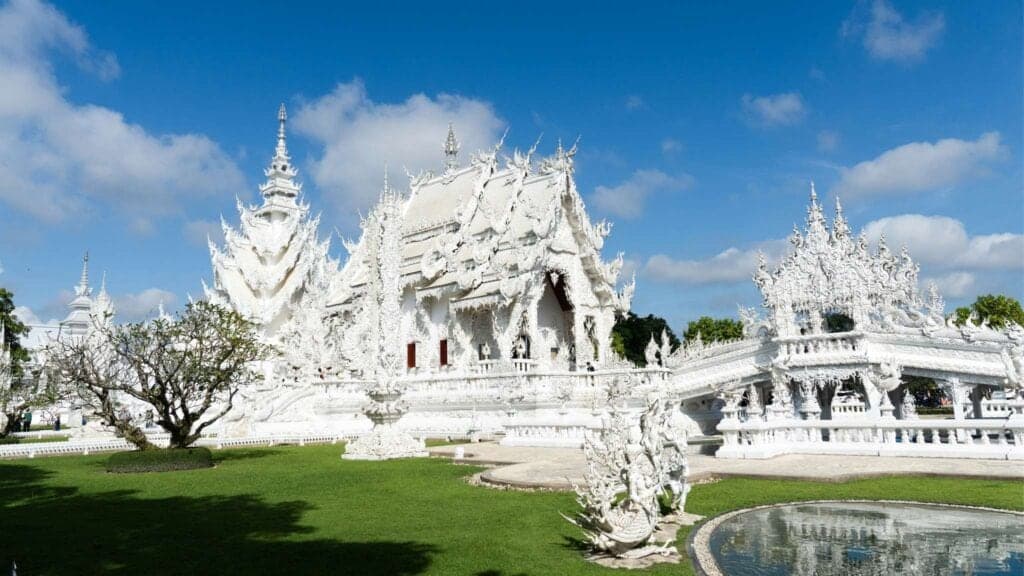
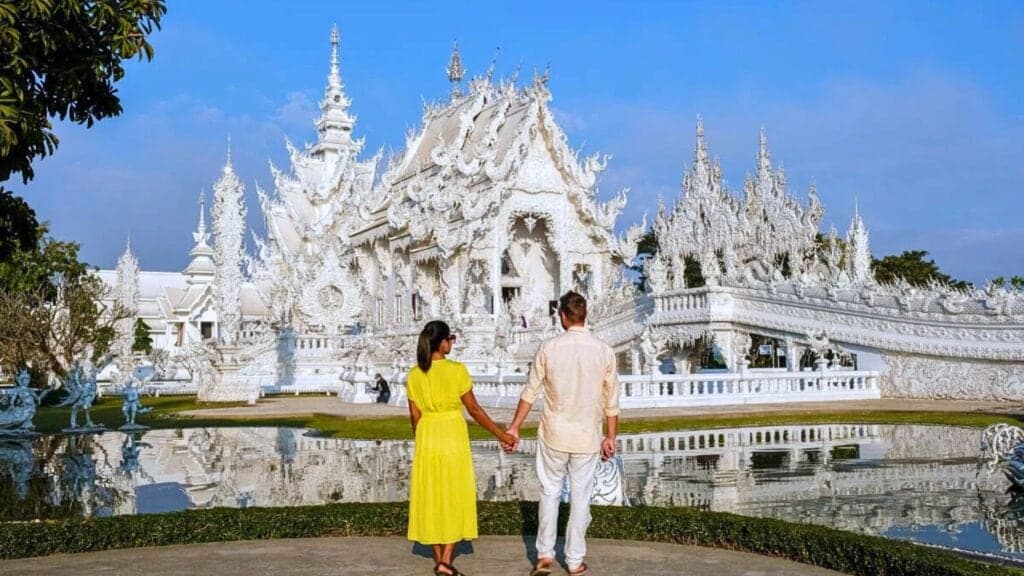
The classic Chiang Rai day trip pattern combines the White Temple (Wat Rong Khun), Blue Temple (Wat Rong Suea Ten), Black House (Baandam Museum), and the Golden Triangle. That's an aggressive 12-hour day from Chiang Mai or a comfortable two-day trip with one overnight in Chiang Rai.
The two-day version makes much more sense. Day 1: drive Chiang Mai to Chiang Rai (3 hours), White Temple in the afternoon, overnight in Chiang Rai city. Day 2: Black House morning, Golden Triangle and Hall of Opium afternoon, Mekong boat ride if time allows, drive back to Chiang Mai (3 hours). The single-day version skips at least one major site and exhausts everyone. If you want the temples and the Golden Triangle in one organised run, our full-day White and Blue Temple plus Golden Triangle tour covers the classic loop.
Our Chiang Rai day trip and White Temple guide cover the temple side in more detail.
Is a guided tour the right call for the Golden Triangle?
Yes for most travellers. The driving distance, the need to combine the viewpoint with the museum and boat ride, and the language gaps at boat operators and the Lao border make a guided trip meaningfully smoother than independent. Independent is workable if you're a confident planner with a rental car.
Guided tours typically cost ฿2,500–฿4,500 per person from Chiang Mai for a full day, including transport, museum entry, boat ride, and lunch. From Chiang Rai, ฿1,200–฿2,000 per person for a half-day or full-day.
If you'd prefer a tour that combines the Golden Triangle properly with the Chiang Rai temples and a Mekong boat ride, our full-day private Chiang Rai and Golden Triangle boat tour does exactly that, and the wider Chiang Rai temple tours listings cover other options.
What's the right time of year to visit?
November to February for the cool, dry, clear weather. March to April is burning season (visibility drops dramatically). June to October is wet season with rain showers and brown river water from upstream sediment.
The Mekong river color changes significantly by season. November–January is when the water is clearest and the river-confluence photographs look their best. By April the burning-season haze obscures the view across to Laos. June–September the river is high and muddy from upstream rain runoff but the surrounding landscape is its lushest green.
What about food and where to eat?
Sop Ruak has a handful of riverside restaurants — most are tourist-priced but the river view is genuine. For better and cheaper food, eat in Chiang Saen (15km south, a real working Thai town) before or after the Golden Triangle.
Chiang Saen has been a settlement since the 14th century and still functions as a working Mekong river town. The food economy is real Thai, not tourist Thai. Specific recommendations: the lakeside restaurants on the southern edge of Chiang Saen (lake fish, northern Thai larb, sticky rice) and the morning market for breakfast staples. Prices are 40–60% below the Sop Ruak tourist row.
The bottom line on the Golden Triangle
The viewpoint photo isn't the point. The Hall of Opium museum, the Mekong boat ride, and the optional Lao border experience are. Combine all three and the day is genuinely substantive. Visit only the viewpoint and you'll wonder why you drove 3 hours.
If you're already in Chiang Rai, the Golden Triangle is an easy half-day add. If you're considering it as a Chiang Mai day trip, do it as part of an overnight Chiang Rai trip instead — the driving math otherwise doesn't work.
Book the private Chiang Rai and Golden Triangle boat tourMulti-stop day combining the temples, Hall of Opium, and a Mekong boat rideInternal reading worth your time:
- Chiang Rai day trip from Chiang Mai: what to see, what to skip
- White Temple Chiang Rai guide: the art, the controversy, the visit
- UNODC Thailand country report on alternative development (external)
- Mae Fah Luang Foundation — Hall of Opium (external)
Frequently asked questions
Is the Golden Triangle viewpoint actually worth visiting?
Only just. The viewpoint at Sop Ruak is the photo-op every tour-bus passenger gets — three flags (Thailand, Laos, Myanmar), a giant golden Buddha, a sign reading 'Golden Triangle.' It's 15 minutes of looking, 5 minutes of photos, then disappointment that there isn't more. Pair it with the Opium Museum (the actual content of the visit) and a Mekong boat ride, and the day becomes worthwhile. Visit the viewpoint alone and you'll feel cheated of the 3-hour drive each way. The 'is it worth it?' answer depends on what else you combine.
Is the Hall of Opium museum actually good?
Yes — it's the most-substantive museum in northern Thailand and the under-marketed reason to visit the Golden Triangle. The exhibits walk through the British opium wars, the CIA's involvement in 20th-century Asian heroin trade, the King's Royal Project that replaced opium with coffee and macadamias in the 1980s–90s, and the present-day Myanmar–Thai border dynamics. Two hours minimum, three hours if you read everything. ฿200 entry, closes 16:00. Skip the much-smaller 'House of Opium' next door — different museum, less substantive.
Can I cross to Laos from the Golden Triangle?
Yes, via the Houayxay border crossing about 20km east of Sop Ruak — but for a day trip it's a logistical hassle. You take a longtail boat across the Mekong to the Laos side at Houayxay (formal visa-on-arrival, around USD 30–40 depending on nationality, plus exit fees), spend 2–3 hours there, and return. The Laos side of the border has a small market and the entry point to the slow boat route to Luang Prabang. For day-trip tourists, the boat ride to a sandbar mid-river (which technically touches Laos beach) gives the 'I crossed into Laos' photo without the visa hassle. Decide which version you want before going.
What about the Mekong boat ride from Chiang Saen?
Worth it for the river scenery and the optional landing on the Laos riverbank. Standard one-hour boat trips from Sop Ruak cost ฿400–฿600 per person depending on boat size and route. The boat takes you upstream past Don Sao island (technically Laos territory, no formal immigration but a small market that accepts THB), then back. The two-hour trip extends further upstream into the more scenic Mekong gorge. Boats run mostly mornings 09:00–14:00; afternoon water is calmer but the light is harsher for photography.
Frequently asked questions
Is the Golden Triangle viewpoint actually worth visiting?
Only just. The viewpoint at Sop Ruak is the photo-op every tour-bus passenger gets — three flags (Thailand, Laos, Myanmar), a giant golden Buddha, a sign reading 'Golden Triangle.' It's 15 minutes of looking, 5 minutes of photos, then disappointment that there isn't more. Pair it with the Opium Museum (the actual content of the visit) and a Mekong boat ride, and the day becomes worthwhile. Visit the viewpoint alone and you'll feel cheated of the 3-hour drive each way. The 'is it worth it?' answer depends on what else you combine.
Is the Hall of Opium museum actually good?
Yes — it's the most-substantive museum in northern Thailand and the under-marketed reason to visit the Golden Triangle. The exhibits walk through the British opium wars, the CIA's involvement in 20th-century Asian heroin trade, the King's Royal Project that replaced opium with coffee and macadamias in the 1980s–90s, and the present-day Myanmar–Thai border dynamics. Two hours minimum, three hours if you read everything. ฿200 entry, closes 16:00. Skip the much-smaller 'House of Opium' next door — different museum, less substantive.
Can I cross to Laos from the Golden Triangle?
Yes, via the Houayxay border crossing about 20km east of Sop Ruak — but for a day trip it's a logistical hassle. You take a longtail boat across the Mekong to the Laos side at Houayxay (formal visa-on-arrival, around USD 30–40 depending on nationality, plus exit fees), spend 2–3 hours there, and return. The Laos side of the border has a small market and the entry point to the slow boat route to Luang Prabang. For day-trip tourists, the boat ride to a sandbar mid-river (which technically touches Laos beach) gives the 'I crossed into Laos' photo without the visa hassle. Decide which version you want before going.
What about the Mekong boat ride from Chiang Saen?
Worth it for the river scenery and the optional landing on the Laos riverbank. Standard one-hour boat trips from Sop Ruak cost ฿400–฿600 per person depending on boat size and route. The boat takes you upstream past Don Sao island (technically Laos territory, no formal immigration but a small market that accepts THB), then back. The two-hour trip extends further upstream into the more scenic Mekong gorge. Boats run mostly mornings 09:00–14:00; afternoon water is calmer but the light is harsher for photography.