No, you should not ride elephants in Chiang Mai. The short reason: an elephant's spine is structurally not built to carry vertical load, and the training method historically used to make elephants compliant for riding involves prolonged physical abuse. This piece covers the anatomy, the training reality, the recent market shift away from riding, and how to tell a genuine sanctuary from a camp that has just dropped the chair from its marketing photos.
Why is "no" the answer in one line?
Because the elephant spine is structurally wrong for vertical load, the training method that historically made elephants ride-compliant is documented as cruel, and there are better alternatives in Chiang Mai that cost the same money.
The complete answer requires three lines, but the headline is consistent across decades of veterinary research, animal welfare investigation, and tourism industry data: elephants in tourism should not be ridden.
For travellers visiting Chiang Mai who want to see and interact with elephants, the alternatives are clear and well-developed:
- Observation-only sanctuaries where visitors watch elephants from designated platforms.
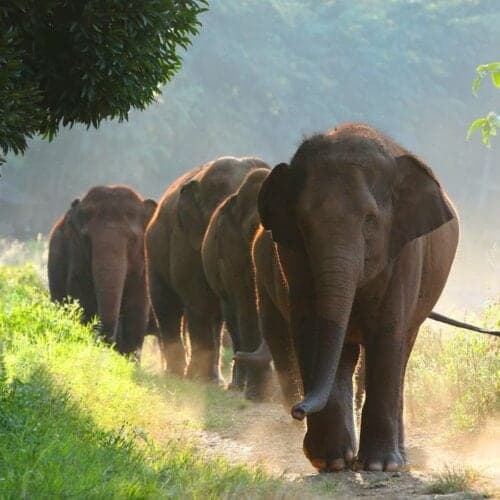
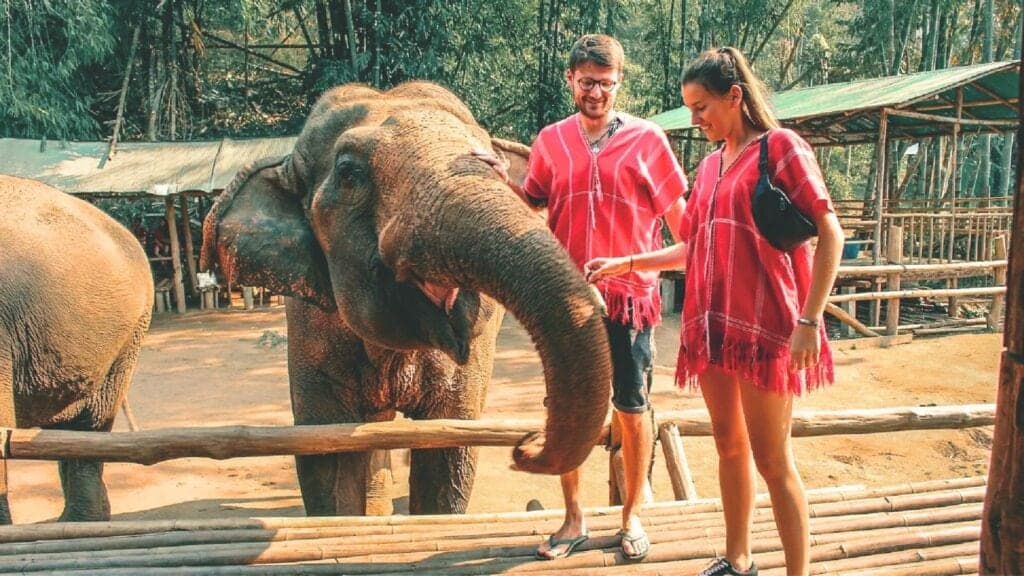
- Feeding and walking sanctuaries where visitors can feed, walk alongside, and bathe elephants without riding.
- Project camps that focus on conservation, research and elephant-handler training.
All three options are widely available across our Chiang Mai elephant tours at the same price as riding camps used to charge. The market shift since 2014 has been substantial.
What's wrong with the elephant's spine for riding?
An elephant's spine has upward-pointing bony protrusions (spinous processes) along its back, which take direct pressure when weight is loaded vertically. Years of vertical loading causes documented degeneration, soft-tissue inflammation and chronic discomfort.
The anatomical structure is unambiguous. An elephant evolved to carry weight forward through its skeletal frame to its legs — a horizontal load-bearing system. Vertical load on the back was not part of any evolutionary pressure on elephants. The spinous processes, which on a horse are angled to receive a saddle, on an elephant point straight up and lack the muscle and ligament structure to absorb pressure.
The honest comparison most elephant welfare biologists use is to picture a person being asked to carry a 30 kg load on the top of their head, all day, every day. The human spine is also vertical — the elephant equivalent is the same direction of load on a structure that did not evolve for it.
What was phajaan and why does it still matter?
Phajaan ("the crush") was the traditional method of training young elephants to accept human handlers — confinement in a small wooden frame, sleep deprivation, beating with bullhooks until the elephant became compliant. It was documented extensively in the early 2000s and has been reduced but not eliminated since.
The reason phajaan still matters in 2026 is that elephants now working in Chiang Mai camps are typically 25 to 65 years old. The middle-aged working elephants were trained as juveniles in the 1990s and early 2000s, when phajaan-style training was widespread across Thailand and Burma. A camp that no longer offers riding still has elephants in its herd that went through this training as young animals.
For investigative context, the 2002 National Geographic documentary "Phajaan: The Spirit-Breaking Ceremony" first brought the practice to global awareness, and World Animal Protection's 2017 elephant welfare report (accessed 2026-04-25) documented continued widespread use of phajaan-style training across Thai working elephants.
What it means for travel choices: even ethical sanctuaries are managing elephants who carry trauma from earlier training. The shift is partial, not absolute. The fact that more recent camps now use positive-reinforcement training (target-training with food rewards rather than bullhooks) is a major improvement, and the next generation of sanctuary-born elephants is the first to grow up without phajaan exposure.
Have most Chiang Mai camps actually stopped riding?
Most major camps in the Chiang Mai region phased out riding between 2014 and 2020. A handful still offer riding. The marketing word "sanctuary" alone is not a reliable signal — some non-sanctuary camps use it.
The transition timeline by major camp category:
- 2014–2017: First major non-riding sanctuaries open. Elephant Nature Park (operating since 2003 as a non-riding rescue) becomes the global reference point.
- 2017–2020: Most flagship camps in the Mae Taeng and Mae Wang valleys phase out riding and shows. The decision is driven by changing tourist demand rather than regulation.
- 2020–2023: Pandemic period — most camps suspend operations. Many re-open in 2022–2023 as fully non-riding venues.
- 2023–2026: Riding camps remain in operation primarily targeting Chinese and Russian tour groups via package operators. Western and independent tourist booking is overwhelmingly non-riding.
For broader background on the ethical landscape, see our ethical elephant sanctuary guide and our which Chiang Mai elephant sanctuary should I choose decision guide.
What about "ethical riding" claims and bareback marketing?
Reject both as marketing language. Bareback riding is less harmful than chair riding but is not harmless. "Ethical riding" is not a category that elephant welfare researchers recognise.
The "ethical riding" or "bareback only" framing emerged around 2016 as some camps tried to reposition rather than fully phase out riding. The argument is that without the howdah, the dead weight is removed and the elephant carries only one rider at a time. The argument has some technical truth — the structural load is reduced — but it does not address the underlying issue that elephants are not anatomically built for vertical load of any kind.
The current consensus position from major welfare organisations (World Animal Protection, Asian Captive Elephant Working Group, Friends of the Asian Elephant Foundation) is that all riding is incompatible with elephant welfare in tourism.
If you see a camp marketed as offering "ethical riding" or "bareback only" — that is a camp that has retained riding as a product line.
What are the legitimate alternatives in Chiang Mai?
Observation, feeding, walking, bathing. All four are available at multiple ethical sanctuaries in the Mae Taeng, Mae Wang and Doi Saket valleys, at prices equivalent to what riding camps used to charge.
The four legitimate Chiang Mai elephant activities, ranked by intensity:
- Observation-only. You watch from designated viewing platforms. The herd moves freely through forest. Best for travellers who want minimal interaction. Around ฿1,400–฿1,800 for a half-day.
- Feeding and gentle interaction. You hand-feed bananas and sugarcane while the elephant remains free to move. The most common entry-level format, as on our half-day Karen hill tribe elephant sanctuary visit. Around ฿1,900–฿2,400 for a half-day.
- Walking alongside. You walk with the elephants and their handlers through the forest. The pace is set by the elephants, not the visitors. Around ฿2,400–฿2,800 for half-day, ฿2,800–฿3,500 for full-day.
- Mud bath and river bath. You join the elephants in their daily bath at the river or mud wallow. Most physically interactive of the ethical activities. Around ฿2,400–฿3,200 for half-day.
The mud bath and river bath are themselves the subject of some welfare debate — the elephants may have learnt to enter the bath on command rather than from genuine play behaviour. The most thorough sanctuaries now offer observation-only days as the preferred option, with bathing only when the elephant initiates it.
What about elephant tours that include riding for kids only?
Not a real category. If a camp offers riding for children but not adults, the elephants are still trained to accept vertical load and the welfare problem is unchanged. Treat this as a riding camp.
This is a marketing framing some operators have tried — positioning child-only riding as gentler because children weigh less. The structural load argument does not change with rider weight. The training to accept any rider remains a welfare issue.
For family travel context including kid-appropriate ethical elephant options, see our Chiang Mai with kids guide. The short version: ethical observation-and-feeding sanctuaries are excellent for children and avoid the welfare trade-off entirely.
What's the deal with elephant painting and elephant shows?
Skip both. Painting is the visible result of weeks of bullhook training. Shows (football, dancing, balancing) likewise. If a camp offers either, it is not an ethical sanctuary.
The elephant-painting performance, where an elephant appears to spontaneously paint a picture of a flower or an elephant, is the most over-marketed and least ethical activity in the Chiang Mai elephant landscape. The handler stands beside the elephant's ear and uses small bullhook taps to guide the trunk to specific brush strokes. The painting is the same painting every time — the elephant has been trained to repeat the strokes.
Tourist demand for the painting show has dropped sharply since 2018. A handful of camps still offer it. None of them should be on a 2026 traveller's shortlist.
How can I verify a camp before booking?
Three checks. Read the camp's written welfare policy. Check independent reviews on TripAdvisor and animal-welfare forums. Phone the operator (us or any direct operator) and ask the 3 questions.
The verification workflow for any prospective elephant camp:
- Written policy. Look for an explicit "no riding, no chains, no shows" statement on the camp's website or in their booking confirmation.
- Independent reviews. Search TripAdvisor and the Reddit r/ThailandTourism community for the camp name. Look for recent (2024–2026) photos showing how the elephants are managed in practice. Old marketing photos can be misleading.
- Operator phone call. Ask the direct operator the 3 questions above. An operator who hesitates on any of the three is signalling something.
For a deeper guide to comparison-shopping camps, see the ethical elephant sanctuary guide.
Book the half-day Karen elephant sanctuary visitNo riding, no chains, no shows. Feed and walk with the herd, hotel pickup includedFrequently asked questions
Is bareback elephant riding less harmful than riding with a chair?
Bareback riding is less damaging than chair-and-howdah riding, but neither is harmless. The chair (howdah) adds 30–50 kg of dead weight that the elephant carries all day. Bareback removes that load and puts a single rider, usually around 65 kg, directly behind the elephant's neck. The neck-mounted bareback position is where the elephant's spine has the most muscle support, but daily multi-hour riding still causes documented spinal stress and behavioural distress in working elephants. The current consensus in elephant welfare research is that no riding is sustainable for long-term elephant health.
Are elephant rides actually banned in Thailand?
No, not banned. Thailand regulates elephant ownership and the captive-elephant tourism industry under the Wildlife Conservation and Protection Act, but riding is legal where the camp holds the relevant permits. What has changed since 2014 is the market — tourist demand for non-riding sanctuaries has grown significantly, and most major camps in the Chiang Mai area have phased out riding voluntarily because the bookings come from non-riding tourists. Some camps still offer riding to capture a different segment of the market. The legal framework allows it; the market has moved away from it.
What was phajaan and is it still happening?
Phajaan, sometimes called 'the crush', was the traditional Thai method of breaking a young elephant's spirit using a small enclosure, sleep deprivation, ropes and beatings until the elephant became compliant. It was the historical training method for working elephants in Thailand and Burma. Investigative reports from 2002 onward (notably by World Animal Protection and ENGOs) documented widespread continued use. Thai law and industry standards have shifted since 2014, but phajaan-style training has not been fully eliminated. Elephants born before 2010 who currently work in camps may have gone through some form of it as juveniles.
Why is the elephant's spine an issue for riding?
The elephant spine is shaped for forward-and-back load transmission, not vertical load on the back. Vertebrae have upward-pointing bony protrusions called spinous processes that take direct pressure when a person or chair sits on the back. Continuous vertical load over years causes documented degeneration, soft-tissue inflammation and chronic discomfort. The spine analogy elephant welfare biologists use is that asking an elephant to carry a person on its back is more like asking a person to carry a load on their head all day, not on their shoulders — the structural alignment is wrong for the load direction.
Frequently asked questions
Is bareback elephant riding less harmful than riding with a chair?
Bareback riding is less damaging than chair-and-howdah riding, but neither is harmless. The chair (howdah) adds 30–50 kg of dead weight that the elephant carries all day. Bareback removes that load and puts a single rider, usually around 65 kg, directly behind the elephant's neck. The neck-mounted bareback position is where the elephant's spine has the most muscle support, but daily multi-hour riding still causes documented spinal stress and behavioural distress in working elephants. The current consensus in elephant welfare research is that no riding is sustainable for long-term elephant health.
Are elephant rides actually banned in Thailand?
No, not banned. Thailand regulates elephant ownership and the captive-elephant tourism industry under the Wildlife Conservation and Protection Act, but riding is legal where the camp holds the relevant permits. What has changed since 2014 is the market — tourist demand for non-riding sanctuaries has grown significantly, and most major camps in the Chiang Mai area have phased out riding voluntarily because the bookings come from non-riding tourists. Some camps still offer riding to capture a different segment of the market. The legal framework allows it; the market has moved away from it.
What was phajaan and is it still happening?
Phajaan, sometimes called 'the crush', was the traditional Thai method of breaking a young elephant's spirit using a small enclosure, sleep deprivation, ropes and beatings until the elephant became compliant. It was the historical training method for working elephants in Thailand and Burma. Investigative reports from 2002 onward (notably by World Animal Protection and ENGOs) documented widespread continued use. Thai law and industry standards have shifted since 2014, but phajaan-style training has not been fully eliminated. Elephants born before 2010 who currently work in camps may have gone through some form of it as juveniles.
Why is the elephant's spine an issue for riding?
The elephant spine is shaped for forward-and-back load transmission, not vertical load on the back. Vertebrae have upward-pointing bony protrusions called spinous processes that take direct pressure when a person or chair sits on the back. Continuous vertical load over years causes documented degeneration, soft-tissue inflammation and chronic discomfort. The spine analogy elephant welfare biologists use is that asking an elephant to carry a person on its back is more like asking a person to carry a load on their head all day, not on their shoulders — the structural alignment is wrong for the load direction.