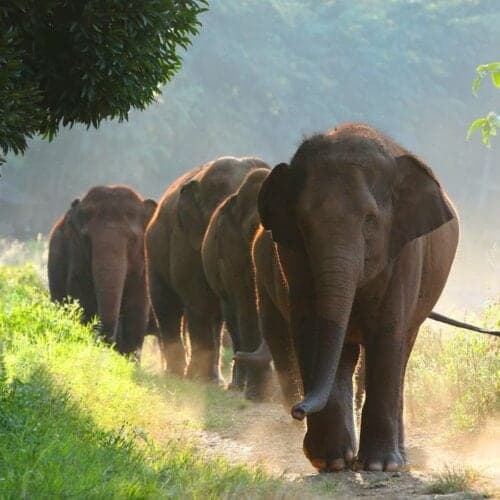
An ethical elephant sanctuary in Chiang Mai passes one simple filter: no riding, no chains, no shows. We call it the 3-Question Camp Test. It's the same screen we run before adding any camp to our roster of ~7 sanctuaries. It catches roughly 70% of rebranded riding camps and saves you the unwinnable argument of "but the website says 'ethical'."
What is the 3-Question Camp Test?
Three yes/no questions, asked of the operator or camp before you book: can guests ride, are there chains, are there shows. Three no's means proceed.
The test works because the three things it screens for — riding, chains, and performance — are the high-confidence indicators of welfare failure that cannot be cosmetically hidden. A camp can call itself a sanctuary on its website. It cannot quietly stop chaining elephants at 6pm without rebuilding its entire infrastructure.
Ask the camp directly, by email, before booking. Genuinely ethical camps reply within 48 hours with a written policy. Camps that evade or send marketing PDFs without answering specifics — that's your answer.
How did Chiang Mai end up with so many elephant camps?
Roughly 100 captive elephants worked in Chiang Mai's logging industry until Thailand's 1989 logging ban left them unemployed and their mahouts without income.
Most logging elephants and their mahouts moved into tourism in the 1990s because there was nowhere else for them to go. The first generation of camps offered rides, shows, and circus-style performances. The first sanctuaries — Lek Chailert's Elephant Nature Park (founded 1996) — emerged when Western volunteers started asking why the elephants were chained.
So roughly four out of five camps in the Chiang Mai area still fail one or more of the three questions. The aggregate market is improving — riding is on the decline — but the rate of rebranding (riding camps changing names to include "sanctuary" or "rescue") is also rising.
What does "no riding" actually mean?
No saddles, no neck-riding, no "walking with elephants" where the guest is on the elephant's back. Mahout-only riding for medical or transport reasons is acceptable.
The grey area is the phrase "no saddle riding." Several camps in the Mae Sa valley advertise "saddle-free elephant interaction" while still offering bareback or neck-riding for ~฿500 extra. Neck-riding looks gentler than a wooden saddle. It is not — sustained pressure on the seventh cervical vertebra is the same biomechanical problem as a saddle on the back.
The clean line: guests do not get on the elephant at all. Period. The only person who should be on the elephant is the mahout, and only when medically necessary or for short transport.
What does "no chains" actually mean?
No chains on legs at any point in 24 hours — including overnight, including transport, including the moments before guests arrive.
This is the question most camps lie about. Many advertise "chain-free during the day" while chaining elephants in pens overnight for staff convenience. A genuinely chain-free camp has fenced enclosures, electric fencing for protected areas, or simply enough land that chaining isn't needed.
| Chain practice | What it looks like | Welfare status |
|---|---|---|
| No chains, ever | Fenced enclosures, free roaming in day, fenced corral overnight | Ethical |
| Short tether overnight | 5-10m chain at night for safety, free in day | Borderline — declining acceptance |
| Short tether all day | Elephant chained near a feeding station during guest visits | Unethical |
| Spike or pulley chains | Restraint chains tightened to limit movement | Severely unethical |
| Crush training (phajaan) | Historical training method using restraint and pain | Severely unethical |
If the camp says "we use chains only at night for the elephants' safety" — that's the borderline category. Some sanctuaries we list do this and we accept it because the alternative (large free-roam enclosures) requires land they can't afford. But ask, and weigh it accordingly.
What does "no shows" actually mean?
No painting, no football, no dancing, no music performance, no circus tricks. Bathing and feeding are not shows if they happen on the elephant's schedule, not the tour group's.
The grey area here is "natural behaviour" displays. A camp might say "we don't do shows, we just demonstrate how elephants pick up logs" — that's a show. Anything where the elephant is performing a learned behaviour for an audience on cue is a show. The behaviour was trained at some point, and training methods for performance behaviours are typically aversive.
The cleanest distinction: if the elephant would do this activity without humans present, it's not a show. If it would only do it because a mahout cued it for a tour bus, it's a show.
Are no-touch sanctuaries always more ethical?
Not automatically. Touch is not the welfare fail-point — riding, chains, and performance are. A well-run feeding-and-bathing camp can be more ethical than a sloppy no-touch one.
The two genuine no-touch sanctuaries near Chiang Mai are BLES (Boon Lott's Elephant Sanctuary, technically in Sukhothai — 6 hours south but often discussed alongside Chiang Mai camps) and Elephant Valley Thailand near Mae Ping. Both are excellent. Both are also limited in availability and expensive.
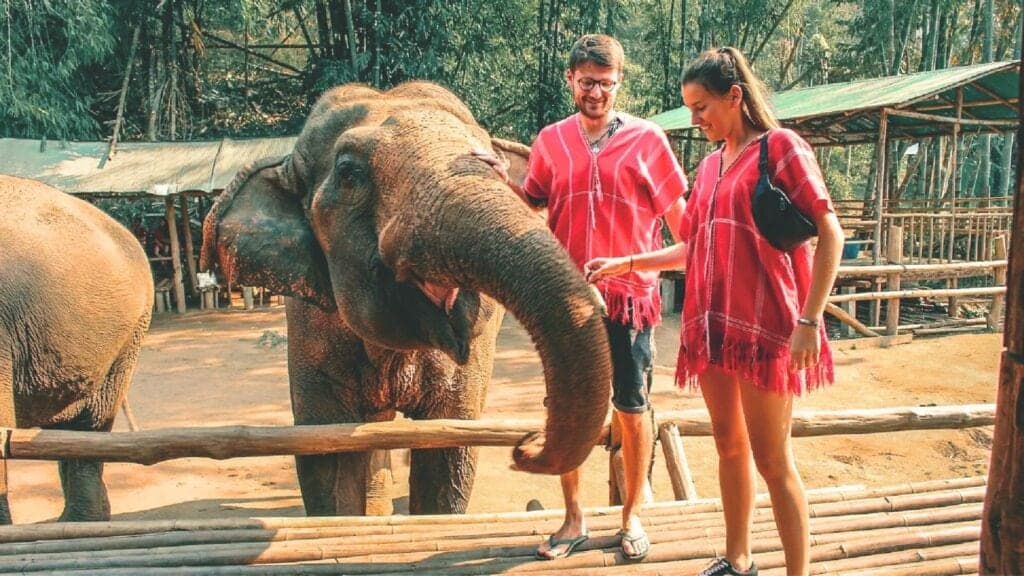
For travellers who want close interaction without harm, a feeding-and-bathing camp that passes the 3-Question Test is fine. The half-day Karen hill tribe sanctuary visit is the version we send most first-timers to: the elephant chooses to come for food, the bathing is on the elephant's daily cooling schedule, and the interaction is on the elephant's terms. For a quieter, smaller-group alternative, the Maerim ethical half-day tour follows the same no-riding, no-shows model.
How do I verify a camp before paying a deposit?
Email the camp three specific questions. Read the response carefully. Genuine camps answer specifically; rebranded riding camps deflect with marketing language.
The three emails to send (or have your operator forward):
- "Is any elephant on your property chained at any point in a 24-hour period? If yes, when and for how long?"
- "Do you offer any form of elephant riding, including bareback or neck-riding, paid or unpaid?"
- "Do guests participate in any scheduled activity where the elephant performs a behaviour (painting, walking on cue, playing instruments, picking up objects)?"
Good answers are specific: "Elephants are in fenced pens of 0.5 hectares per family group at night, no chains. No riding of any kind. We have one daily bathing session at 11am which the elephants come to or not, based on the day's heat."
Bad answers are vague: "We follow ethical practices in line with Asian elephant welfare guidelines and are committed to..." — that's not an answer.
What does an ethical camp cost vs a rebranded riding camp?
Genuine ethical camps cost ฿2,100-฿3,500 for a day trip. Rebranded camps usually undercut at ฿1,200-฿1,800 because rides and shows monetise per-elephant capacity.
Unit economics matter here. An ethical camp with ~12 elephants on 5+ hectares can host maybe 40 guests per day. A riding camp with the same elephants on the same land can host 100+. To match the riding camp's revenue, the ethical camp has to charge more per head — that's the structural reason ethical camps are more expensive.
If you see a "sanctuary" priced at ฿1,200 including transport, lunch, and an elephant experience, the maths doesn't work without rides or shows somewhere in the day. Even if the website says they're ethical.
Should I trust marketplace "ethical" filters?
Partially. Marketplace filters are policy-only and don't include site visits. They're better than nothing but worse than asking the operator directly.
We covered this in our Viator alternatives breakdown — the major marketplaces (Viator, GetYourGuide, Klook) rely on operator self-declaration. A camp can call itself a sanctuary and check the box. None of the three platforms visits camps in person at scale.
The best filter is a direct operator who actually visits the camps they sell. That's what we do. It's also what ToursByLocals' Chiang Mai guides and Withlocals' Chiang Mai network do. Marketplaces are a fallback, not a first choice.
What about volunteering instead of day trips?
Multi-day volunteering at a properly ethical sanctuary is usually higher-welfare for the elephant — fewer transitions, calmer environment — but requires ฿8,000-฿15,000 per night and 3+ days minimum.
Elephant Nature Park, BLES, and Boon Lott's all run multi-day volunteer programmes. The work is real (preparing food, cleaning enclosures, walking observation) and the welfare gains are real (fewer guest groups, less novelty stress on the elephant). If you have a week and the budget, volunteering is the cleanest ethical option. For a shorter immersive version, our 2-day ethical sanctuary overnight homestay gives you one night in the village without the multi-day commitment.
If you have one day and a kid, a day-trip camp that passes the 3-Question Test is fine. Don't let the perfect be the enemy of the good.
Book the Karen elephant sanctuary daySmall groups, ethical camp, hotel pickup — passes the 3-Question TestFurther reading worth your time:
- Best Viator alternatives for booking Chiang Mai tours
- Chiang Mai elephant tours: real price breakdown
- Mae Taeng vs Mae Wang: which elephant valley wins?
Outbound references for further reading: World Animal Protection's captive elephant welfare framework and the Asian Captive Elephant Working Group welfare standards are the two most credible third-party rubrics. Both inform our internal screening.
Frequently asked questions
What is the 3-Question Camp Test?
Three yes/no questions that filter most unethical camps in under a minute. (1) Can guests ride the elephants? (2) Are there chains on legs at any point in the day? (3) Are there shows, painting, football, or other performance activities? If the answer to all three is 'no' and the camp will share its policy in writing, the camp is probably fine. We use this test internally before adding any camp to our roster. It catches roughly 70% of the rebranded riding camps that have changed their name but not their practice.
Are no-touch sanctuaries always better than ones with feeding and bathing?
Not automatically. The two genuine no-touch sanctuaries in Chiang Mai (BLES, Boon Lott's) are excellent, but limited herd-observation distance can be a deal-breaker for families with young children. A well-run feeding-and-bathing camp with no chains, no riding, and no shows can be more engaging without harming the elephants. The ethical fail-points are riding, chains, and performance — not contact. Vet on those three first, then decide whether you want close interaction or pure observation.
Which Chiang Mai camps fail the 3-Question Test?
We don't publicly name camps because the list changes month to month — some camps reform, some rebrand and get worse. As of 2026, the broad pattern is: camps in the Mae Sa valley with 'jungle' or 'tribal' in the name still tend to offer riding, and some of the larger camps in Mae Wang quietly chain elephants overnight even when they advertise 'chain-free' daytime. The fastest way to verify: email the camp and ask 'is any elephant chained at any point in 24 hours?' If they evade, they chain.
Is elephant bathing ethical?
It's a grey area. Bathing once a day in a river or pond is normal elephant behaviour — they do it themselves in the wild. The problem starts when bathing is scheduled four to six times per day to fit tour groups, which is stressful and unnatural. A camp with one daily bathing session timed to elephants' natural cooling rhythm is fine. A camp where elephants are walked back into the river every two hours for the next minivan is not. Ask how many bathing sessions per day before you book.
How much does an ethical elephant sanctuary cost in Chiang Mai?
Day trips at properly ethical camps range from ฿2,100 to ฿3,500 per adult depending on group size, transport, and whether lunch is included. Overnight stays at the very best (BLES, Boon Lott's) run ฿8,000-฿15,000 per night and require booking months ahead. Anything advertised below ฿1,500 for a 'sanctuary' day trip is almost certainly running rides or shows to make the unit economics work. We publish typical price ranges per camp type.
Do I have to feed bananas or sugarcane?
No, but it's the most natural form of interaction at camps that allow it. Elephants eat 150-200kg of vegetation per day in the wild, and supplemented banana/sugarcane is calorically appropriate. The activity to avoid is hand-feeding rice balls stuffed with vitamins from a basket — this is associated with old logging-camp practice and is more about photo opportunities than nutrition. Stick to whole fruit and sugarcane offered slowly. If the camp hands you a bucket of branded pellets, that's a red flag.
Frequently asked questions
What is the 3-Question Camp Test?
Three yes/no questions that filter most unethical camps in under a minute. (1) Can guests ride the elephants? (2) Are there chains on legs at any point in the day? (3) Are there shows, painting, football, or other performance activities? If the answer to all three is 'no' and the camp will share its policy in writing, the camp is probably fine. We use this test internally before adding any camp to our roster. It catches roughly 70% of the rebranded riding camps that have changed their name but not their practice.
Are no-touch sanctuaries always better than ones with feeding and bathing?
Not automatically. The two genuine no-touch sanctuaries in Chiang Mai (BLES, Boon Lott's) are excellent, but limited herd-observation distance can be a deal-breaker for families with young children. A well-run feeding-and-bathing camp with no chains, no riding, and no shows can be more engaging without harming the elephants. The ethical fail-points are riding, chains, and performance — not contact. Vet on those three first, then decide whether you want close interaction or pure observation.
Which Chiang Mai camps fail the 3-Question Test?
We don't publicly name camps because the list changes month to month — some camps reform, some rebrand and get worse. As of 2026, the broad pattern is: camps in the Mae Sa valley with 'jungle' or 'tribal' in the name still tend to offer riding, and some of the larger camps in Mae Wang quietly chain elephants overnight even when they advertise 'chain-free' daytime. The fastest way to verify: email the camp and ask 'is any elephant chained at any point in 24 hours?' If they evade, they chain.
Is elephant bathing ethical?
It's a grey area. Bathing once a day in a river or pond is normal elephant behaviour — they do it themselves in the wild. The problem starts when bathing is scheduled four to six times per day to fit tour groups, which is stressful and unnatural. A camp with one daily bathing session timed to elephants' natural cooling rhythm is fine. A camp where elephants are walked back into the river every two hours for the next minivan is not. Ask how many bathing sessions per day before you book.
How much does an ethical elephant sanctuary cost in Chiang Mai?
Day trips at properly ethical camps range from ฿2,100 to ฿3,500 per adult depending on group size, transport, and whether lunch is included. Overnight stays at the very best (BLES, Boon Lott's) run ฿8,000-฿15,000 per night and require booking months ahead. Anything advertised below ฿1,500 for a 'sanctuary' day trip is almost certainly running rides or shows to make the unit economics work. We publish typical price ranges per camp type.
Do I have to feed bananas or sugarcane?
No, but it's the most natural form of interaction at camps that allow it. Elephants eat 150-200kg of vegetation per day in the wild, and supplemented banana/sugarcane is calorically appropriate. The activity to avoid is hand-feeding rice balls stuffed with vitamins from a basket — this is associated with old logging-camp practice and is more about photo opportunities than nutrition. Stick to whole fruit and sugarcane offered slowly. If the camp hands you a bucket of branded pellets, that's a red flag.