Elephant Nature Park is the most-known ethical elephant sanctuary in Asia. A single-day visit is a structured 9-hour experience with bus transfer, hands-on feeding, observation walks, lunch with the herd visible across the river, and a clear emphasis on rescue and education. It is genuinely good. It is also a much larger and more processed operation than the smaller partner camps. This review is from an operator perspective after several visits and from sending hundreds of clients there over the years.
Disclosure: We publish chiangmaigotours.com. We are an independent Chiang Mai operator that works with several elephant sanctuaries, including some that compete with ENP for visitor attention. We have reviewed ENP's public pricing and program structure as of 2026-05-01. We do not receive commission from ENP and we did not consult them before writing this. We have visited ENP multiple times.
What is Elephant Nature Park, exactly?
ENP is a 250-acre rescue sanctuary in the Mae Taeng valley, 60 km north of Chiang Mai, founded by Lek Chailert in 1995. Around 100 elephants live there, plus roughly 4,000 rescued dogs, several hundred cats, and a working education centre.
ENP was the first major Thai sanctuary to phase out riding and bullhooks. Lek Chailert became a public figure for Asian elephant welfare. Day-visit revenue funds rescue operations. The sanctuary continues to rescue elephants from logging, riding camps, and circus operations across Thailand and Myanmar. Dogs and cats are part of the wider rescue mission — many rescued during the 2011 Thai floods. Dogs roam freely between buildings; cats have a dedicated multi-story rescue building visitors can tour. This is a working sanctuary, not a curated tour-property — scale and mission are the defining features.
What does a single-day visit actually look like?
07:00 to 18:00 end-to-end. Bus pickup in Chiang Mai, two-hour drive to Mae Taeng, four hours on-site including hands-on feeding and herd-observation walk, included buffet lunch, return drive, drop-off back at hotel.
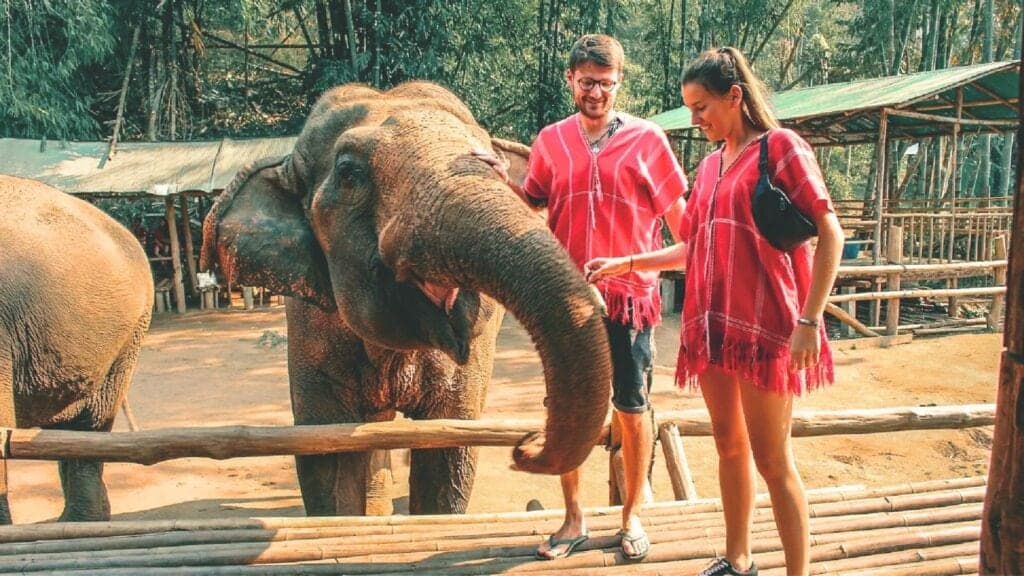
The standard day: bus pickup 07:00 to 08:00 at your hotel, drive 08:00 to 09:30, brief group intro on arrival, first feeding session 10:00 to 11:00 (hand-feeding watermelon and banana from a raised platform), walk to observation deck 11:00 to 12:30, buffet lunch with elephants visible across the river, second feeding session and dog area walk 13:30 to 15:30, wrap-up and return drive 16:00 to 18:00.
ENP receives 200 to 300 day visitors per day in high season, managed in groups of 8 to 12 with one guide per group. Group rotations between zones keep visitor density at any single point manageable.
What is genuinely good about ENP?
Three things stand out: scale of the rescue mission, quality of guides, and herd diversity. You see elephants at multiple ages and life-stages, observed in genuine herd structure rather than performance.
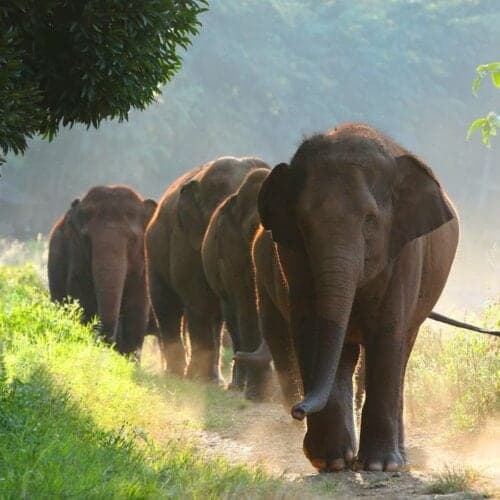
ENP's herd contains rescued elephants of all ages — calves born at the sanctuary, working-age adults rescued from logging or riding camps, blind, injured or geriatric elephants in protected zones. Most smaller camps have 8 to 15 elephants of similar profile. ENP's 100 show genuine herd structure — matriarchs, sub-groups, calves with aunts, social dynamics you can observe. Guides have 3 to 8 years of tenure, know individual elephants by name and history, speak fluent English. Guide ratio is around 1 to 10. The dog and cat rescue story adds an unexpected dimension — many visitors come for elephants and end the day deeply moved by the dog area.
What are the trade-offs versus a smaller camp?
ENP is more processed, larger group sizes, less flexibility, and you do not bathe in the river with the elephants. Smaller camps offer more intimacy and (at the best ones) similar ethical standards in a more flexible format.
| Dimension | ENP single-day | Smaller partner camp |
|---|---|---|
| Elephants on site | ~100 | 8–25 |
| Group size per guide | 8–12 | 4–8 |
| Visitors per day | 200–300 | 20–60 |
| Hands-on time | Feeding only | Feeding + food prep + walks |
| River bathing | No (observational) | Yes (most camps) |
| Drive time | 2 hours each way | 60–90 minutes |
| Day-visit price | ฿2,500 + ฿500 | ฿1,900–฿2,800 incl. |
| Multi-day option | Yes, on-site bungalows | Rare |
The river-bathing point matters more than people expect. Several smaller Mae Wang camps let visitors wade in with the elephants — iconic Chiang Mai experience not available on the ENP day visit. ENP's river is observation-only. Our half-day elephant sanctuary and bamboo rafting tour and the Karen Hill Tribe elephant sanctuary day both deliver that closer, river-side format in smaller groups.
What about ethics and animal welfare standards?
ENP sets the regional benchmark on ethics — no riding, no chains, no hooks (bullhooks), no shows, no painting, no forced contact. Welfare protocols are documented and audited.
ENP's policies match the floor we consider mandatory for any ethical operator. Lek Chailert has campaigned across Thailand against riding and chain practices; journalists from National Geographic and BBC have documented the welfare standards. Some academics argue any tourist-funded model subjects animals to high human interaction; ENP responds that the rescue mission requires funding. For most travellers, ENP is comfortably on the right side of every ethical line that matters.
How do you book and what are the catches?
Book direct on ENP's website. Slots fill 4 to 8 weeks ahead in high season. Marketplace listings often inflate the price 20 to 40 percent.
Booking notes: high season 4 to 8 weeks ahead; low season 1 to 2 weeks; Songkran week (April 11-16) closed; Christmas / New Year books out earliest; refund / reschedule with 72-hour notice. Single-day is the entry point for most travellers — multi-day options require advance planning and target travellers with specific conservation interest.
What should you wear and bring?
Closed-toe shoes you can get muddy, light long-sleeve shirt, hat, sunscreen, refillable water bottle, small towel, insect repellent, camera or phone.
Walking surfaces are mixed — paved paths around the main pavilion, packed dirt on observation walks, occasionally muddy in rainy season. Avoid open sandals; the dog area has uneven terrain. Lunch is vegetarian / vegan buffet; bring a snack if you have severe allergies. Coffee, tea and water included; no alcohol on-site.
When is the best month to visit?
November to February for best weather. May, June and October for best value and quietest visit. Avoid March-April burning season.
ENP's elevation (around 500 to 600 metres) gives slightly better air quality than the city on burning-season days, but not enough to make March comfortable. The May-June window is underrated — river runs higher, forest is green, visitor numbers drop to 100 to 150 per day (versus 250 to 300 in December), group sizes shrink. Trade-off is afternoon rain risk.
What about combining ENP with other activity?
The two-hour each-way drive eats most of the day. ENP works best as a standalone day — combining with another activity on the same day is rushed.
If you have a week in Chiang Mai, the natural pairing is one day at ENP plus another day at a smaller partner camp in Mae Wang for the river-bathing experience. Two different elephant experiences, both ethical, broader picture of Thai elephant welfare. Travellers with conservation interest who want overnight depth can look at our 2-day ethical elephant sanctuary overnight homestay. You can also browse every option on the Chiang Mai elephant tours page.
Is ENP worth it?
Yes, for almost every traveller — first-timer or repeat. The combination of scale, mission, and execution quality is genuinely unmatched in the Chiang Mai elephant tourism market. The trade-off is processed format rather than intimate.
We send roughly 25 to 30 percent of our elephant-tour clients to ENP for their main elephant experience. The other 70 to 75 percent go to smaller partner camps. The choice is mostly about which experience profile the traveller prefers — choose ENP for the deepest education and sense of mission, choose a smaller camp for intimacy and river bathing, do both if you have two days.
Book the Karen Hill Tribe elephant sanctuary dayRiver bathing, intimate groups, English-speaking guide — operator-confirmed within 6 hoursRelated reading worth your time:
- Which Chiang Mai elephant sanctuary should you choose?
- Ethical elephant sanctuary Chiang Mai: how to evaluate a camp
- Best Viator alternatives for Chiang Mai tours
External references used in this guide:
- Elephant Nature Park official site
- Save Elephant Foundation
- World Animal Protection — captive elephant welfare
Frequently asked questions
Is feeding hands-on at Elephant Nature Park?
Yes, the day visit includes hands-on feeding — you stand at a feeding platform and hand fruit (watermelon, banana, pumpkin) to specific elephants. The feeding sessions are structured by herd group so you typically feed 2 to 4 different elephants over the morning. It is closer than most ethical camps allow because ENP's older rescue elephants are accustomed to interaction. Touching is encouraged in moderation and only on the trunk and shoulder. The handlers (mahouts) are right there guiding.
What are the photography rules at ENP?
Photography is allowed throughout the visit except inside the elephant medical clinic. No drones. No flash near elephants. Tripods are technically fine but practically awkward — you move between zones too frequently. Most photographers find a phone or mirrorless camera with a 24-70mm equivalent is the sweet spot. The day visit has multiple group-photo opportunities staged by the guides. Professional video for commercial use requires advance permission from ENP.
What is the difference between ENP single-day and multi-day visits?
The single-day visit is the standard for most travellers — bus from Chiang Mai, full day on-site, return by 18:00. The multi-day options (2-day, 7-day, Save Elephant volunteer) get you behind-the-scenes access: feeding prep, herd observation hours, sometimes elephant medical-room visits. Multi-day visitors stay in basic on-site bungalows. For a first ENP visit, the single-day delivers 80 percent of the experience for 30 percent of the cost. Multi-day is for repeat visitors who want depth.
How does ENP compare to the alternatives?
ENP is the largest, oldest and most internationally-known ethical sanctuary — its scale (around 100 elephants and roughly 4,000 rescued dogs and cats) makes it unique. Smaller partner camps like ours offer a more intimate visit with 8 to 25 elephants, shorter drives, and more flexible private formats. ENP wins on conservation seriousness, herd diversity, and the broader rescue story. Smaller camps win on intimacy, river bathing access, and flexibility. Both are ethical. Many travellers visit ENP and a smaller camp on the same trip.
Frequently asked questions
Is feeding hands-on at Elephant Nature Park?
Yes, the day visit includes hands-on feeding — you stand at a feeding platform and hand fruit (watermelon, banana, pumpkin) to specific elephants. The feeding sessions are structured by herd group so you typically feed 2 to 4 different elephants over the morning. It is closer than most ethical camps allow because ENP's older rescue elephants are accustomed to interaction. Touching is encouraged in moderation and only on the trunk and shoulder. The handlers (mahouts) are right there guiding.
What are the photography rules at ENP?
Photography is allowed throughout the visit except inside the elephant medical clinic. No drones. No flash near elephants. Tripods are technically fine but practically awkward — you move between zones too frequently. Most photographers find a phone or mirrorless camera with a 24-70mm equivalent is the sweet spot. The day visit has multiple group-photo opportunities staged by the guides. Professional video for commercial use requires advance permission from ENP.
What is the difference between ENP single-day and multi-day visits?
The single-day visit is the standard for most travellers — bus from Chiang Mai, full day on-site, return by 18:00. The multi-day options (2-day, 7-day, Save Elephant volunteer) get you behind-the-scenes access: feeding prep, herd observation hours, sometimes elephant medical-room visits. Multi-day visitors stay in basic on-site bungalows. For a first ENP visit, the single-day delivers 80 percent of the experience for 30 percent of the cost. Multi-day is for repeat visitors who want depth.
How does ENP compare to the alternatives?
ENP is the largest, oldest and most internationally-known ethical sanctuary — its scale (around 100 elephants and roughly 4,000 rescued dogs and cats) makes it unique. Smaller partner camps like ours offer a more intimate visit with 8 to 25 elephants, shorter drives, and more flexible private formats. ENP wins on conservation seriousness, herd diversity, and the broader rescue story. Smaller camps win on intimacy, river bathing access, and flexibility. Both are ethical. Many travellers visit ENP and a smaller camp on the same trip.