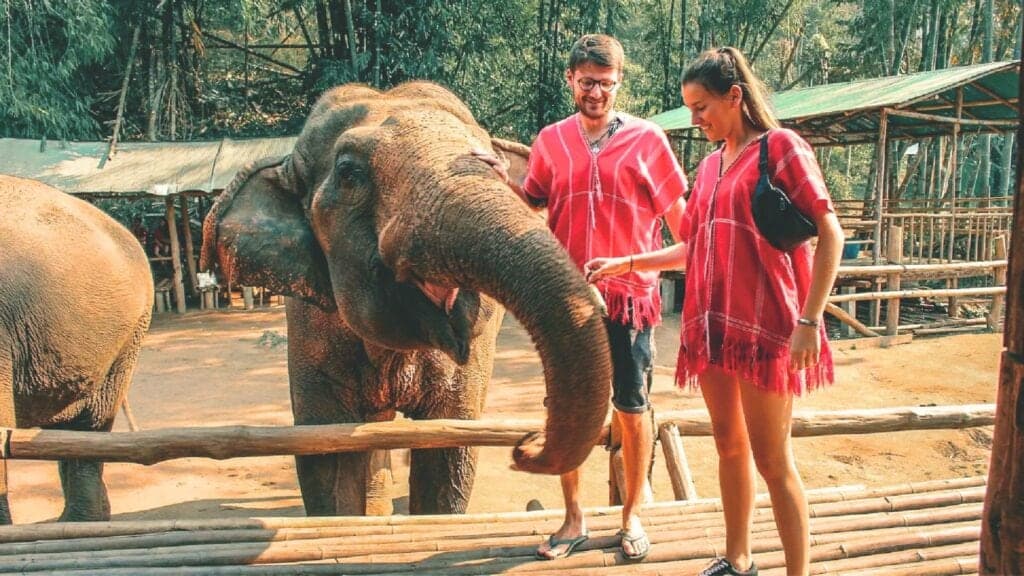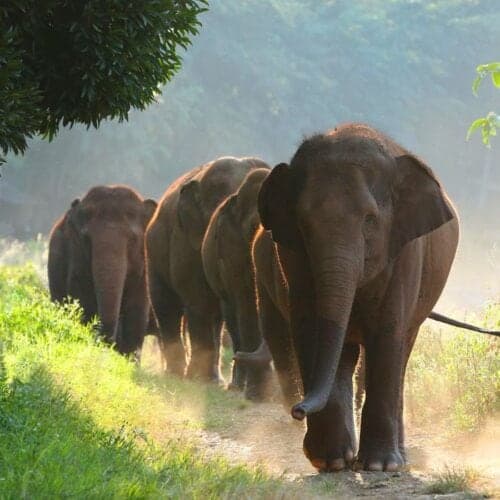
Mae Taeng has more camps and more variety; Mae Wang is closer to Chiang Mai, quieter, and stronger on river bathing. We send roughly 60 percent of clients to Mae Wang and 40 percent to Mae Taeng — distance and river access drive that split. Both valleys have ethical operators worth your money. Both still have camps that fail our 3-Question Test. This is a side-by-side from an operator running tours into both for over a decade.
Disclosure: We publish chiangmaigotours.com. We've reviewed Mae Taeng and Mae Wang operators' public pricing and feature documentation as of 2025-12-28. We don't pay competitors for placement.
Why does the valley you pick matter for an elephant day trip?
The valley changes drive time, river access, herd visibility, and tourist density — but does not change ethical risk, because each camp's policies matter more than its postcode.
Most blog posts treat "Mae Taeng" and "Mae Wang" as interchangeable. They are not. Two distinct valleys, different terrain, different rivers, different camp clusters, different histories. The valley shapes how the day feels but does not guarantee an ethical experience. A genuine sanctuary in Mae Wang and a chain park in Mae Taeng are two completely different days at similar prices.
How far is each from Chiang Mai?
Mae Wang is 45 km southwest, 60 to 75 minutes one-way. Mae Taeng is 65 to 75 km north, 90 minutes to two hours one-way. Mae Taeng has more switchbacks.
| Logistics | Mae Wang | Mae Taeng |
|---|---|---|
| Distance from city centre | ~45 km southwest | ~65–75 km north |
| Drive time one-way | 60–75 min | 90–120 min |
| Road type | Mostly highway, light switchbacks | Highway + significant mountain road |
| Pickup window | 07:00 – 08:30 typical | 06:30 – 07:45 typical |
| Return to hotel by | 16:30 – 17:30 | 17:30 – 18:30 |
| Motion-sickness risk | Low | Moderate |
Mae Wang is the better default for travellers with young children, anyone over 70, guests who want to be back for an evening market or dinner reservation, and people who hate switchback roads. Mae Taeng is the better choice for travellers who want a fuller day in nature, are comfortable with the longer drive, or are combining the trip with a destination further north.
What is the terrain actually like in each valley?
Mae Wang is rolling hills and a wide, shallow river through farmland. Mae Taeng is forested mountains with a faster, narrower river and more elevation change.
Mae Wang sits at roughly 380 to 500 metres elevation — rice paddies, banana groves, cleared pasture, gentle mountains on either side, camps built right onto the riverbank. Mae Taeng sits 500 to 800 metres with steeper forested ridges and a faster, colder river. Several Mae Taeng camps are at the end of switchback roads climbing 20 to 40 minutes from the highway. Both valleys have river bathing at ethical camps; Mae Wang's is generally easier — wider, shallower, longer sessions. If river time matters most to you, our half-day elephant sanctuary and bamboo rafting tour pairs herd time with a float on the valley river.
How many camps are in each, and how do you tell ethical from rebrand?
Mae Taeng has roughly 18 elephant camps; Mae Wang has around 9. Higher density does not mean higher quality.
Mae Taeng's history is the source of both its scale and its ethics problem. It was the original cluster when Thailand's elephant tourism scaled in the 1990s, and many riding-and-shows camps from that era still operate under new "sanctuary" branding. Mae Wang scaled later and its operators largely modelled themselves on Elephant Nature Park's no-riding approach from the start.
Of our active partner camps: 3 in Mae Wang (all river-bathing-included), 4 in Mae Taeng (mix of river-bathing and walk-with-the-herd formats). All passed our 3-Question Test and are audited in person annually.
What do prices look like in each valley?
Day-trip prices are broadly similar — 1,900 to 2,800 THB per adult — but Mae Wang trips run shorter and so tend to sit at the lower end of that range.
The half-day vs full-day split matters. Mae Wang's shorter drive enables genuinely good half-day formats (7 am pickup, 1 pm return) for travellers who want elephant time but not a full day commitment. Mae Taeng's distance forces a full-day format — by the time you have driven 90 minutes each way, you may as well make it a full visit.
Marketplace pricing for both valleys runs 20 to 35 percent higher than booking with the operator directly.
Which is better for first-time visitors?
Mae Wang, mostly. The shorter drive, easier river access, and smaller crowds make for a less overwhelming first elephant day.
For first-timers we recommend a Mae Wang half-day: pickup 07:30, arrive 08:45, meet the herd, prepare food, feed, river bathe, lunch, return to Chiang Mai by 15:00. Half-day cost is 1,900 to 2,400 THB. Our half-day elephant experience at the Karen Hill Tribe sanctuary is the format most first-timers book. Mae Taeng works better for repeat visitors or travellers specifically wanting Elephant Nature Park (in the Mae Taeng cluster) or combining elephants with a hill-tribe village stop — our Half Day Visit to Elephant Nature Park covers that camp directly.
What about photography quality?
Mae Wang for water shots, Mae Taeng for mountain backdrops. Both produce strong photos at ethical camps.
Mae Wang's wide shallow river makes the iconic elephant-bathing shots — full herd in water, low golden-hour light reflecting off the surface. Mae Taeng's tighter valleys, forest cover, and elevation give you the misty-mountain photos. Morning fog around 8 to 9 am makes the dramatic depth-of-field images. The cooler river is less photogenic itself, but the forest does the heavy lifting.
When in the year is each valley at its best?
November through February for both — same as Chiang Mai broadly. March is the worst for both because of burning season, but Mae Taeng's elevation means slightly cleaner air on bad March days than Mae Wang's lower valley.
In our booking system: November to February (cool dry) is excellent for both, peak tourist density. March-April (burning season) is uncomfortable in both though Mae Taeng's elevation helps marginally. May-June (early rains) is dramatic improvement, Mae Wang river bathing at its best. July-September (monsoon) sometimes washes out Mae Taeng road; Mae Wang holds up better. October (post-monsoon) is the best month for either — clean air, full rivers, low crowds.
How does Elephant Nature Park fit into this?
ENP is in the Mae Taeng cluster — the most-known ethical sanctuary in Chiang Mai, with its own access dynamics that make it different from a typical Mae Taeng visit.
Day visits run via ENP's own buses from Chiang Mai city centre, not your tour operator's pickup. You book on ENP's website. Day-visit slots fill 4 to 8 weeks ahead in high season. Day-visit price is 2,500 THB plus 500 THB transport. ENP is essentially its own category — book direct on ENP's site for the ENP experience; pick a partner camp for a smaller, more flexible, local-operator experience.
What is the bottom-line recommendation?
First-time visitors: Mae Wang for shorter drive, easier river bathing, fewer crowds. Travellers wanting the iconic experience and willing to do the drive: Mae Taeng. Elephant Nature Park specifically: book direct with ENP.
Our internal defaults: family with kids → Mae Wang. Wellness traveller, couple, water-focused photographer → Mae Wang. Hardcore ethical traveller doing one tour → Mae Taeng partner camp. Returning ENP fan → ENP direct. Big group across days → one day each.
Ethics question is solved at camp level, not valley level. Either valley works if you screen the specific camp before booking.
Book the Karen elephant sanctuary half-dayEthical screening, river bathing, no riding ever — operator-confirmed within 6 hoursBrowse every screened option on our Chiang Mai elephant tours page.
Related reading worth your time:
- Ethical elephant sanctuary Chiang Mai: how to evaluate a camp
- Chiang Mai elephant tours price breakdown
External references:
Frequently asked questions
Which is closer to Chiang Mai, Mae Taeng or Mae Wang?
Mae Wang is closer — roughly 45 km southwest of Chiang Mai, with drive times of 60 to 75 minutes depending on traffic. Mae Taeng sits 65 to 75 km north, taking 90 minutes to two hours one-way. The Mae Taeng drive goes through more switchbacks, which matters for travellers prone to motion sickness. We default to Mae Wang for clients with under-fives, anyone over 70, or guests who do not want a full-day commitment. Both areas have ethical operators worth visiting, so distance is mostly a comfort question.
Which area has more genuinely ethical camps?
Both have ethical operators, but Mae Taeng has the higher absolute number simply because it is the bigger elephant tourism cluster — roughly 18 camps versus around 9 in Mae Wang. That density cuts both ways. Mae Taeng also has more of the chain-and-riding camps that have rebranded as ethical to capture search traffic. Mae Wang's smaller scene means fewer choices but proportionally more of those choices pass our 3-Question Test. Of our active partner camps, four are in Mae Taeng and three in Mae Wang.
Which has better river bathing with the elephants?
Mae Wang. The Mae Wang river runs wider and shallower through the valley floor, and ethical camps there are typically built right on the riverbank — guests can wade in with the herd without a 15-minute walk-in. Mae Taeng has river access at several camps, but the rivers are smaller tributaries and bathing sessions are shorter and more managed. If river time with the elephants is your priority, choose Mae Wang. If hill terrain and forest walks matter more, Mae Taeng wins.
Which area is quieter — less tourist density?
Mae Wang. Mae Taeng is the historic centre of Chiang Mai's elephant tourism. It still sees thousands of visitors per day across its 18 camps during high season, particularly the famous-name sanctuaries clustered along the Mae Taeng River. Mae Wang sees a fraction of that — partly because the chain camps never set up there, partly because the road is less developed. If you want fewer tour buses in the parking lot, Mae Wang. Both areas, ethical camps cap group sizes regardless.
Frequently asked questions
Which is closer to Chiang Mai, Mae Taeng or Mae Wang?
Mae Wang is closer — roughly 45 km southwest of Chiang Mai, with drive times of 60 to 75 minutes depending on traffic. Mae Taeng sits 65 to 75 km north, taking 90 minutes to two hours one-way. The Mae Taeng drive goes through more switchbacks, which matters for travellers prone to motion sickness. We default to Mae Wang for clients with under-fives, anyone over 70, or guests who do not want a full-day commitment. Both areas have ethical operators worth visiting, so distance is mostly a comfort question.
Which area has more genuinely ethical camps?
Both have ethical operators, but Mae Taeng has the higher absolute number simply because it is the bigger elephant tourism cluster — roughly 18 camps versus around 9 in Mae Wang. That density cuts both ways. Mae Taeng also has more of the chain-and-riding camps that have rebranded as ethical to capture search traffic. Mae Wang's smaller scene means fewer choices but proportionally more of those choices pass our 3-Question Test. Of our active partner camps, four are in Mae Taeng and three in Mae Wang.
Which has better river bathing with the elephants?
Mae Wang. The Mae Wang river runs wider and shallower through the valley floor, and ethical camps there are typically built right on the riverbank — guests can wade in with the herd without a 15-minute walk-in. Mae Taeng has river access at several camps, but the rivers are smaller tributaries and bathing sessions are shorter and more managed. If river time with the elephants is your priority, choose Mae Wang. If hill terrain and forest walks matter more, Mae Taeng wins.
Which area is quieter — less tourist density?
Mae Wang. Mae Taeng is the historic centre of Chiang Mai's elephant tourism. It still sees thousands of visitors per day across its 18 camps during high season, particularly the famous-name sanctuaries clustered along the Mae Taeng River. Mae Wang sees a fraction of that — partly because the chain camps never set up there, partly because the road is less developed. If you want fewer tour buses in the parking lot, Mae Wang. Both areas, ethical camps cap group sizes regardless.