Chiang Mai has the best vegetarian and vegan food scene of any Thai city outside Bangkok — at least 14 standout restaurants where plant-based is the menu, not an afterthought. Pun Pun (Wat Suan Dok) is the strict-vegan benchmark; Free Bird Cafe pairs food with a refugee-school cause; Anchan and May Veggie Home cover comfort-food territory. Knowing the difference between jay and mangsavirat unlocks twice the options.
Why is Chiang Mai's vegetarian scene better than most Thai cities?
Three converging factors: a long-standing Chinese-Thai jay tradition, a digital-nomad demographic that pushed cafes toward plant-based, and the surrounding hill-tribe agriculture making fresh produce abundant year-round.
Bangkok has more total restaurants. Chiang Mai has higher density of dedicated vegetarian and vegan spots per capita — 14+ standout places inside a city of 130,000 in the urban core. The temple proximity helps. So does the fact that Chiang Mai Vegetarian Festival (September–October) is a major nine-day community event with citywide jay flags and a dedicated food market.
The other factor is the digital-nomad demographic. Nimman and Santitham now host plant-based cafes that wouldn't have existed in 2015 — places like Goodsouls Kitchen, Reform Kafe, and Bee Vegan. The nomad wave fundamentally reshaped the city's daytime menu.
Where do you start if you've never eaten vegetarian Thai?
Pun Pun at Wat Suan Dok. Fully vegan, daytime hours, every dish under 120 baht, heritage Thai recipes adapted plant-based. It's the easiest first visit and the highest baseline.
The Wat Suan Dok branch sits inside the temple compound on Suthep Road, run as part of Pun Pun's permaculture-and-seed-saving NGO. Open 8am–4pm, closed Wednesdays. Order at the counter, sit in the open-air pavilion, food arrives in 8 minutes. Cash only (no card terminals at the temple branch).
Must-try dishes: khao soi with seitan, sticky rice with mango (in season), Burmese-style tofu salad, fresh papaya salad without fish sauce. The fresh juices are the city's best — pure fruit, no sugar syrup.
The Sankamphaeng farm branch (15 minutes east of the Old City by car) opens evenings and runs cooking workshops on selected weekends. Same menu, bigger seating, table service.
What's the difference between jay and vegetarian?
Jay (เจ) is strict Chinese-Buddhist vegan — no eggs, dairy, fish sauce, oyster sauce, or pungent vegetables (garlic, onion, leek, chive). Vegetarian (มังสวิรัติ, mangsavirat) is general — no meat but may include eggs, dairy, fish sauce.
The yellow jay flag with red Chinese characters is the visual signal. You'll see it on:
- Restaurants that are full-time jay
- Mainstream restaurants flagging a jay-friendly menu
- Street stalls during the September–October Vegetarian Festival
Pun Pun, May Veggie Home, Goodsouls Kitchen, Anchan, and most temple cafes run jay or fully vegan. Free Bird Cafe and Free Bird Bakery are vegan. Reform Kafe is vegan. May Kaidee is vegan.
Where's the best Northern Thai vegetarian food?
Anchan Vegetarian Restaurant (Nimman) for refined plant-based Northern Thai. Aum Vegetarian (Old City) for the traditional family-style version. Both serve khao soi without compromising the broth.
Northern Thai cuisine is harder to veganise than central Thai because the base is fermented and stock-driven. Anchan and Aum solve this by building broths from mushroom, soybean paste, and tamarind rather than just substituting meat-out. The result tastes like Northern Thai, not like a stripped version.
| Restaurant | Style | Strictness | Average price | Best dish |
|---|---|---|---|---|
| Pun Pun (Wat Suan Dok) | Heritage Thai vegan | Fully vegan | ฿80 | Khao soi with seitan |
| Anchan (Nimman) | Refined Northern Thai | Vegan | ฿150 | Vegan khao soi |
| Aum (Old City) | Family-style Northern Thai | Vegan | ฿110 | Hang lay curry |
| May Veggie Home (Sankamphaeng Rd) | Thai comfort food | Jay | ฿70 | Stir-fried morning glory |
| Free Bird Cafe (Nimman) | Cafe + Thai mains | Vegan | ฿180 | Vegan pad krapow |
| May Kaidee (Old City) | Cooking class + Thai | Vegan | ฿140 | Massaman |
| Goodsouls Kitchen (Nimman) | Cafe + Asian | Vegan | ฿200 | Burmese tofu salad |
| Reform Kafe (Nimman) | Brunch + global | Vegan | ฿200 | Vegan benedict |
What about vegan brunch and cafe culture?
Nimman is the dense zone — Free Bird Cafe, Goodsouls Kitchen, Reform Kafe, and Bee Vegan within 10 minutes' walk. All do plant-based brunch, espresso, and oat-milk lattes.
The nomad demographic pushed the cafe scene toward dairy-free defaults. Most Nimman cafes now offer oat milk or soy at no upcharge, which wasn't standard before 2020. The plant-based brunch menu is robust enough to eat for a week without repeating.
Notable picks:
- Free Bird Cafe. Profits fund a school for Burmese refugee children. Food is straightforward vegan Thai and Western brunch — pad krapow with mock pork, vegan banana pancakes. The cause is real, not greenwashing. Photos of the school on the cafe walls.
- Goodsouls Kitchen. Pan-Asian vegan with a Burmese lean. Tofu salads, laksa, tom kha. Tighter execution than Free Bird, slightly higher prices.
- Reform Kafe. Vegan brunch in a New York deli style. Eggs Benedict (tofu hollandaise), buckwheat pancakes. Best for travellers needing a Western-food day.
- Bee Vegan. Smoothie bowls, raw desserts, gluten-free crusts. The healthy-extreme pick of the four.
What about street food and markets?
The Warorot Market jay food court is the largest single concentration of plant-based street food in the city — 12+ stalls operating year-round, expanding to 30+ during the Vegetarian Festival.
Warorot (Kad Luang) is the Chinese-Thai market north of the Ping River. The jay food court sits on the second floor, accessible by escalator near the eastern entrance. Stalls run noon to 6pm most days. Plates run 30–60 baht. Everything is buffet-style — point at what you want, the stall holder ladles it onto rice.
Outside Warorot, jay street stalls cluster around:
- Wat Suan Dok temple gates (lunchtime, weekdays only)
- The Saturday Walking Street (Wualai Road, evenings)
- The Sunday Walking Street (Ratchadamnoen Road, evenings, larger selection)
Walking-street stalls during festival season are reliably jay-flagged. Outside festival season, ask before assuming.
What about cooking classes that are actually vegan?
May Kaidee runs the long-standing dedicated vegan class. Pun Pun's seasonal workshops at the Sankamphaeng farm are the more ambitious alternative. Generic "vegetarian option" tours are usually meat-recipes with the protein swapped.
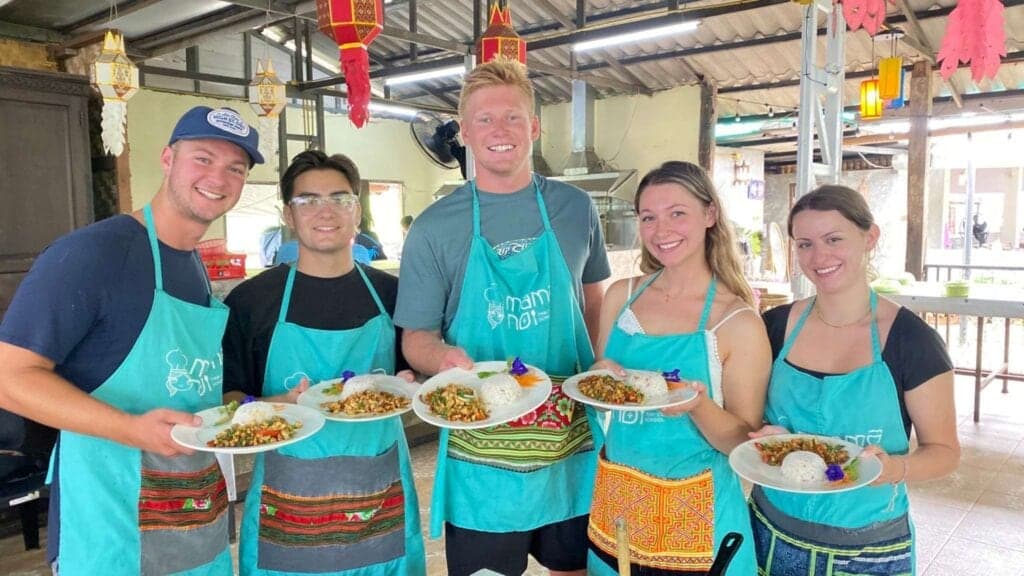
May Kaidee's class is 4 hours, 1,200 baht, runs morning and afternoon shifts. Pun Pun's seasonal workshops vary by season — strawberry-focused in February, mango-focused in April, rice-focused in October. If you want a market-to-wok session you can ask to keep fully plant-based, the Thai cooking class at Siam Garden and the class at Mamanoi both teach from the ingredient up; tell the instructor "gin jay" when you book so the recipes are built without fish sauce, not swapped after the fact. See the full set of Chiang Mai food tours for current schedules.
What gets harder if you're vegan in Chiang Mai?
Three honest pain points: small village stops on day-tours, breakfast at non-tourist hotels, and the fish-sauce default in basic street food.
If you're doing a Doi Inthanon or other day-trip or Mae Hong Son day-trip, the lunch stop is often at a roadside restaurant where the only plant-based option is plain rice and stir-fried vegetables. Pack snacks. Phone ahead to your tour operator and ask them to flag vegan requirements with the lunch stop.
Hotel breakfasts at smaller guesthouses default to omelette-and-toast or rice porridge with shredded pork. Vegan options usually exist but require asking. Big-chain hotels (Le Méridien, Anantara, Shangri-La) handle vegan breakfast competently.
Basic street food (single-plate vendors selling pad krapow, basil chicken, etc.) almost always includes fish sauce even when the visible meat is removed. The mangsavirat phrase doesn't always work at these stalls because fish sauce isn't perceived as "meat" by some vendors. The jay phrase is safer.
What does the Vegetarian Festival look like?
Late September or early October, nine days, citywide. Yellow-and-red flags everywhere. Even non-vegetarian restaurants offer jay menus. A dedicated jay food court fills the Warorot area.
The festival follows the Chinese lunar calendar so dates shift each year. In 2026, it falls in early October. The official kickoff is a Chinese-temple procession; the practical effect is that 60% of street stalls flag a jay menu and prices for vegetable-based dishes briefly drop.
If you're vegan and can time your trip, this is the week. Even non-tourist restaurants run jay specials. The cultural texture — incense, lion dances, temple offerings — is the bonus.
The bottom line
Chiang Mai is the best Thai city for plant-based eating outside Bangkok. Start with Pun Pun for the baseline, work your way through Anchan or Aum for Northern Thai specifically, then explore Nimman's cafe cluster for brunch and Western-food days. Learn the two Thai phrases. Time a trip around the September Vegetarian Festival if you can.
Book a Thai cooking class at Siam GardenAsk for gin jay and the recipes are built plant-based from scratchFurther reading:
- Best Chiang Mai cooking class — full options breakdown
- Northern Thai food guide — what to order beyond pad thai
Outbound references:
- Wikipedia — Vegetarianism in Thailand (jay tradition)
- Tourism Authority of Thailand — Vegetarian Festival
- Pun Pun — permaculture and food project
Frequently asked questions
Is Pun Pun fully vegan?
Yes. Pun Pun is fully vegan with no eggs, dairy, fish sauce or shrimp paste anywhere in the menu. The owners run a permaculture seed-saving NGO at the Wat Suan Dok branch, and the food is heritage Thai recipes adapted with plant-based replacements. Most dishes are 50–120 baht. The Wat Suan Dok location is daytime-only (8am–4pm, closed Wednesdays). A second branch in Sankamphaeng opens evenings. Bring cash. Pun Pun is the strict-vegan benchmark in Chiang Mai — everywhere else gets compared to it.
What's the difference between jay food and vegetarian food in Thailand?
Jay (เจ) is a stricter Chinese-Buddhist tradition — no eggs, dairy, fish sauce, oyster sauce, garlic, onions, leeks, or chives. Look for the yellow 'jay' flag with red Chinese characters. Mangsavirat (มังสวิรัติ) is general Thai vegetarian, which usually excludes meat but may include eggs, dairy, and fish sauce. Most temple restaurants and Pun Pun-style places are jay or vegan. Most cafe menus with 'vegetarian' tags are mangsavirat. If you're strict vegan, ask: 'mai sai khai mai sai nam pla' — no eggs, no fish sauce.
What's the best vegetarian cooking class in Chiang Mai?
May Kaidee's plant-based class is the long-standing choice — 4 hours, 1,200 baht, five Thai dishes including khao soi, pad thai, tom kha, mango sticky rice. The class is fully vegan and the teacher trained with the original May Kaidee in Bangkok. A newer alternative is Pun Pun's seasonal cooking workshop at the Sankamphaeng farm — half-day, 1,500 baht, includes seed-saving demo. Both run in English. Book 48 hours ahead. Avoid generic 'cooking class with vegetarian option' tours — the recipes are usually meat-base with the protein swapped out.
How does Buddhist Lent (vassa) affect vegetarian eating in Chiang Mai?
The bigger effect is the Vegetarian Festival in late September or October — nine days when the Chinese-Thai community goes strictly jay, and red-and-yellow jay flags appear citywide. During the festival, even normal restaurants offer jay menus and a temporary jay food court fills the Warorot market area. Buddhist Lent (Khao Phansa, July–October) is more about monk-life observance than public diet, but some Buddhist families increase vegetarian days during this period. If you're vegan and visiting in October, time the trip to the festival.
Frequently asked questions
Is Pun Pun fully vegan?
Yes. Pun Pun is fully vegan with no eggs, dairy, fish sauce or shrimp paste anywhere in the menu. The owners run a permaculture seed-saving NGO at the Wat Suan Dok branch, and the food is heritage Thai recipes adapted with plant-based replacements. Most dishes are 50–120 baht. The Wat Suan Dok location is daytime-only (8am–4pm, closed Wednesdays). A second branch in Sankamphaeng opens evenings. Bring cash. Pun Pun is the strict-vegan benchmark in Chiang Mai — everywhere else gets compared to it.
What's the difference between jay food and vegetarian food in Thailand?
Jay (เจ) is a stricter Chinese-Buddhist tradition — no eggs, dairy, fish sauce, oyster sauce, garlic, onions, leeks, or chives. Look for the yellow 'jay' flag with red Chinese characters. Mangsavirat (มังสวิรัติ) is general Thai vegetarian, which usually excludes meat but may include eggs, dairy, and fish sauce. Most temple restaurants and Pun Pun-style places are jay or vegan. Most cafe menus with 'vegetarian' tags are mangsavirat. If you're strict vegan, ask: 'mai sai khai mai sai nam pla' — no eggs, no fish sauce.
What's the best vegetarian cooking class in Chiang Mai?
May Kaidee's plant-based class is the long-standing choice — 4 hours, 1,200 baht, five Thai dishes including khao soi, pad thai, tom kha, mango sticky rice. The class is fully vegan and the teacher trained with the original May Kaidee in Bangkok. A newer alternative is Pun Pun's seasonal cooking workshop at the Sankamphaeng farm — half-day, 1,500 baht, includes seed-saving demo. Both run in English. Book 48 hours ahead. Avoid generic 'cooking class with vegetarian option' tours — the recipes are usually meat-base with the protein swapped out.
How does Buddhist Lent (vassa) affect vegetarian eating in Chiang Mai?
The bigger effect is the Vegetarian Festival in late September or October — nine days when the Chinese-Thai community goes strictly jay, and red-and-yellow jay flags appear citywide. During the festival, even normal restaurants offer jay menus and a temporary jay food court fills the Warorot market area. Buddhist Lent (Khao Phansa, July–October) is more about monk-life observance than public diet, but some Buddhist families increase vegetarian days during this period. If you're vegan and visiting in October, time the trip to the festival.