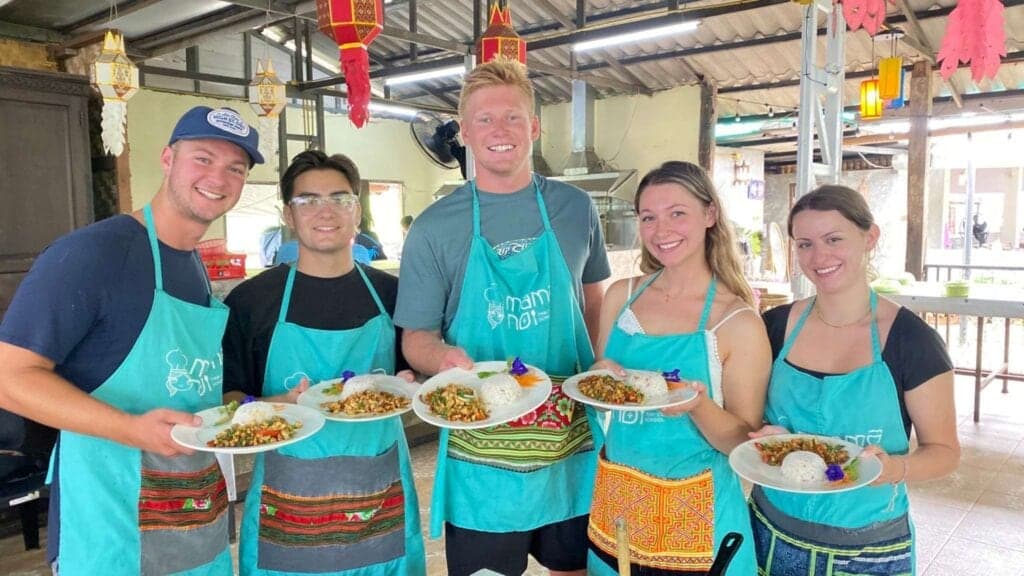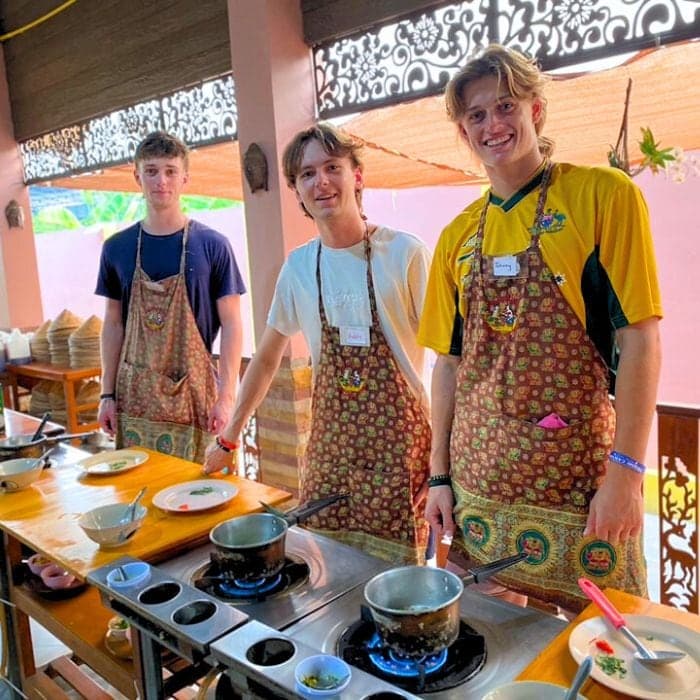
A good Chiang Mai cooking class costs ฿1,000-1,800, caps at eight students per instructor, includes a real market visit, and lets you pound your own curry paste. Anything that skips the market, runs classes of 15+, or hands you pre-portioned ingredients in plastic cups is selling the photo, not the skill. Below is how we filter the ~80 schools currently operating in Chiang Mai down to the five we recommend.
What separates a good Chiang Mai cooking class from a tourist trap?
Four things: class size, real market visit, real curry paste prep, and a head chef who teaches rather than supervises.
The market is crowded — over 80 schools in metro Chiang Mai. Quality varies wildly at the same price point. Use this checklist before you book.
How much does a Chiang Mai cooking class cost in 2026?
Half-day classes are ฿1,000-1,400 per person, full-day classes ฿1,400-1,800. Outside that band, you're paying for either compromise (below) or premium (above).
Below ฿900, something has been cut. Usually the market visit, sometimes the curry paste, often both. Above ฿2,000, you're paying a hotel-brand premium or for a private one-on-one. The mid-range is where the quality lives.
Which Chiang Mai cooking schools actually deliver?
Five schools meet the four-point test consistently: Thai Farm Cooking School, Asia Scenic, Sammy's Organic, Baan Thai, and Smart Cook Thai. The first three are farm-based, the last two are Old City.
| School | Location | Class size cap | Market visit | Half-day price |
|---|---|---|---|---|
| Thai Farm Cooking School | Mae Rim farm, 45min from town | 8 per chef | Yes, working market | ฿1,200 |
| Asia Scenic | Mae Rim farm + Old City branch | 8 per chef | Yes, with herb garden tour | ฿1,000-1,400 |
| Sammy's Organic Thai Cooking | Hang Dong, 30min from town | 10 per chef | Yes, plus on-site organic farm | ฿1,200 |
| Baan Thai Cookery School | Old City (Ratchadamnoen) | 10 per chef | Yes, Somphet market walk | ฿1,000 |
| Smart Cook Thai Cookery | Old City (Tha Phae area) | 8 per chef | Yes, Somphet market | ฿1,100 |
The marketplace listings (Viator, GetYourGuide, Klook) for these same schools sit ฿300-600 above the direct price — a 20-30% commission band consistent across other Chiang Mai tour categories.
Why does the market visit matter so much?
Because the market visit is where you learn to shop, not just to cook. Without it, you can replicate the recipe at home but not adapt when an ingredient is wrong.
A working Chiang Mai wet market — Muang Mai (largest), Ton Lam Yai, Somphet (Old City) — runs from 4am to noon. Your instructor walks you through how to identify holy basil vs Thai basil, how to read palm sugar grades, and why fish sauce is sold in five price tiers. Skip this and the class becomes paint-by-numbers. Schools drop the market visit because it's logistically expensive (45 minutes of one chef minding 8 people) and bus-tour aggregators time-slot it out. The cost saving doesn't go back to you.
Are vegetarian and vegan classes worth doing?
Yes, and Chiang Mai is one of the easier cities to find proper ones — but the menu skews central Thai because northern Thai dishes are heavily fermented-fish-based.
The three schools we'd send a strict vegetarian or vegan to are Asia Scenic, Thai Farm, and Sammy's Organic. All three run a dedicated veg menu where the chef substitutes light soy plus salted soybean paste for fish sauce, and a seaweed-based stock for shrimp paste. Northern Thai dishes like sai oua and nam prik ong don't have great vegetarian versions — if those are on your must-cook list, pick an omnivore class.
What's the right class size?
Eight students per instructor is the practical maximum. Above ten, you queue at the wok stations and the curry paste step becomes a group activity rather than a personal one.
Reputable Chiang Mai schools cap at 8 per chef and run multiple chefs in parallel when fully booked. Thai Farm on a peak morning might run three chefs and 24 students total — but each cohort is a self-contained 8. That's fine. Bus-tour classes push 15-20 per chef with pre-pounded paste and pre-weighed ingredient cups. Confirm per-chef ratio when you book, not just total class size.
Should I pick an Old City school or a farm school?
Farm schools win on atmosphere. Old City schools win on logistics. Food quality is determined by the head chef, not the kitchen location.
Farm schools (Thai Farm, Sammy's Organic) pick up from Old City around 8:30am, drive 30-45 minutes into the rice paddies, run the class until 3-4pm. Outdoor cooking, garden vegetables, slower pace. Old City schools (Baan Thai, Smart Cook Thai) are walkable from any Old City hotel, market visit at Somphet, less atmospheric, more efficient. Pick farm if you have a free morning or afternoon either side. Pick Old City if the class is slotted between a temple visit and dinner.
How do I book a Chiang Mai cooking class without getting ripped off?
Book direct on the school's website. The marketplaces (Viator, GetYourGuide, Klook) add 20-30% commission on the exact same class.
The five schools above all run their own booking pages with English-language confirmation. Hotels can also book on your behalf at the direct rate — there's usually no concierge markup for cooking classes because the school pays the hotel a referral fee of ฿100-200 per booking instead.
We do run a Thai cooking class at Siam Garden and a class at Mamanoi Thai Cookery School, both operator-direct with a real market visit, and you can browse the rest of our Chiang Mai food tours. If neither fits your group size or dietary needs, email us and we'll point you to a school that does. Email is the simplest route.
Book the Siam Garden Thai cooking classOperator-direct, real market visit, small groups, no marketplace markupFurther reading from our travel guide:
- Chiang Mai elephant tours price breakdown — the same commission gap, in another vertical.
- Where to stay in Chiang Mai Old City — proximity to cooking schools and morning markets.
- Best Viator alternatives for Chiang Mai tours — how the marketplace markup works across categories.
External references used in this post:
- Tourism Authority of Thailand 2025 arrival statistics (tat.or.th).
- Thai Farm Cooking School public price list, accessed 2026-05-25.
- Asia Scenic Cooking School public price list, accessed 2026-05-25.
Frequently asked questions
Should a Chiang Mai cooking class include a market visit?
Yes. A 30-45 minute walk through a working market (Muang Mai, Ton Lam Yai) is where you learn to identify holy basil vs Thai basil, three kinds of soy sauce, and palm sugar in disc form. Classes that skip the market and pre-portion ingredients save 45 minutes and lose the most useful part of the day. If you only have a half-day, pick one that still does a shortened market visit.
Is a half-day class enough or do I need a full day?
Half-day works if you've cooked Thai food before. You'll make three dishes in three hours. Full-day classes (six to seven hours) make five to six dishes plus dessert and a longer market visit. For first-timers, full-day is better value. For people stacking the class around other activities, half-day fits. Avoid evening classes — they cut corners on the curry paste step.
Are vegetarian-only Chiang Mai cooking classes any good?
Yes. Asia Scenic, Thai Farm, and Sammy's Organic run dedicated veg menus with tofu-and-mushroom substitutes for fish sauce and shrimp paste (light soy, salted soybean paste, seaweed). Some northern Thai dishes — sai oua sausage, nam prik ong — don't have great vegetarian versions, so the menu skews central Thai. Confirm substitutions with the school by email before booking if you eat strict vegan.
What's the right class size for a Chiang Mai cooking class?
Eight students per instructor is the practical maximum. Above that, you queue at the wok stations and get less individual feedback. Reputable schools cap at 8-10 per chef and run multiple chefs at the farm-style places (Thai Farm, Asia Scenic). Bus-tour cooking classes that we'd avoid push 15-20 per chef. Confirm the per-chef ratio when you book.
Should I pick a school in the Old City or out at a farm?
Farm schools (30-45 minutes outside town) cost the same as Old City schools but feel less commercial — you cook outdoors, herbs picked from the garden, slower pace. Old City schools win on logistics: walk back to your hotel after. If you have an afternoon free, farm. If the class is your only window, Old City. The food quality is determined by the head chef, not the kitchen.
How much should a Chiang Mai cooking class cost in 2026?
Half-day ฿1,000-1,400 at established schools, including market visit, ingredients, recipe booklet, and Old City pickup. Full-day ฿1,400-1,800. Below ฿900 the class is too large or uses pre-prepared paste. Above ฿2,000 you're paying for a private class or a hotel brand premium. The mid-range is where the quality lives.
Frequently asked questions
Should a Chiang Mai cooking class include a market visit?
Yes. A 30-45 minute walk through a working market (Muang Mai, Ton Lam Yai) is where you learn to identify holy basil vs Thai basil, three kinds of soy sauce, and palm sugar in disc form. Classes that skip the market and pre-portion ingredients save 45 minutes and lose the most useful part of the day. If you only have a half-day, pick one that still does a shortened market visit.
Is a half-day class enough or do I need a full day?
Half-day works if you've cooked Thai food before. You'll make three dishes in three hours. Full-day classes (six to seven hours) make five to six dishes plus dessert and a longer market visit. For first-timers, full-day is better value. For people stacking the class around other activities, half-day fits. Avoid evening classes — they cut corners on the curry paste step.
Are vegetarian-only Chiang Mai cooking classes any good?
Yes. Asia Scenic, Thai Farm, and Sammy's Organic run dedicated veg menus with tofu-and-mushroom substitutes for fish sauce and shrimp paste (light soy, salted soybean paste, seaweed). Some northern Thai dishes — sai oua sausage, nam prik ong — don't have great vegetarian versions, so the menu skews central Thai. Confirm substitutions with the school by email before booking if you eat strict vegan.
What's the right class size for a Chiang Mai cooking class?
Eight students per instructor is the practical maximum. Above that, you queue at the wok stations and get less individual feedback. Reputable schools cap at 8-10 per chef and run multiple chefs at the farm-style places (Thai Farm, Asia Scenic). Bus-tour cooking classes that we'd avoid push 15-20 per chef. Confirm the per-chef ratio when you book.
Should I pick a school in the Old City or out at a farm?
Farm schools (30-45 minutes outside town) cost the same as Old City schools but feel less commercial — you cook outdoors, herbs picked from the garden, slower pace. Old City schools win on logistics: walk back to your hotel after. If you have an afternoon free, farm. If the class is your only window, Old City. The food quality is determined by the head chef, not the kitchen.
How much should a Chiang Mai cooking class cost in 2026?
Half-day ฿1,000-1,400 at established schools, including market visit, ingredients, recipe booklet, and Old City pickup. Full-day ฿1,400-1,800. Below ฿900 the class is too large or uses pre-prepared paste. Above ฿2,000 you're paying for a private class or a hotel brand premium. The mid-range is where the quality lives.