TL;DR — Chiang Mai's street food peaks at 12 specific stalls that justify queuing. The headline picks: Mae Manee (mango sticky rice), SP Chicken (gai yang), Khao Soi Khun Yai (khao soi), Cowboy Hat Lady (khao kha moo), and Khao Niao Som Sa-nguan (sour sticky rice). Skip the Night Bazaar food zone, the famous "Coke Lady" karaoke setup, and any stall with photos of food at the front. Eat at Chang Phueak gate market for the local benchmark.
Why Chiang Mai street food deserves its reputation
Chiang Mai sits at the intersection of three Thai regional cuisines — northern Lan Na, central Thai, and Isan (northeastern) — plus Burmese, Yunnanese Chinese, and Shan influences from the surrounding hill regions. That density of culinary traditions in one walkable city is unusual even by Thai standards. Twelve specific stalls capture that breadth.
The city's street food economy survived the COVID years better than Bangkok's because most stalls are family-owned with low overheads, not rented chain operations. The result in 2026 is that most of the 2018-era benchmarks are still operating with the same recipes and often the same families. That's not true in Bangkok, where post-pandemic rent pressure has thinned the famous-stall density considerably.
Below, the 12 stalls we'd queue for and the famous ones we'd skip. Plus the framework for finding others yourself.
The 12 stalls actually worth queuing for
| Stall | Dish to order | Best time | Wait expectation |
|---|---|---|---|
| Mae Manee (Phra Pokklao Rd) | Mango sticky rice with coconut cream | 11:00–14:00 | 5–10 min |
| SP Chicken (Suthep Rd, moat side) | Half gai yang + sticky rice + som tam | 11:30 sharp | 20–40 min at lunch |
| Khao Soi Khun Yai (Sripoom 9) | Khao soi gai (chicken) with extra crispy noodles | 10:00–14:00, closed Sun | 10–25 min |
| Cowboy Hat Lady (Chang Phueak gate) | Khao kha moo (stewed pork leg over rice) | 17:30–22:00 | 5–15 min |
| Khao Niao Som Sa-nguan (Faham market) | Sai ua + sour sticky rice | 07:00–10:00 | 5 min |
| Aroon Rai (Kotchasarn Rd) | Gaeng hung lay (northern pork curry) | 11:00–20:00 | Sit-down, 5 min wait |
| Jok Sompet (Sompet market) | Jok mu (pork rice porridge) | 06:00–11:00 | 5 min |
| Khao Soi Lam Duan (Faham Rd) | Khao soi nuea (beef) | 09:00–16:00 | 10–20 min |
| Lung Eed (Khwang Soi 2) | Larb gai khua (northern roasted chicken larb) | 12:00–20:00, closed Sun | 10 min |
| Pa Krong (Chang Moi Rd) | Boat noodles | 09:00–14:00 | 5 min |
| Khao Soi Mae Sai (Ratchaphakhinai Rd) | Khao soi mu (pork) | 10:00–15:00 | 5–15 min |
| Saturday Walking Street stall row (Wualai Rd, 17:00 onwards) | Mu ping (grilled pork skewers) | 17:30–20:00 | 5 min |
Mango sticky rice deserves its own paragraph. Mae Manee uses Nam Dok Mai mango — the smaller, oblong cultivar with more aroma and softer flesh than the Khaeo Sawoey variety most tourist-facing stalls use. The difference is immediately obvious: Nam Dok Mai mango is fragrant enough that you smell the dish before it reaches your hand. Mango Tango near Thapae Gate gets more foot traffic and Instagram tags but uses Khaeo Sawoey and charges nearly double for the privilege.
What makes a stall worth queuing for?
Three signals correlate with quality: cooks-to-order with visible high heat, Thai customers outnumbering tourists, and a one-or-two-dish menu rather than a 40-item picture menu. Apply that filter and you'll find good food on streets we don't list.
The cooks-to-order rule matters because Thai cuisine relies on the wok hei (the high-heat sear) and on aromatics that fade in minutes. A khao soi made fresh tastes different from one ladled out of a stock pot. A gai yang straight off the charcoal beats one resting under a heat lamp.
The Thai-customer ratio matters because Thai diners walk past stalls they don't trust. If the regulars are absent, there's usually a reason. Chang Phueak gate market on a Tuesday evening is roughly 90% Thai diners. That's the benchmark.
Where are the night markets actually worth eating?
Sunday Walking Street is the best food-to-tourist ratio of the night markets. Chang Phueak gate market is the local-benchmark spot. Skip the Night Bazaar food zone and most of the Saturday Walking Street's food carts.
Chang Phueak gate market deserves the highest praise. It runs nightly from about 17:30 to 22:30 at the north gate of the Old City moat. The Cowboy Hat Lady (Khao Kha Moo Chang Phueak — she wears a cowboy hat, it's not a metaphor) is the most-famous stall but the whole row is good. Khao soi, sai ua, gai yang, mu ping, fresh juices — everything is there, prices are Thai-domestic-grade (฿20–฿80 per dish), and the diners are mostly local families.
Sunday Walking Street's food spine runs along Ratchadamnoen Road from Thapae Gate west to Wat Phra Singh. The food vendors set up between 17:00 and 22:30. Quality is genuinely high because the stallholders are mostly family operations doing what they cook at home, not specialist event-caterers. The mango sticky rice stalls on Sunday Walking Street are competitive with Mae Manee; the khao soi stalls are not as good as the daytime specialists.
What are the famous stalls actually worth skipping?
Mango Tango near Thapae Gate (overpriced, wrong mango variety). Most of the Night Bazaar food court (tourist-priced, average product). The "Cowboy Hat Lady Karaoke" YouTube-famous setup on the Sunday Walking Street (the dish is fine, the queue is two hours, just go to Chang Phueak gate instead). YouTube and TikTok have inflated some stalls past their actual value.
The pattern recurs city by city: a stall gets a viral video, queues triple, the proprietor either compromises quality to manage volume or holds quality and you wait 90 minutes for a dish that's available 600 metres away with no queue. We don't begrudge the viral stalls — they earn their attention — but we don't queue with you.
How does the guided-tour vs walking-alone trade-off work?
A guided food tour is most valuable on night one. After that, walking alone with the vocabulary you've learned is better and cheaper. The right way to use a tour is as a starter pack, not a substitute for independent eating.
A typical Chiang Mai food tour runs 3 hours, hits 5–7 stalls, costs ฿1,200–฿1,800 per person, and feeds you genuinely enough to skip dinner. The value isn't the food itself (you could find similar stalls alone). The value is:
- Translation. Most stall menu boards are Thai-only. A guide reads them aloud and translates.
- Regional context. Northern vs Isan vs central Thai differences are invisible without explanation.
- Family stalls. A guide knows the family-run stalls that don't show up on Google.
- Eating order. Five stalls in three hours requires a guide who knows portion sizes. Independent eaters typically overshoot at stall two.
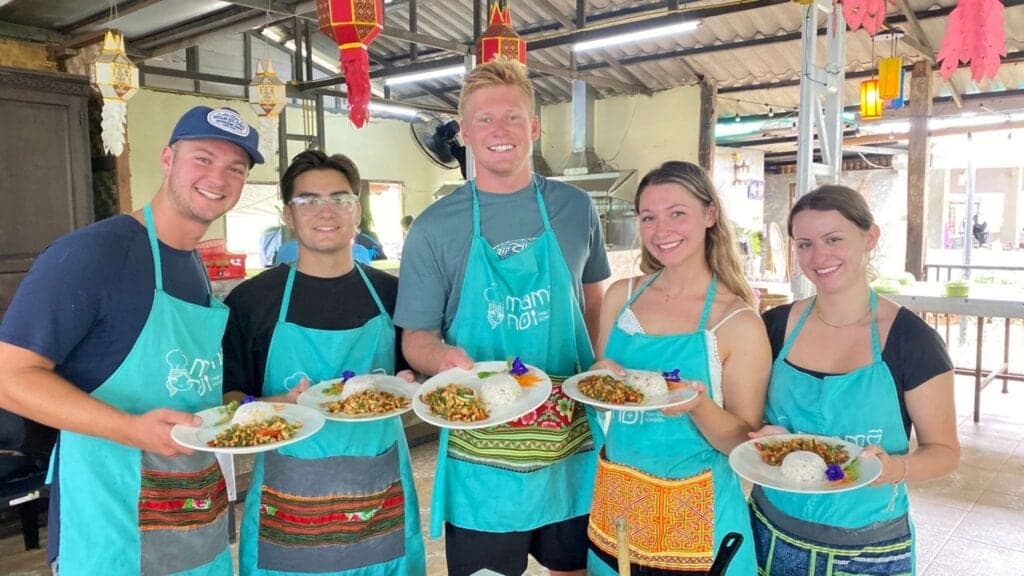
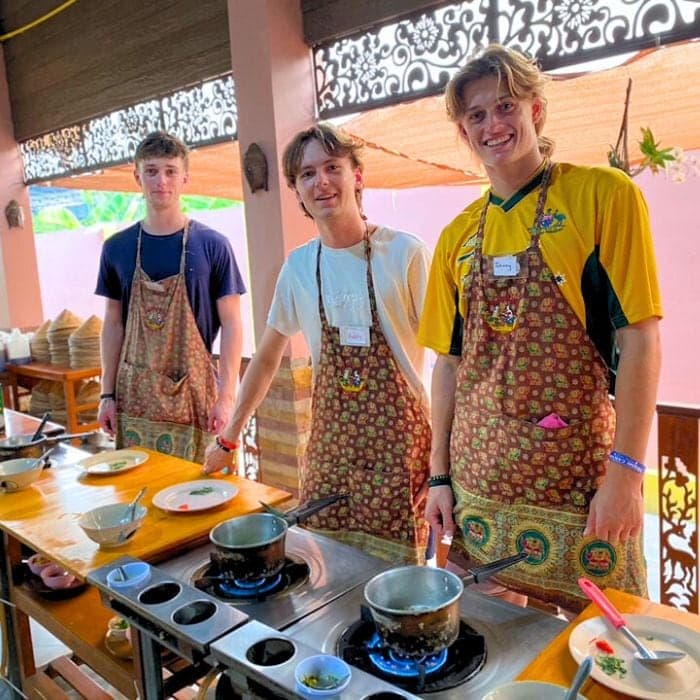
If you'd like a guided introduction to the food before walking on your own the rest of the week, our food tours category lists current options. To go a step further and learn to cook the dishes yourself, the Thai cooking class at Siam Garden starts with a market walk before the kitchen, and the class at Mamanoi covers the same northern staples.
What about dietary restrictions — vegetarian, vegan, allergies?
Vegetarian is workable but requires asking. Vegan is hard. Severe allergies are a serious challenge in Thai street food and need direct communication with each stall.
Buddhist vegetarianism (called jay or je in Thai) exists but isn't widespread. About 10–15% of stalls offer at least one vegetarian option clearly. The phrase to learn: gin jay (เจ) for strict vegetarian, gin mang sa wirat (มังสวิรัติ) for ovo-lacto. Northern dishes like khao soi traditionally use chicken or beef; jay versions exist at specialist stalls but aren't the default.
Fish sauce is the hidden trap. It's in almost every cooked dish including ones that look meat-free. Vegan diners need to ask specifically (mai sai naam plaa, "no fish sauce"). Soy sauce versions exist but the stall may not offer them automatically.
Severe peanut, shellfish, or gluten allergies require disclosure on every order. Carry a printed Thai-language allergy card and show it before ordering. Cross-contamination at woks is real because most stalls use one wok for everything.
What's a reasonable budget for street food?
฿300–฿500 per person per day buys three substantial meals plus a snack or dessert. That's roughly half what equivalent sit-down restaurants charge for similar food.
A typical day's eating: ฿40 for jok or rice porridge breakfast, ฿80 for khao soi lunch with a drink, ฿120 for a Chang Phueak gate market dinner with two dishes and sticky rice, ฿80 for mango sticky rice or a dessert later. Total ฿320. Add a coconut juice and a beer and you're at ฿420.
For a couple on a five-day trip, that's ฿4,200 for ten days of food across two people — significantly less than a single sit-down dinner at a hotel restaurant. The cost-to-quality ratio is the genuine reason Chiang Mai's food economy holds up against tourist pressure.
How do you find good stalls beyond this list?
Walk Thai-resident streets between 17:30 and 19:30 (the local dinner hour). Apply the 3-Signal Test. Don't optimise for the most-Googled stall — optimise for the third or fourth most-recommended in any neighbourhood.
The streets to walk for organic stall discovery: Faham Road north of the river (morning markets, breakfast staples), Suthep Road outside the moat (lunch stalls serving the university crowd), Mahidol Road near the main railway station (working-Thai neighbourhood evening food), and Sankamphaeng Road east of the old city (suburban Thai eating, fewer tourists).
Avoid: Thapae Road inside the Old City moat after 18:00 (too tourist-priced), the immediate vicinity of any hotel rated 4-star or higher, and the food courts at Maya Mall or Central Festival (mall food court quality, no street character).
The bottom line on Chiang Mai street food
Eat at the 12 stalls above, apply the 3-Signal Test for anything else, and use a guided tour on night one to learn the vocabulary. Chiang Mai's food economy still delivers genuine quality at Thai-domestic prices in 2026, which can't be said for every Asian tourist city.
The single best decision is to skip restaurants for most meals. The pricing gap between street food and sit-down equivalents has widened post-2022, and the quality gap has narrowed. The food you'll remember from this trip will almost certainly come from a folding stool, not a tablecloth.
Book the Siam Garden Thai cooking classMarket walk then hands-on northern Thai dishes, small groups, hotel pickupInternal reading worth your time:
- Best khao soi in Chiang Mai: the 5 specialists worth comparing
- Northern Thai food guide: dishes, sauces, and what's actually local
- Sunday vs Saturday Walking Street: which one is actually better
- Michelin Guide Thailand 2025 listings (external)
Frequently asked questions
Is street food in Chiang Mai actually safe?
Yes — Chiang Mai's street food has one of the better safety records among major Thai tourist cities. Most stalls cook to order at high heat, which kills the bacteria that cause traveller's stomach trouble. The risks come from raw or undercooked items (Larb dishes, raw shrimp salad, fermented sausage if eaten raw) rather than from the cooked items most foreigners order. Practical rule: eat where Thai people eat, eat what's cooking when you walk up, and skip pre-cooked items sitting at room temperature. We've never had a tour group get sick from the stalls on our route.
Which stall actually wins for mango sticky rice?
Mae Manee on Phra Pokklao Road, two blocks south of Wat Chedi Luang. She uses Nam Dok Mai mango (more aromatic than the Khaeo Sawoey variety most stalls use), her sticky rice is glutinous and slightly under-sweetened so the coconut cream balances it, and she cuts the mango fresh per order. The queue is usually 5–10 minutes after 11:00. Mango Tango near Thapae Gate gets more tourist traffic and more Instagram coverage; the product is fine but pricier and noticeably less fragrant. For ฿80 vs ฿150 for similar volume, Mae Manee wins.
Are the queues at SP Chicken worth waiting for?
Yes, but only at lunch. SP Chicken on the Old City moat road serves Chiang Mai's best gai yang (charcoal-roasted chicken with the herbal northern marinade). The wait is 20–40 minutes from noon to 14:00 because they cook in batches and refuse to rush. Their som tam (papaya salad) and sticky rice are equal-quality to anywhere in the city. The trick: arrive at 11:30 to skip the queue, or pre-order via the phone number on their sign and pick up. Going at 19:00 means smaller queue but the chickens have been resting longer and the skin loses crispness.
What about Michelin-starred Bib Gourmand street stalls in Chiang Mai?
As of the 2025 Michelin Guide Thailand, Chiang Mai has 12 Bib Gourmand listings including Khao Soi Khun Yai, Khao Soi Lam Duan, Aroon Rai, and Jok Sompet. The Bib Gourmand seal genuinely correlates with quality, but the listings have caused crowd surges that double wait times and sometimes hurt the experience. Three of the 12 we'd still queue for; the others have been overrun. The non-Michelin stalls on our route generally match Bib Gourmand quality without the line. Use the Guide as a starting point, not a finish line.
Should I do a guided food tour or just walk myself?
Walking yourself works for confident eaters who can read a stall by sight and aren't intimidated by pointing at what looks good. A guided tour adds value if you want translation of menu boards, context on regional differences (northern vs Isan vs central Thai), introductions to family-run stalls that don't appear on Google Maps, and a route that hits 5–7 stalls in 3 hours without overeating. The honest answer: do a guided tour on night one of your trip to learn the vocabulary, then walk independently the rest of the week.
Are the night markets actually good for food, or just for tourists?
Mixed. The Sunday Walking Street has the best food-to-tourist ratio of the night markets — most stalls are family-run and the food is competitive with daytime spots. Chang Phueak Gate night food market (the north gate of the Old City) is the genuinely-local pick where Thai families eat. The Night Bazaar (east of the Old City) has been mostly hollowed out by tourist-priced fare; skip it for food unless you specifically want a sit-down restaurant. Saturday Walking Street is fine but smaller and less food-focused than Sunday's.
Frequently asked questions
Is street food in Chiang Mai actually safe?
Yes — Chiang Mai's street food has one of the better safety records among major Thai tourist cities. Most stalls cook to order at high heat, which kills the bacteria that cause traveller's stomach trouble. The risks come from raw or undercooked items (Larb dishes, raw shrimp salad, fermented sausage if eaten raw) rather than from the cooked items most foreigners order. Practical rule: eat where Thai people eat, eat what's cooking when you walk up, and skip pre-cooked items sitting at room temperature. We've never had a tour group get sick from the stalls on our route.
Which stall actually wins for mango sticky rice?
Mae Manee on Phra Pokklao Road, two blocks south of Wat Chedi Luang. She uses Nam Dok Mai mango (more aromatic than the Khaeo Sawoey variety most stalls use), her sticky rice is glutinous and slightly under-sweetened so the coconut cream balances it, and she cuts the mango fresh per order. The queue is usually 5–10 minutes after 11:00. Mango Tango near Thapae Gate gets more tourist traffic and more Instagram coverage; the product is fine but pricier and noticeably less fragrant. For ฿80 vs ฿150 for similar volume, Mae Manee wins.
Are the queues at SP Chicken worth waiting for?
Yes, but only at lunch. SP Chicken on the Old City moat road serves Chiang Mai's best gai yang (charcoal-roasted chicken with the herbal northern marinade). The wait is 20–40 minutes from noon to 14:00 because they cook in batches and refuse to rush. Their som tam (papaya salad) and sticky rice are equal-quality to anywhere in the city. The trick: arrive at 11:30 to skip the queue, or pre-order via the phone number on their sign and pick up. Going at 19:00 means smaller queue but the chickens have been resting longer and the skin loses crispness.
What about Michelin-starred Bib Gourmand street stalls in Chiang Mai?
As of the 2025 Michelin Guide Thailand, Chiang Mai has 12 Bib Gourmand listings including Khao Soi Khun Yai, Khao Soi Lam Duan, Aroon Rai, and Jok Sompet. The Bib Gourmand seal genuinely correlates with quality, but the listings have caused crowd surges that double wait times and sometimes hurt the experience. Three of the 12 we'd still queue for; the others have been overrun. The non-Michelin stalls on our route generally match Bib Gourmand quality without the line. Use the Guide as a starting point, not a finish line.
Should I do a guided food tour or just walk myself?
Walking yourself works for confident eaters who can read a stall by sight and aren't intimidated by pointing at what looks good. A guided tour adds value if you want translation of menu boards, context on regional differences (northern vs Isan vs central Thai), introductions to family-run stalls that don't appear on Google Maps, and a route that hits 5–7 stalls in 3 hours without overeating. The honest answer: do a guided tour on night one of your trip to learn the vocabulary, then walk independently the rest of the week.
Are the night markets actually good for food, or just for tourists?
Mixed. The Sunday Walking Street has the best food-to-tourist ratio of the night markets — most stalls are family-run and the food is competitive with daytime spots. Chang Phueak Gate night food market (the north gate of the Old City) is the genuinely-local pick where Thai families eat. The Night Bazaar (east of the Old City) has been mostly hollowed out by tourist-priced fare; skip it for food unless you specifically want a sit-down restaurant. Saturday Walking Street is fine but smaller and less food-focused than Sunday's.