TL;DR — Northern Thai cuisine (called Lanna or aharn nuea) has a distinct identity built on dried chillies, fermented soybean, sticky rice and herb-led larb, separate from the coconut-and-fish-sauce profile most people know as 'Thai food.' Beyond khao soi, the dishes worth seeking out in Chiang Mai are sai oua, gaeng hung lay, nam prik num, larb meuang, khao niao and a handful of regional specialities you won't find in Bangkok.
What makes Northern Thai food different?
Lanna food is sticky-rice-led, herb-driven, dry-chilli-spiced and historically more Burmese-influenced than the coconut-and-fish-sauce cuisine of Central Thailand.
The kingdom of Lanna (roughly 1296–1775) sat at the crossroads of Burmese, Yunnanese, Tai and Lao culture, and the food shows it. The coconut palm doesn't grow well in the Northern hills, so the curries lean dry-paste over coconut-cream. Sticky rice replaces jasmine rice as the staple. Fermented soybean (tua nao) shows up the way fish sauce shows up in Bangkok. Dried chillies, galangal, lemongrass and herb bundles dominate the flavour palette.
The result is a cuisine that feels distinctly different from the pad thai, green curry and tom yum tourists arrive expecting. It's also where most of the dishes worth travelling for actually live.
Which dish do I have to try first?
Khao soi — the curried coconut noodle soup with crispy fried noodles on top — is the dish to start with, but it shouldn't be your only one.
Khao soi is the most-Googled Lanna dish for good reason: it's accessible, it's photogenic, and the contrast of soft egg noodles in coconut broth topped with crispy fried noodles is genuinely a great dish. The classic version is chicken (khao soi gai) or beef (khao soi neua), served with pickled mustard greens, sliced shallots, lime and a chilli oil on the side.
Order it once at a sit-down restaurant (Khao Soi Khun Yai or Khao Soi Lam Duan are the canonical specialists) and once at a street stall — they're different enough to warrant both. After that, move on. Eating khao soi every day for two weeks is a common tourist mistake.
What are the 15 Northern Thai dishes worth ordering?
The list below is the working set — the ones that come up on every Lanna-food round-up and that we'd order over a 5-day trip.
| Dish | What it is | Heat level | Where to start |
|---|---|---|---|
| Khao soi | Curried coconut noodle soup with crispy noodle topping | Medium | Khao Soi Khun Yai, Khao Soi Lam Duan |
| Sai oua | Northern herb sausage (lemongrass, kaffir, galangal, chilli) | Medium | Sunday Walking Street, Huen Phen |
| Gaeng hung lay | Burmese-influenced pork belly curry with ginger and tamarind | Mild | Aroon Rai, Huen Phen |
| Nam prik num | Green-chilli roasted dip with sticky rice and vegetables | Hot | Any Old City Lanna restaurant |
| Nam prik ong | Tomato-and-pork chilli dip, milder, brick-red | Mild | Huen Phen |
| Larb meuang | Northern larb — herb-heavy, bitter, blood-fortified | Medium | Lab Cha-em (Nimman) |
| Khao niao | Sticky rice — the base of every meal | — | Everywhere |
| Khanom jeen nam ngiao | Rice noodles in pork-rib-and-tomato broth | Medium | Khanom Jeen Khun Pen |
| Sai krok meuang | Sour fermented pork sausage | Mild | Walking Street vendors |
| Yum makhua yao | Grilled long eggplant salad with pork | Medium | Huen Phen |
| Naem khao thawt | Crispy fermented rice salad with sour sausage | Medium | Lao-influenced specialists, some Lanna places |
| Khao soi neua | Beef version of khao soi — richer, slower-cooked | Medium | Khao Soi Lam Duan, Khao Soi Mae Sai |
| Tam khanun | Young jackfruit curry with sai oua and pork | Mild | Huen Phen, seasonal |
| Aep pla | Banana-leaf-grilled fish with herbs and chilli paste | Medium | Riverside Lanna restaurants |
| Khao kan jin | Steamed pork-blood rice in banana leaf | Mild | Sunday Walking Street, hill-tribe specialists |
What's the realistic order to try them in?
The 5-Day Lanna Food Order: Day 1 khao soi, Day 2 sai oua and gaeng hung lay, Day 3 nam prik num with sticky rice, Day 4 larb meuang and khanom jeen nam ngiao, Day 5 the rest.
That's our internal heuristic — we call it the 5-Day Lanna Order — because it sequences from familiar to adventurous, lets your palate adjust to the herb intensity, and saves the polarising stuff (larb meuang, fermented sour sausage) for later in the trip when you've calibrated.
Where do you actually go to eat these?
For a 90%-coverage single-restaurant approach, Huen Phen (in the Old City) and SP Chicken Restaurant (Soi 1, Sirimangkalajan) are the canonical Lanna sit-down meals.
The realistic eating map for Chiang Mai:
- Huen Phen (112 Ratchamanka Rd) — the sit-down Lanna restaurant most foreigners and Thais agree on. Lunch is more authentic than dinner; the menu shifts upmarket after 18:00.
- Aroon Rai (45 Kotchasarn Rd) — bigger menu, larger groups, gaeng hung lay and khao soi both strong.
- Khao Soi Khun Yai (next to Wat Faham) — closes at 14:00, queue early. The single best khao soi in town if the queue is bearable.
- Khao Soi Lam Duan (Faham road area) — open longer hours, similarly excellent, less of a queue.
- Lab Cha-em (Nimman backstreets) — specialist for larb meuang and the various pork-and-herb regional sausages.
- Sunday Walking Street (Ratchadamnoen, Sun evenings) — 30+ Lanna stalls in one long market. Best graze meal of the week.
For a deeper sit-down round-up we've got a separate post: best Chiang Mai cooking class — many of the schools double as restaurants you can eat at without the class.
What about street food versus sit-down?
Lanna street food is some of the best in Thailand, but for first-time visitors the sit-down restaurants offer more menu coverage and a safer entry point.
The Sunday Walking Street, the Saturday Walking Street and the Night Bazaar all run dedicated Lanna stalls — sai oua sliced fresh from grills, sticky rice in bamboo cylinders, gaeng hung lay in vats, fresh nam prik with rolled banana-leaf vegetables. If you have the appetite for stall-grazing, the 5-day order can be compressed into two evenings.
For travellers wary of street food: the rule of thumb is busy stalls with high turnover are safe, quiet stalls with food sitting out are not. Most Lanna street vendors cook to order or rotate stock in 20-minute cycles.
What about the regional variations within Northern Thailand?
Chiang Mai's Lanna food is one of three distinct Northern Thai sub-cuisines — Chiang Rai (Lao-influenced, more sour notes), Nan (Tai Lue minority influence, more bitter), and Mae Hong Son (Shan and Burmese, more dry-spice).
If you're doing a Chiang Rai overnight, look for kanom jeen nam ngiao done in the Chiang Rai style (more tomato, less pork rib) and naem khao thawt (the crispy rice salad better-known from Laos). If you're going Mae Hong Son or Pai, look for Shan-influenced dishes — Shan-style tofu (tao hoo), pork rib with mustard greens, and a different sai oua recipe with more turmeric.
For most Chiang Mai-only visitors, this is more depth than the trip needs. The 15-dish list above is the working core.
Is a cooking class worth it for Lanna food?
For travellers who want to understand the herb-and-paste structure, yes — Lanna cooking classes typically cost ฿1,000–฿1,800/person and run a half or full day.
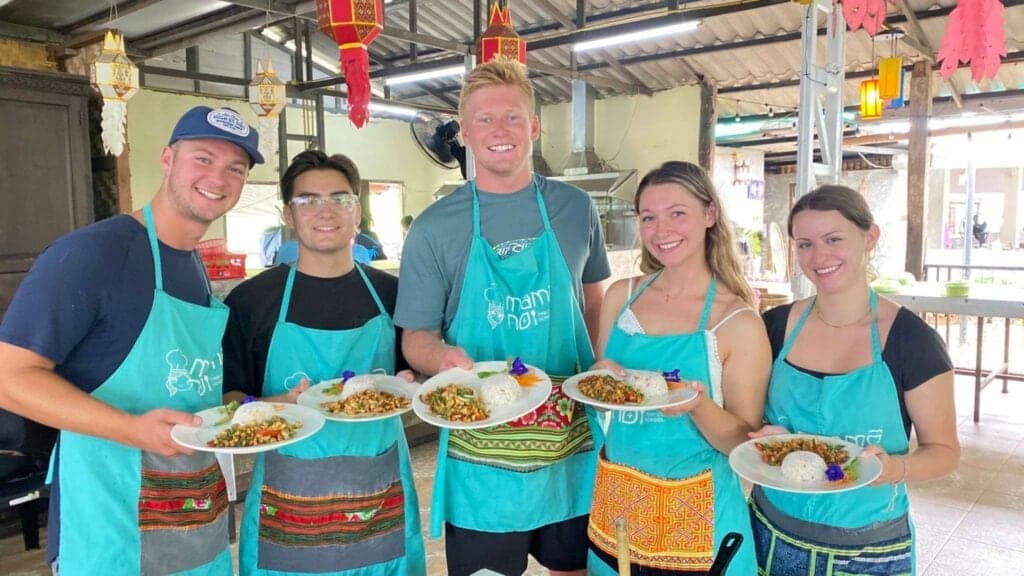
The good schools (Thai Farm Cooking School, Smart Cook Thai Cookery, Chiang Mai Cookery Centre) all have Lanna-specific menus or modules. You'll make khao soi paste from scratch, grind nam prik num with mortar and pestle, and roll your own sai oua. The point isn't really recreating the dishes at home (the ingredients are hard outside Asia) — it's understanding why the herbs and dried chillies combine the way they do. Our own half-day classes at Siam Garden and Mamanoi both run market-and-cook formats that cover the Lanna staples, and the full list lives on the Chiang Mai food tours page.
A class on day 2 or 3 of your trip primes you to taste better at every restaurant afterwards.
The bottom line
Chiang Mai's food scene is the best argument for the city as a Northern Thailand base. Khao soi is the gateway dish but only the start — sai oua, gaeng hung lay, nam prik num and larb meuang are the dishes that define Lanna cuisine and that most visitors miss. The 5-Day Lanna Order is the framework we'd give a friend visiting for the first time: start familiar, move adventurous, save the polarising stuff for the back half. Skip the raw-blood larb unless you're with locals.
Book a half-day Lanna cooking class at Siam GardenMarket trip plus hands-on cooking, small groups, hotel pickupInternal reading worth your time:
- Best khao soi in Chiang Mai: the 6 spots locals actually use
- Best Chiang Mai cooking class: 8 schools compared
Outbound references:
- Wikipedia — Northern Thai cuisine (en.wikipedia.org, accessed 2026-02-13)
- Thailand National Food Institute Lanna food survey — nfi.or.th (accessed 2026-02-13)
- Wikipedia — Khao soi (en.wikipedia.org, accessed 2026-02-13)
Frequently asked questions
Are Northern Thai dishes spicier than central Thai food?
Different rather than spicier. Northern Thai food relies more on dried chillies, fermented soybean and herbs than the fresh-chilli heat of Bangkok cooking. Nam prik num is fiery, but most curries like gaeng hung lay are gentle. Khao soi sits in the medium range. Larb meuang (Northern larb) is herb-heavy with bitter undertones, not chilli-led. The local heat scale runs lower than Isaan or Southern Thai food. If you find central Thai food too hot, Northern Thai is usually more approachable.
Where can I order all 15 of these dishes at one restaurant?
Huen Phen on Ratchamanka Road inside the Old City is the closest single-restaurant answer — they cover roughly 12 of the 15. Aroon Rai on Kotchasarn is a close second with strong gaeng hung lay and khao soi. For larb meuang done properly, Lab Cha-em on Nimman side streets is the specialist. Sunday Walking Street has stalls covering 8–10 of these on a single evening if you treat it as a graze rather than a sit-down meal.
Is larb dipped in raw blood (larb dip) safe to eat?
Risk-managed but not zero-risk. Larb dip is traditionally made with fresh raw beef or buffalo and the animal's own blood, served at the same restaurant or village where the animal was slaughtered that morning. The risk is foodborne illness (campylobacter, trichinella). For travellers, we'd say: only eat it at trusted Lanna restaurants serving locals, or skip it. Cooked larb (larb kua or larb suk) gives you the herb and spice profile without the raw-meat risk. Most Chiang Mai restaurants will default-cook it for tourists.
Are there vegetarian versions of Northern Thai dishes?
Yes for most, with some adaptation. Khao soi can be made with tofu and coconut broth (no chicken or beef). Gaeng hung lay's pork can be swapped for tofu or eggplant — the spice paste carries it. Nam prik num is already vegetarian (chilli paste, eggplant, herbs). Sai oua is the one major dish that doesn't translate vegetarian — it's a pork-and-herb sausage by definition. Most Old City restaurants understand 'jay' (Buddhist vegan) and 'mangsawirat' (vegetarian) — say which one you mean.
Frequently asked questions
Are Northern Thai dishes spicier than central Thai food?
Different rather than spicier. Northern Thai food relies more on dried chillies, fermented soybean and herbs than the fresh-chilli heat of Bangkok cooking. Nam prik num is fiery, but most curries like gaeng hung lay are gentle. Khao soi sits in the medium range. Larb meuang (Northern larb) is herb-heavy with bitter undertones, not chilli-led. The local heat scale runs lower than Isaan or Southern Thai food. If you find central Thai food too hot, Northern Thai is usually more approachable.
Where can I order all 15 of these dishes at one restaurant?
Huen Phen on Ratchamanka Road inside the Old City is the closest single-restaurant answer — they cover roughly 12 of the 15. Aroon Rai on Kotchasarn is a close second with strong gaeng hung lay and khao soi. For larb meuang done properly, Lab Cha-em on Nimman side streets is the specialist. Sunday Walking Street has stalls covering 8–10 of these on a single evening if you treat it as a graze rather than a sit-down meal.
Is larb dipped in raw blood (larb dip) safe to eat?
Risk-managed but not zero-risk. Larb dip is traditionally made with fresh raw beef or buffalo and the animal's own blood, served at the same restaurant or village where the animal was slaughtered that morning. The risk is foodborne illness (campylobacter, trichinella). For travellers, we'd say: only eat it at trusted Lanna restaurants serving locals, or skip it. Cooked larb (larb kua or larb suk) gives you the herb and spice profile without the raw-meat risk. Most Chiang Mai restaurants will default-cook it for tourists.
Are there vegetarian versions of Northern Thai dishes?
Yes for most, with some adaptation. Khao soi can be made with tofu and coconut broth (no chicken or beef). Gaeng hung lay's pork can be swapped for tofu or eggplant — the spice paste carries it. Nam prik num is already vegetarian (chilli paste, eggplant, herbs). Sai oua is the one major dish that doesn't translate vegetarian — it's a pork-and-herb sausage by definition. Most Old City restaurants understand 'jay' (Buddhist vegan) and 'mangsawirat' (vegetarian) — say which one you mean.