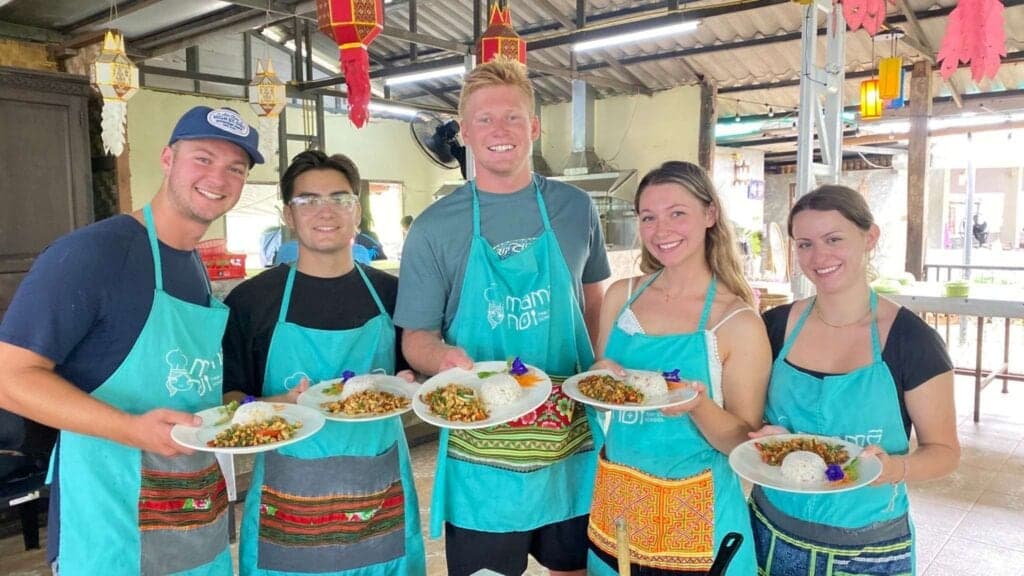
A Thai cooking class without a market visit is a kitchen tutorial, not a cooking class. The 90 minutes spent at a wet market (kaffir lime, galangal, fish sauce grades, palm sugar in three forms) is where students learn to actually re-create the food at home — and where you discover Chiang Mai cooks are stricter about ingredient quality than most home chefs. This guide ranks the Chiang Mai cooking schools that get the market visit right and flags the marketplace listings that skip it.
Disclosure: We publish chiangmaigotours.com and we sell cooking-class tours. We've reviewed Viator's and GetYourGuide's public listings for Chiang Mai cooking classes as of 2026-02-26. We don't pay competitors for placement. The market-visit observations below come from us shadowing classes at each school.
What does the market visit actually teach?
Ingredient identification, sourcing logic, and northern Thai food culture — none of which fits into the kitchen portion of the class.
A typical market segment runs 75-90 minutes at one of three markets (Muang Mai for the pro-chef version, Tanin for the family-friendly version, Somphet for the closest-to-old-city option). The instructor walks students through:
- The four key flavour-makers. Fish sauce (and the difference between ฿80 and ฿250 bottles), palm sugar (block, paste, liquid), tamarind paste (fresh, dried, sour-sweet variants), and shrimp paste (kapi).
- Three basils. Thai basil (hoo-ra-pa), holy basil (gra-prao), and lemon basil (manglak). The recipe difference matters more than westerners expect.
- Curry-paste base ingredients. Galangal, lemongrass, kaffir lime leaves, kaffir lime peel, makrut lime, white pepper, dried chili (small and large), turmeric root, garlic, shallot.
- Northern Thai specialty produce. Bamboo shoot varieties, hill-tribe greens, edible flowers, Lanna sausage casings.
- Protein logic. Why pork is the default for northern Thai cooking, what kind of fish goes in fish-cake (pla rai), where laab meat comes from.
Without the market segment, students get the dishes but not the framework. Two months later at home they can't substitute or scale — they're stuck following the recipe card.
| Component | With market | Without market |
|---|---|---|
| Ingredient identification | Yes — see and smell each one | No — pre-bagged trays |
| Sourcing knowledge | Yes — which vendor, what grade | No |
| Cultural context | Yes — vendor stories, food history | Partial — only in kitchen |
| Substitution skills | Strong — alternative ingredients shown | Weak |
| Take-home recipes confidence | High | Medium-low |
Which Chiang Mai cooking schools include a real market visit?
Six schools consistently include a working wet market in their full-day class: Thai Farm Cooking School, Asia Scenic Cooking School, Mama Noi's Thai Cookery School, Smart Cook, Baan Hongnual, and Sammy's Organic Thai Cooking.
These six all do a 60-90 minute market segment with the instructor narrating, then drive students to the cooking-school garden or kitchen for the cooking portion. They're not all equal — Thai Farm has the biggest farm, Mama Noi's the most charismatic instructor, Sammy's the strongest northern Thai focus. For a market-then-kitchen class with a working wet-market segment, our Siam Garden cooking class follows the same format, and you can compare the full lineup on our Chiang Mai food tours page.
The schools that skip the market and ship pre-chopped trays to a city-centre kitchen tend to advertise as "express" or "half-day" classes. They're not bad — they're just a different product.
What's the difference between the market-visit schools?
Thai Farm is the longest-running and has the biggest garden. Mama Noi's is the most fun. Asia Scenic is the most polished. Sammy's leans hardest into northern Thai (sai oua, khao soi, nam prik num). Baan Hongnual and Smart Cook are quieter operators with smaller class sizes.
| School | Market | Class size | Specialty | Best for |
|---|---|---|---|---|
| Thai Farm Cooking School | Muang Mai | 8-10 | Garden-to-table | Travellers who want farm setting |
| Asia Scenic Cooking School | Somphet | 6-8 | Curry pastes | Old-city walkable |
| Mama Noi's Thai Cookery | Tanin | 6-8 | Personality, depth | Solo travellers |
| Smart Cook Thai Cookery | Somphet | 4-6 | Small group, technique | Couples wanting attention |
| Sammy's Organic Thai Cooking | Muang Mai | 8-10 | Northern Thai dishes | Foodies |
| Baan Hongnual | Tanin | 4-6 | Quiet, ingredient-focused | Returning travellers |
What do the marketplaces leave out?
Many Viator and GetYourGuide listings advertise a "market visit" that is actually a 15-minute photo stop at Somphet market on the way to the kitchen, with no instruction, no purchasing, and no narrative.
We've shadowed eight such listings. The pattern: tour van pulls up, group walks one lap of Somphet, instructor points at five things in three minutes, everyone gets back in the van. The full 90-minute version doesn't happen because the operators are running 14-20 students per session and can't manage that many people through a working market.
The price difference is small (฿200-400) but the experience difference is meaningful. If you're booking on Viator or GetYourGuide, look at the actual itinerary on the listing — if "market" gets less than 60 minutes, it's a token stop.
What's the right class size?
4-6 students per instructor with a one-wok-per-student setup is the gold standard. 8-10 with shared woks works if the school splits across two instructors. Anything above 12 stops being hands-on.
We use the Market-to-Wok rule internally: from market arrival to first wok-flame should be one instructor per six students or fewer. If the ratio is worse than that, the market visit becomes a herding exercise (students bunch around the instructor, miss most of the narration) and the cooking becomes a demo (instructor cooks one wok while students watch).
Ask before booking. Reputable schools answer cleanly. Big-volume schools dodge with "small group" without committing to a number.
How long should the cooking portion be?
Four to five hours, cooking five dishes (one curry, one stir-fry, one soup, one salad/dip, one dessert). Less than four hours and you're rushing; more than five and you're padding.
Each dish takes 30-45 minutes of student time — prep, cook, plate, taste. Five dishes × 40 minutes = 3.5 hours of pure cooking, plus 30 minutes of curry-paste pounding (a separate hands-on segment), plus 30-40 minutes for instructor demos at the start. That's the 4-5 hour band.
Schools that cram seven dishes into a full day usually drop the curry-paste-from-scratch segment in favour of a pre-made tray. That's the segment most students remember a year later — don't let them skip it.
What dishes does a typical class cover?
A balanced full-day class covers: one curry (red, green or massaman), one stir-fry (pad Thai, pad see ew, or holy basil chicken), one soup (tom yum or tom kha), one salad or dip (som tam, laab, or nam prik), and one dessert (mango sticky rice or coconut custard).
Northern Thai-focused classes substitute khao soi for the curry, sai oua sausage for the stir-fry, or hang lay (Burmese-influenced pork curry) for one of the dishes. Some classes let students choose between options at booking; others run a set menu.
Where do you eat what you've cooked?
At the school. The five-course meal you cooked is your lunch (or dinner, if it's an evening class). Most schools pace the cooking so each dish is eaten just after it's plated, while it's hottest.
Bring an appetite. You will cook five dishes and you will be expected to eat them. Pack-up boxes are usually provided for anything you can't finish (most schools have students unable to finish the curry course).
Evening classes are slightly cheaper (฿900-1,200) and run from 4-9pm. The market visit happens at a working evening market rather than the wholesale morning markets — different vibe, mostly the same content.
What about the recipe book?
Most schools include a printed recipe book covering all dishes plus 10-15 bonus recipes. The good ones (Thai Farm, Asia Scenic) print full-colour with ingredient photos. Cheaper schools photocopy.
The recipe book is the bridge between the class and home cooking. If your school's book doesn't include weights in grams (not just "1 cup garlic"), it's not built for export use. Check before booking.
For broader Chiang Mai food planning, see our best Chiang Mai cooking class deep-dive and northern Thai food guide. For marketplace alternatives, see our Viator alternatives guide.
For external reference, the Thai Restaurant Association maintains a cooking-school certification register worth checking before booking.
Book the Siam Garden Thai cooking classWet-market visit, hands-on kitchen, group and vegan optionsMore food and class reading:
- Best Chiang Mai cooking class — full school-by-school breakdown
- Northern Thai food guide — what to order on a Chiang Mai trip
Frequently asked questions
Why does the market visit matter on a Thai cooking class?
Two reasons. First, you learn what the ingredients actually look like — kaffir lime versus regular lime, galangal versus ginger, three different basils, fish sauce grades, palm sugar in three forms. Buying these at home is hard if you've never seen them outside a recipe. Second, the market is where the cooking class becomes a cultural class — your instructor explains which vendor's curry paste their grandmother used, why khao soi noodles come from Yunnan, and how seasonality shapes northern Thai cooking. Without the market the class becomes a hands-on recipe demo, which is a different (worse) experience.
Are vegetarian Thai cooking classes worth doing without the market?
Yes, if the kitchen has its own organic garden. A market for vegetarian cooking is less critical because the produce-heavy version of Thai cooking is more about preparation technique than ingredient sourcing. Several Chiang Mai cooking schools (Asia Scenic, Thai Farm Cooking School) run garden-to-table classes where the herb garden replaces the market. The trade-off is missing the cultural depth, but the cooking technique itself is fully covered. Pure recipe-trays-handed-to-you classes are still weak — you want the picking and washing step at minimum.
Is a half-day cooking class enough?
Half-day works for one specific dish (curry paste from scratch, then making one curry). It doesn't work as an introduction to Thai cooking because you can't cover both the market visit and 4-5 dishes in 4 hours. The standard full-day is 6-7 hours: market visit 90 minutes, cooking 4-5 hours, eating 30-45 minutes. Half-day classes skip either the market or the variety. We push first-time guests toward full-day and second-timers toward half-day specialised classes (one dish, deeper technique).
Are Chiang Mai cooking classes truly hands-on?
Mostly yes, but watch for the 4:1 ratio. Good schools have one instructor per 4 students and one wok station per student — every dish is cooked by the student under direct supervision. Schools that run 10 students per instructor or share wok stations end up demo-heavy, with students watching more than cooking. Ask the question before booking: 'How many students per instructor and per wok station?' Reputable schools answer it cleanly. Schools that dodge typically run larger groups.
Can vegetarians or vegans do a Thai cooking class?
Yes — almost every Chiang Mai cooking school can accommodate vegan and vegetarian. Most run dedicated veg classes weekly because the demand is high. The substitutions are straightforward: shrimp paste swaps to fermented soybean paste, fish sauce swaps to soy sauce (Healthy Boy is the standard), oyster sauce to mushroom-based vegan oyster. Mention the diet at booking, not on arrival. Vegan-specific schools like Pure Thai Cookery focus exclusively on plant-based Thai cooking and run deeper into the cuisine than 'we can also accommodate vegan' offerings.
How much should a Chiang Mai cooking class cost?
Group full-day with market visit: ฿1,000-1,400 per person. Half-day: ฿700-1,000. Private one-on-one full-day: ฿2,500-3,500. Marketplaces (Viator, GetYourGuide) typically add 20-25% on top. The ฿1,000-1,400 band is the sweet spot — anything below ฿900 is usually a tray-style class with weak instruction, anything above ฿1,500 charges premium for accommodation pickup or specific dietary specialism. Most schools include a recipe book to take home.
Frequently asked questions
Why does the market visit matter on a Thai cooking class?
Two reasons. First, you learn what the ingredients actually look like — kaffir lime versus regular lime, galangal versus ginger, three different basils, fish sauce grades, palm sugar in three forms. Buying these at home is hard if you've never seen them outside a recipe. Second, the market is where the cooking class becomes a cultural class — your instructor explains which vendor's curry paste their grandmother used, why khao soi noodles come from Yunnan, and how seasonality shapes northern Thai cooking. Without the market the class becomes a hands-on recipe demo, which is a different (worse) experience.
Are vegetarian Thai cooking classes worth doing without the market?
Yes, if the kitchen has its own organic garden. A market for vegetarian cooking is less critical because the produce-heavy version of Thai cooking is more about preparation technique than ingredient sourcing. Several Chiang Mai cooking schools (Asia Scenic, Thai Farm Cooking School) run garden-to-table classes where the herb garden replaces the market. The trade-off is missing the cultural depth, but the cooking technique itself is fully covered. Pure recipe-trays-handed-to-you classes are still weak — you want the picking and washing step at minimum.
Is a half-day cooking class enough?
Half-day works for one specific dish (curry paste from scratch, then making one curry). It doesn't work as an introduction to Thai cooking because you can't cover both the market visit and 4-5 dishes in 4 hours. The standard full-day is 6-7 hours: market visit 90 minutes, cooking 4-5 hours, eating 30-45 minutes. Half-day classes skip either the market or the variety. We push first-time guests toward full-day and second-timers toward half-day specialised classes (one dish, deeper technique).
Are Chiang Mai cooking classes truly hands-on?
Mostly yes, but watch for the 4:1 ratio. Good schools have one instructor per 4 students and one wok station per student — every dish is cooked by the student under direct supervision. Schools that run 10 students per instructor or share wok stations end up demo-heavy, with students watching more than cooking. Ask the question before booking: 'How many students per instructor and per wok station?' Reputable schools answer it cleanly. Schools that dodge typically run larger groups.
Can vegetarians or vegans do a Thai cooking class?
Yes — almost every Chiang Mai cooking school can accommodate vegan and vegetarian. Most run dedicated veg classes weekly because the demand is high. The substitutions are straightforward: shrimp paste swaps to fermented soybean paste, fish sauce swaps to soy sauce (Healthy Boy is the standard), oyster sauce to mushroom-based vegan oyster. Mention the diet at booking, not on arrival. Vegan-specific schools like Pure Thai Cookery focus exclusively on plant-based Thai cooking and run deeper into the cuisine than 'we can also accommodate vegan' offerings.
How much should a Chiang Mai cooking class cost?
Group full-day with market visit: ฿1,000-1,400 per person. Half-day: ฿700-1,000. Private one-on-one full-day: ฿2,500-3,500. Marketplaces (Viator, GetYourGuide) typically add 20-25% on top. The ฿1,000-1,400 band is the sweet spot — anything below ฿900 is usually a tray-style class with weak instruction, anything above ฿1,500 charges premium for accommodation pickup or specific dietary specialism. Most schools include a recipe book to take home.