Sai oua is the lemongrass-and-galangal grilled pork sausage that defines Lanna cooking. Eat it at Warorot market or a Sunday Walking Street grill stall, pair it with sticky rice and nam prik num, and skip the supermarket vacuum packs. It's the single dish that distinguishes Chiang Mai's regional cuisine from the rest of Thailand, and a ฿100 coil at a market grill is one of the best food experiences in the city.
What is sai oua and why does it taste different from other Thai sausages?
Sai oua is a coil of ground pork seasoned with red curry paste, lemongrass, galangal, makrut lime leaves and garlic, grilled over charcoal. The aromatics — not the chilli — set it apart.
The name means "stuffed intestine" in Northern Thai (Kam Mueang), but the dish has nothing in common with Bangkok-style Isaan sausages. Where Isaan sai krok uses fermentation and a tart profile, sai oua is fresh and herbaceous. Done right, it smells of grilled lemongrass before you taste it. Done wrong (mass-produced, artificially coloured) it's just pork with red dye.
Where should I go to taste the best version?
Warorot market (Kad Luang) for the canonical Chiang Mai version. Sunday Walking Street for grab-and-go. Talat Pa Khwang for the Mae Hong Son style.
Warorot — Chiang Mai's biggest day market — has had sai oua stalls running since the 1970s. The most-recommended vendors are clustered along the western edge of the market off Praisanee Road. Damnoen Sai Oua and Sai Oua Lampang are two names that come up year after year. Both grill fresh coils on charcoal from 06:00; by noon the queue can be 15-deep.
The Sunday Walking Street (Ratchadamnoen, 16:00–22:00 every Sunday during high season) hosts 4–5 grill stalls that sell sai oua by the slice in cardboard trays with sticky rice. Less authentic than the daytime markets but better-timed for travellers on a temple-day schedule.
For the Mae Hong Son turmeric-led version, take a ride to Talat Pa Khwang — a more local market in the northwest of the city. Jay Sangda's stall is the pick. Quieter, less touristy, and a useful counterpoint to the Chiang Mai red-chilli style.
What do I eat with sai oua and how do I order?
Sticky rice, nam prik num (green chilli relish), raw cabbage and cucumber. Order 'sai oua khao niao' at any stall for the classic ฿80–฿120 combo plate.
The standard plate is three or four slices of sai oua, a fist-sized ball of khao niao (sticky rice) in a small bamboo basket or banana-leaf wrap, a spoonful of nam prik num, and a few raw vegetables — usually cabbage leaves, cucumber, and Thai eggplant. You eat with your hands: pinch a marble of rice, pick up a slice of sausage, dip both into the relish, chase with cucumber. No fork required.
Vegetarian travellers: there's no real vegetarian sai oua. The dish is fundamentally a pork product. The closest equivalent in Northern Thai food is yam khanom jeen — herb-and-rice-noodle salad with the same aromatics minus the pork.
How do I tell good sai oua from bad?
| Sign | Good sai oua | Mass-produced version |
|---|---|---|
| Colour | Brick-red or burnt orange, uneven | Bright neon-red, uniform |
| Smell | Lemongrass and grilled char | Pork-only or smoky-bacon |
| Texture | Coarse-ground, visible aromatics | Smooth paste, no visible herbs |
| Where sold | Market grill, coil-on-grill | Vacuum-packed, refrigerated shelf |
| Price | ฿80–฿150 per 250g coil | ฿60–฿80 per 250g vacuum pack |
| Casing | Hog casing, slight snap | Cellulose or no casing |
The fastest test: lean in and smell. A real coil smells of lemongrass and grill smoke before pork. A factory version smells of pork and smoke flavouring. Trust your nose.
Is sai oua only a Chiang Mai thing, and where did it come from?
Versions exist across northern Thailand and into Shan State, but the dish is strongest in Chiang Mai. It arrived via Shan and Burmese trade routes; the closest cousin outside Thailand is the Shan kyay-zah.
You'll find sai oua in Lampang, Lamphun and Chiang Rai. Bangkok versions are sweeter and less aromatic. Lanna had stronger cultural ties to Shan State than to Bangkok until the 20th century — turmeric, thua nao (fermented soy beans), and gaeng hang lay all share this lineage. See the Lonely Planet Northern Thai primer (accessed 2026-03-01).
Can I learn to make sai oua at a cooking class?
Yes — Lanna-focused full-day classes at Lanna Cooking School and Thai Akha Kitchen teach the technique. ฿1,200–฿1,800 per person.
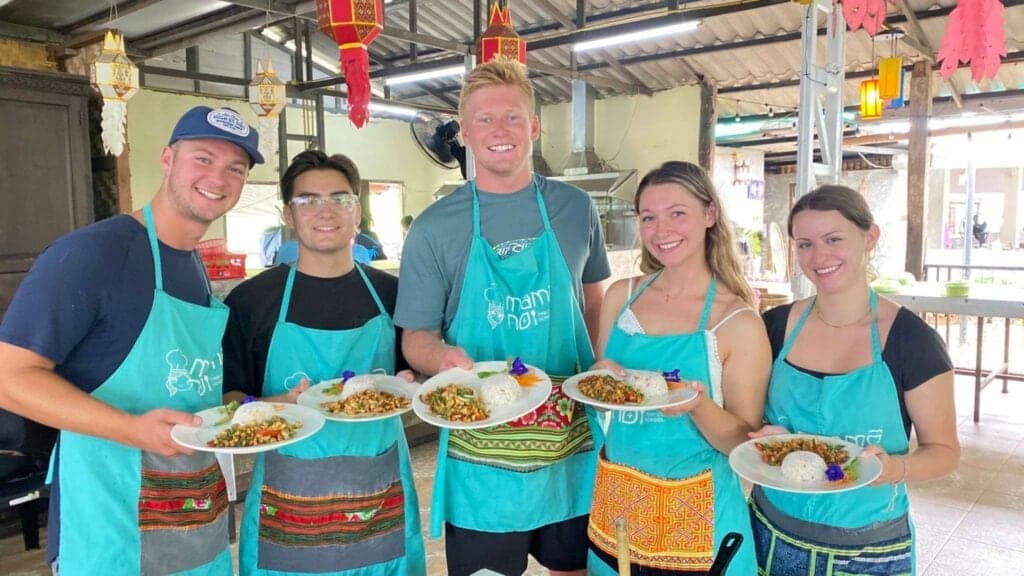
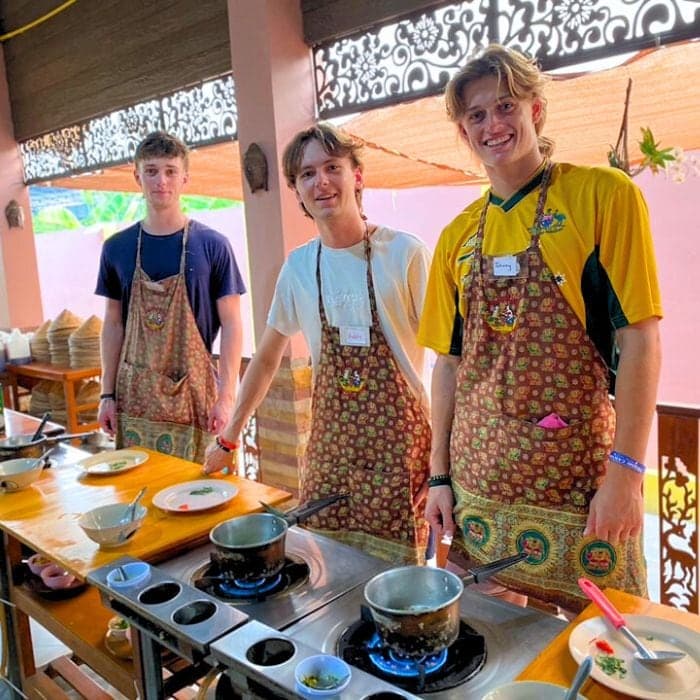
You'll pound curry paste from raw aromatics, mix it through ground pork, stuff hog casing, coil and grill over charcoal. The home version won't match the Warorot stalls (they have decades of practice and proprietary paste) but it's the closest you'll get without spending a year here. Our Thai cooking class at Siam Garden starts with a market walk to choose aromatics, and the class at Mamanoi Thai Cookery School covers the same paste-pounding technique. Browse all our Chiang Mai food tours for the full list.
Book a Thai cooking class with a market walkPound your own curry paste, hotel pickup, small groupsRelated reading:
- Northern Thai food guide: the dishes that define Lanna cooking
- Chiang Mai street food guide: where to eat at each market
- Best time to visit Chiang Mai (and Warorot market hours)
- Chiang Mai complete travel guide 2026
Frequently asked questions
Why is sai oua often coloured red or orange?
The red-orange tint comes from dried red chillies blitzed into the curry paste, plus turmeric. It's not food colouring (in real versions) — the colour is the spice. A pale-yellow sai oua usually means more turmeric than chilli, which is the Mae Hong Son style. A deep brick-red one means a chilli-forward Chiang Mai recipe. Both are correct. The bright, almost neon red you see in some supermarkets is artificial colouring and a sign the sausage is mass-produced rather than from a market grill — avoid those if you can.
Where's the best vendor in Chiang Mai for sai oua?
Tough question — the answer depends on which style you want. For the classic chilli-forward Chiang Mai version, the stalls inside Warorot (Kad Luang) market on Praisanee Road sell coiled fresh and grilled sausages from 06:00 daily; Damnoen Sai Oua and Sai Oua Lampang are two famous ones. For a Mae Hong Son turmeric-led version, Jay Sangda's stall at Talat Pa Khwang is the pick. For the easiest grab-and-go, the Tha Phae Gate Sunday Walking Street has 4–5 grill stalls. Most cost ฿80–฿150 per 250g coil.
Can I take sai oua on a plane home?
Technically yes within Thailand. Internationally, almost certainly no. Sai oua is a fresh, cooked pork product. Most countries (US, UK, EU, Australia, Japan) ban personal-import of fresh meat, even cooked. The vacuum-packed versions sold at the airport are usually confiscated at the destination customs desk, even when sealed. The honest answer is: eat it in Thailand. The shelf-stable versions sold in Thai grocery stores under Doi Kham and similar brands travel legally, but they're a pale imitation of the market grilled coil.
Where can I buy sai oua as a souvenir or gift?
For domestic travel within Thailand, Warorot market vendors will vacuum-seal a coil for transport. It'll keep refrigerated for 3–4 days. For air travel home, your only legal option is shelf-stable supermarket versions (Doi Kham, Thai brands at Tops or Rimping), which are pasteurised and bear little resemblance to fresh-grilled. The best souvenir from a sai oua experience is the recipe and a Lanna curry paste — both fit in checked baggage and let you recreate the flavour at home.
What do I eat sai oua with?
Sticky rice (khao niao), nam prik num (roasted green chilli relish), and raw vegetables like cabbage, cucumber and Thai eggplant. Never with bread. The pairing is the same logic as Northern Thai cooking generally — sticky rice pinched off in your fingers, dipped into the relish, paired with a bite of sausage. Some stalls also serve sai oua with khao soi (the Chiang Mai noodle soup), where a few slices add depth to the broth. For a beginner's plate, ask any market stall for 'sai oua khao niao' and you'll get the classic combo for ฿80–฿120.
Is sai oua spicy?
Moderately, but it depends on the maker. The Chiang Mai version uses dried red chillies in the curry paste and runs at about a 4 out of 10 on the Thai spice scale — noticeable warmth, not overwhelming. The Mae Hong Son turmeric version is milder (2 out of 10). Both are flavoured by aromatics (lemongrass, galangal, makrut lime leaves, garlic, shallots) more than by heat. A first-timer will find the chilli forward but balanced. If you want a heat-reduced version, ask the stall for 'mai phet' (not spicy) — about half of vendors keep a mild batch.
Frequently asked questions
Why is sai oua often coloured red or orange?
The red-orange tint comes from dried red chillies blitzed into the curry paste, plus turmeric. It's not food colouring (in real versions) — the colour is the spice. A pale-yellow sai oua usually means more turmeric than chilli, which is the Mae Hong Son style. A deep brick-red one means a chilli-forward Chiang Mai recipe. Both are correct. The bright, almost neon red you see in some supermarkets is artificial colouring and a sign the sausage is mass-produced rather than from a market grill — avoid those if you can.
Where's the best vendor in Chiang Mai for sai oua?
Tough question — the answer depends on which style you want. For the classic chilli-forward Chiang Mai version, the stalls inside Warorot (Kad Luang) market on Praisanee Road sell coiled fresh and grilled sausages from 06:00 daily; Damnoen Sai Oua and Sai Oua Lampang are two famous ones. For a Mae Hong Son turmeric-led version, Jay Sangda's stall at Talat Pa Khwang is the pick. For the easiest grab-and-go, the Tha Phae Gate Sunday Walking Street has 4–5 grill stalls. Most cost ฿80–฿150 per 250g coil.
Can I take sai oua on a plane home?
Technically yes within Thailand. Internationally, almost certainly no. Sai oua is a fresh, cooked pork product. Most countries (US, UK, EU, Australia, Japan) ban personal-import of fresh meat, even cooked. The vacuum-packed versions sold at the airport are usually confiscated at the destination customs desk, even when sealed. The honest answer is: eat it in Thailand. The shelf-stable versions sold in Thai grocery stores under Doi Kham and similar brands travel legally, but they're a pale imitation of the market grilled coil.
Where can I buy sai oua as a souvenir or gift?
For domestic travel within Thailand, Warorot market vendors will vacuum-seal a coil for transport. It'll keep refrigerated for 3–4 days. For air travel home, your only legal option is shelf-stable supermarket versions (Doi Kham, Thai brands at Tops or Rimping), which are pasteurised and bear little resemblance to fresh-grilled. The best souvenir from a sai oua experience is the recipe and a Lanna curry paste — both fit in checked baggage and let you recreate the flavour at home.
What do I eat sai oua with?
Sticky rice (khao niao), nam prik num (roasted green chilli relish), and raw vegetables like cabbage, cucumber and Thai eggplant. Never with bread. The pairing is the same logic as Northern Thai cooking generally — sticky rice pinched off in your fingers, dipped into the relish, paired with a bite of sausage. Some stalls also serve sai oua with khao soi (the Chiang Mai noodle soup), where a few slices add depth to the broth. For a beginner's plate, ask any market stall for 'sai oua khao niao' and you'll get the classic combo for ฿80–฿120.
Is sai oua spicy?
Moderately, but it depends on the maker. The Chiang Mai version uses dried red chillies in the curry paste and runs at about a 4 out of 10 on the Thai spice scale — noticeable warmth, not overwhelming. The Mae Hong Son turmeric version is milder (2 out of 10). Both are flavoured by aromatics (lemongrass, galangal, makrut lime leaves, garlic, shallots) more than by heat. A first-timer will find the chilli forward but balanced. If you want a heat-reduced version, ask the stall for 'mai phet' (not spicy) — about half of vendors keep a mild batch.