A Doi Inthanon day trip covers Thailand's highest peak (2,565m), the twin pagodas built for the King and Queen's 60th birthdays, two waterfalls, a Karen coffee village, and 100km of mountain driving — best run as a single 10-hour day in November, December or January. It's the easiest national-park day trip from Chiang Mai, but most operator itineraries skip the most worthwhile stop (the Ang Ka boardwalk) and pad with photo-op villages. Here's what a good day looks like.
Disclosure: We publish chiangmaigotours.com and we run Doi Inthanon day trips. We've reviewed Viator's public listing pages and pricing for the same itinerary as of 2026-01-02. We don't pay competitors for placement and we did not consult them before writing this.
What's actually on Doi Inthanon worth seeing?
Five stops carry the day: the summit boardwalk, the twin pagodas, Wachirathan Falls, Mae Klang Luang village for lunch, and either Mae Ya or Siriphum Falls depending on month.
Doi Inthanon is a 482-square-kilometre national park southwest of Chiang Mai. Most of it is closed to visitors — the bits worth seeing cluster along the single paved road climbing from the park gate to the summit. The "tourist road" effectively covers eight stops, of which five are worth your time and three are skippable photo stops.
| Stop | Worth it? | Time needed | Notes |
|---|---|---|---|
| Summit (Ang Ka boardwalk) | Yes | 30-40 min | Cloud forest, the actual reason to come |
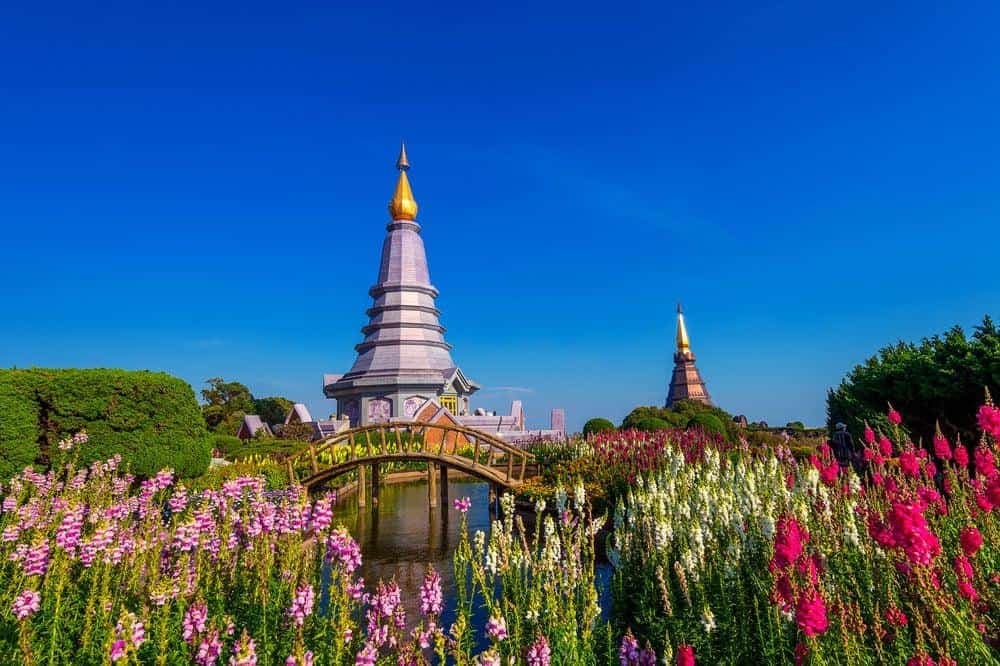
| Twin Pagodas (Phra Maha Dhats) | Yes | 45-60 min | Gardens at peak Nov-Feb |
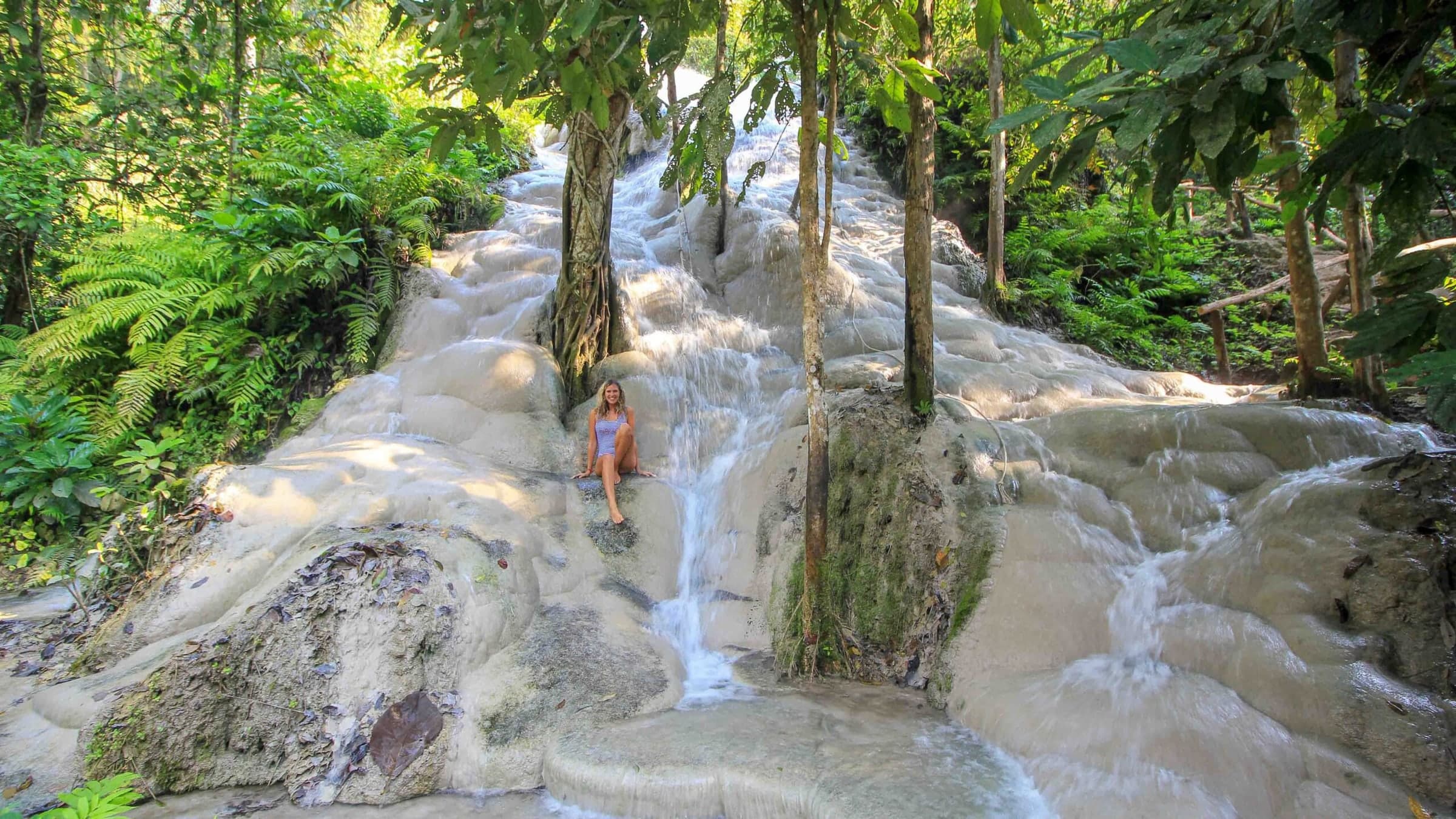
| Wachirathan Falls | Yes | 25-30 min | Year-round strong flow |
| Mae Klang Luang village + lunch | Yes | 60-90 min | Karen coffee, royal project |
| Mae Ya Falls | Yes (Jul-Dec) | 60 min round trip | Tallest in the park, low flow Mar-May |
| Mae Klang Falls (entry road) | Skip if short on time | 15 min | Often skipped to save time |
| Royal Project research station | Skip unless plant-curious | 30 min | More garden than experience |
| Hill-tribe market (lower park) | Skip | 15 min | Souvenir-tier, not local |
When is the best month to do a Doi Inthanon day trip?
November through January. Clear air, cool temperatures at the summit (5-10C in the morning), and waterfalls still flowing from the wet season. December is the absolute peak — book transport early.
The summit microclimate is dramatic. While Chiang Mai sits at 25C in mid-December, Doi Inthanon's summit registers 5-8C overnight and 12-15C by midday. Frost forms on the boardwalk handrails in some weeks. Bring a jacket regardless of season — the temperature drop from city to summit is 10-15C year-round.
What's the right itinerary for a single day?
Leave Chiang Mai at 7-7:30am, hit the summit first while air is clearest, work downhill through the pagodas, lunch at Mae Klang Luang, and end at Wachirathan Falls before the 5pm light fades.
The standard mistake — driven by Google Maps and most marketplace itineraries — is to stop at every waterfall on the way up, then arrive at the summit by noon when clouds have closed in. Our operator's order is reversed: highest stops first, downhill toward food and waterfalls, with the last hour timed for golden-hour photos at Wachirathan. This is the order we run on our Doi Inthanon national park day trip.
A typical day:
- 7:00 — Pickup, Chiang Mai old city. Convoy heads south via Highway 108.
- 8:30 — Park gate, fee paid (฿300). Convoy continues to summit.
- 9:15 — Summit boardwalk. 35 minutes on Ang Ka Nature Trail.
- 10:15 — Twin pagodas (Phra Maha Dhats). 60 minutes including gardens.
- 12:00 — Mae Klang Luang for lunch. Karen-run guesthouse restaurant, 75 minutes.
- 13:30 — Royal coffee farm walk. 30 minutes optional.
- 14:30 — Wachirathan Falls. 30 minutes.
- 15:30 — Mae Ya Falls (Jul-Dec only) or second viewpoint (rest of year). 75 minutes.
- 17:30 — Back in Chiang Mai.
How much should a Doi Inthanon day trip cost?
Direct operator: ฿1,800-2,400 per person for a group tour, ฿4,500-6,500 for a private car-and-driver day. Viator and GetYourGuide list the same itineraries at ฿2,400-3,200 per person.
The price gap between direct and marketplace is 20-30%. For most multi-day Chiang Mai trips, the saving on a Doi Inthanon booking covers a second dinner.
What does the twin pagoda stop actually involve?
The Phra Maha Dhats are two stupa-shaped pagodas built for the King's 60th birthday (1987) and Queen's 60th birthday (1992), connected by formal terraced gardens with views over the Mae Wang valley.
The pagodas themselves take 15 minutes to circle. The gardens — which most visitors miss — are the actual draw. They peak in December and January when Royal Project gardeners plant out 30,000+ cool-climate flowers. The view east from the lower terrace looks down 1,000m onto the Mae Chaem valley with the Karen villages visible as dots in the rice paddies.
Wear sleeves and trousers (this is a religious site) and remove shoes inside the pagoda inner ring. Photography is allowed outside, restricted inside.
What about the hill-tribe village lunch stop?
Mae Klang Luang is the only stop we use. It's a Karen village inside the park boundary, certified Royal Project, and lunch is cooked at a family guesthouse run by villagers — not a staged photo-op.
The Karen here grow arabica for the Royal Project coffee program, and lunch is typically a set menu of northern Thai dishes — khao soi, sai oua (northern sausage), nam prik ong (tomato chili dip), sticky rice, and seasonal vegetables. Cost is built into our day-trip price; on a self-drive trip it's ฿250-350 per person.
You can buy coffee beans direct from the village shop — ฿250-380 per 250g. Better quality than most Chiang Mai cafe blends, and 100% of margin stays in the village.
How does the drive itself work?
Highway 108 south to Chom Thong (1.5 hours), then Highway 1009 climbing the mountain (45-60 minutes from gate to summit). Paved, signed, mostly two-lane. Slow in spots behind tour vans.
The road is in good condition but the upper switchbacks are tight. Motion-sickness is the most common complaint we get — sit in the front seat if you're prone, and pack ginger sweets or anti-nausea tablets. The descent in late afternoon is when most accidents happen on the road; tour drivers handle it daily but self-drive renters can over-brake on the cooler upper sections.
Weather changes fast. We've started days at 28C in Chiang Mai and arrived at the summit in fog at 11C. Phone signal disappears between the twin pagodas and the summit — download offline maps before leaving the gate.
What's the best photo strategy for one day?
Summit: macro shots of moss, lichen and orchids on the boardwalk handrails. Twin pagodas: wide-angle from the lower terrace looking east. Wachirathan: shoot from the upper viewpoint, not the spray-soaked lower deck.
If you only have time for one serious photo stop, make it the twin pagodas at noon-to-1pm — light is harshest then but the formal gardens demand front-light. The summit is best at 9-10am before cloud sets in. Wachirathan needs an ND filter for the long-exposure waterfall look most travel shooters want.
For trip planning around weather and crowds, see our best time to visit Chiang Mai breakdown. For pricing logic on private versus group tours, see Chiang Mai private tour cost.
Should I book private or join a group?
Group tour if you want introductions to other travellers and the lowest price. Private if you have kids, a tight schedule, or one specific photo goal — the private car can pause for as long as you want at each stop.
Groups run 6-12 people in a van with one guide. Private is car-and-driver, sometimes with a guide added. The cost difference is roughly 2-3x per person depending on group size. Family-of-four travellers usually find private competitive once you split four ways.
If you're a couple debating, the group tour is fine for a first visit. The private upgrade pays off if you're a serious photographer or you're returning for a second trip and want to skip the busy stops — see our private Doi Inthanon trekking and sightseeing tour. Walkers who want more time on the mountain can also look at the full-day Doi Inthanon and Kew Mae Pan trek.
For a fuller external reference on the park itself, the Department of National Parks Thailand official page covers official policies and current fee rates.
Book the Doi Inthanon national park day tripSummit first, twin pagodas, waterfalls, Mae Klang Luang lunch built inMore planning reads:
- Best time to visit Chiang Mai — month-by-month
- Chiang Mai private tour cost — what you actually pay
- Best Viator alternatives for Chiang Mai tours
Frequently asked questions
Is the Doi Inthanon summit worth the day trip?
Yes, with a caveat. The actual summit point (2,565m, Thailand's highest) is a wooden boardwalk through cloud forest with a small concrete marker. It's underwhelming as a single photo stop. The reason it's worth the trip is the boardwalk loop — the Ang Ka Nature Trail — through dripping moss, orchids and old-growth montane forest you don't see anywhere else in Thailand. Allow 30-40 minutes for the loop. Skip it only if it's raining hard. The view from the summit itself is fully forested, so don't expect a vista.
Are the Doi Inthanon waterfalls year-round?
Wachirathan Falls runs strong year-round. Mae Ya Falls (260m) is at full force from July to November and slows to a trickle by March. Mae Klang Falls is on the access road and runs reliably year-round. Siriphum Falls (above the twin pagodas) is small but flows year-round. If waterfalls are your priority, August through October gives you the maximum-volume version. November through January gives smaller falls but the clearest air for cloud-forest photography. April through May is the weakest waterfall month — don't expect the marketing-photo Mae Ya.
Is the hill-tribe village stop on a Doi Inthanon tour ethical?
Depends entirely on which village. Mae Klang Luang (a Karen village producing arabica coffee for the royal project) is genuinely community-run — visitors pay a small entry fee that goes to the village association, and you can buy coffee directly from growers. Some tour operators stop at staged photo-op villages where residents wear traditional dress for tips. Ask the operator the village name before booking. We only stop at Mae Klang Luang and Ban Mae Sa Mai. If an operator won't name the village, it's a red flag.
Half-day or full-day Doi Inthanon trip?
Full-day. Doi Inthanon is 60km from Chiang Mai with a slow mountain road, so even the fastest tour spends 3+ hours driving. A half-day version skips the summit boardwalk and one or two waterfalls — for the same petrol cost and most of the time investment. Full-day tours typically run 8am-6pm and cover the summit, twin pagodas, two waterfalls, lunch at Mae Klang Luang and the royal-project gardens. Half-day tours exist mostly on Viator and GetYourGuide because they're easier to sell — they're not better value.
Do I need a guide or can I do Doi Inthanon by rental car?
Self-drive works if you're confident on mountain roads and you're staying past sunset to handle the descent in daylight. The road is paved, signed in English, and not technically difficult, but it climbs 1,500m in a series of switchbacks and rental-car insurance often excludes the national park. A driver-only option (no guide) costs around ฿2,800-3,500 for the day. A full guided tour adds context — the trail names, the cloud-forest ecology, the royal-project history — that you'd otherwise miss. Self-drive is fine if you've researched in advance.
What's the entry fee for Doi Inthanon National Park?
฿300 per foreign adult, ฿150 per foreign child (3-14), ฿60 per Thai adult, ฿30 per Thai child. The fee is charged at the park gate and is separate from any tour cost. Vehicles are charged ฿30 extra (motorbike) or ฿50 (car). Tours typically include this in the per-person price. The fee covers all attractions inside the park boundary including the summit, both Phra Maha Dhats (twin pagodas), all waterfalls, and the nature trails. Keep your ticket — it's checked twice on the upper park road.
Frequently asked questions
Is the Doi Inthanon summit worth the day trip?
Yes, with a caveat. The actual summit point (2,565m, Thailand's highest) is a wooden boardwalk through cloud forest with a small concrete marker. It's underwhelming as a single photo stop. The reason it's worth the trip is the boardwalk loop — the Ang Ka Nature Trail — through dripping moss, orchids and old-growth montane forest you don't see anywhere else in Thailand. Allow 30-40 minutes for the loop. Skip it only if it's raining hard. The view from the summit itself is fully forested, so don't expect a vista.
Are the Doi Inthanon waterfalls year-round?
Wachirathan Falls runs strong year-round. Mae Ya Falls (260m) is at full force from July to November and slows to a trickle by March. Mae Klang Falls is on the access road and runs reliably year-round. Siriphum Falls (above the twin pagodas) is small but flows year-round. If waterfalls are your priority, August through October gives you the maximum-volume version. November through January gives smaller falls but the clearest air for cloud-forest photography. April through May is the weakest waterfall month — don't expect the marketing-photo Mae Ya.
Is the hill-tribe village stop on a Doi Inthanon tour ethical?
Depends entirely on which village. Mae Klang Luang (a Karen village producing arabica coffee for the royal project) is genuinely community-run — visitors pay a small entry fee that goes to the village association, and you can buy coffee directly from growers. Some tour operators stop at staged photo-op villages where residents wear traditional dress for tips. Ask the operator the village name before booking. We only stop at Mae Klang Luang and Ban Mae Sa Mai. If an operator won't name the village, it's a red flag.
Half-day or full-day Doi Inthanon trip?
Full-day. Doi Inthanon is 60km from Chiang Mai with a slow mountain road, so even the fastest tour spends 3+ hours driving. A half-day version skips the summit boardwalk and one or two waterfalls — for the same petrol cost and most of the time investment. Full-day tours typically run 8am-6pm and cover the summit, twin pagodas, two waterfalls, lunch at Mae Klang Luang and the royal-project gardens. Half-day tours exist mostly on Viator and GetYourGuide because they're easier to sell — they're not better value.
Do I need a guide or can I do Doi Inthanon by rental car?
Self-drive works if you're confident on mountain roads and you're staying past sunset to handle the descent in daylight. The road is paved, signed in English, and not technically difficult, but it climbs 1,500m in a series of switchbacks and rental-car insurance often excludes the national park. A driver-only option (no guide) costs around ฿2,800-3,500 for the day. A full guided tour adds context — the trail names, the cloud-forest ecology, the royal-project history — that you'd otherwise miss. Self-drive is fine if you've researched in advance.
What's the entry fee for Doi Inthanon National Park?
฿300 per foreign adult, ฿150 per foreign child (3-14), ฿60 per Thai adult, ฿30 per Thai child. The fee is charged at the park gate and is separate from any tour cost. Vehicles are charged ฿30 extra (motorbike) or ฿50 (car). Tours typically include this in the per-person price. The fee covers all attractions inside the park boundary including the summit, both Phra Maha Dhats (twin pagodas), all waterfalls, and the nature trails. Keep your ticket — it's checked twice on the upper park road.