Doi Suthep is the half-day temple visit. Doi Inthanon is the full-day national park with waterfalls, summit pagodas, and Thailand's highest point at 2,565m. Doi Inthanon wins on nature; Doi Suthep wins on convenience and culture. Most first-time Chiang Mai trips fit both — Suthep as a morning, Inthanon as a separate full day. Pick based on whether you want temple time or mountain time.
What's the actual difference between the two mountains?
Doi Suthep is a 1,676m peak forming Chiang Mai's western backdrop, famous for the gold temple two-thirds of the way up. Doi Inthanon is a 2,565m massif 90km southwest, a 482km² national park with waterfalls, summit pagodas, hill-tribe villages and Thailand's highest point.
The names get conflated because both have "Doi" (mountain in Thai) and both appear in every Chiang Mai itinerary, but they're solving completely different trip needs.
Doi Suthep is the iconic temple visit — Wat Phra That Doi Suthep sits at 1,073m up the mountain, founded in 1383, reached via a 309-step naga staircase or a tram. The drive from Old City is 25 minutes. You're back for lunch.
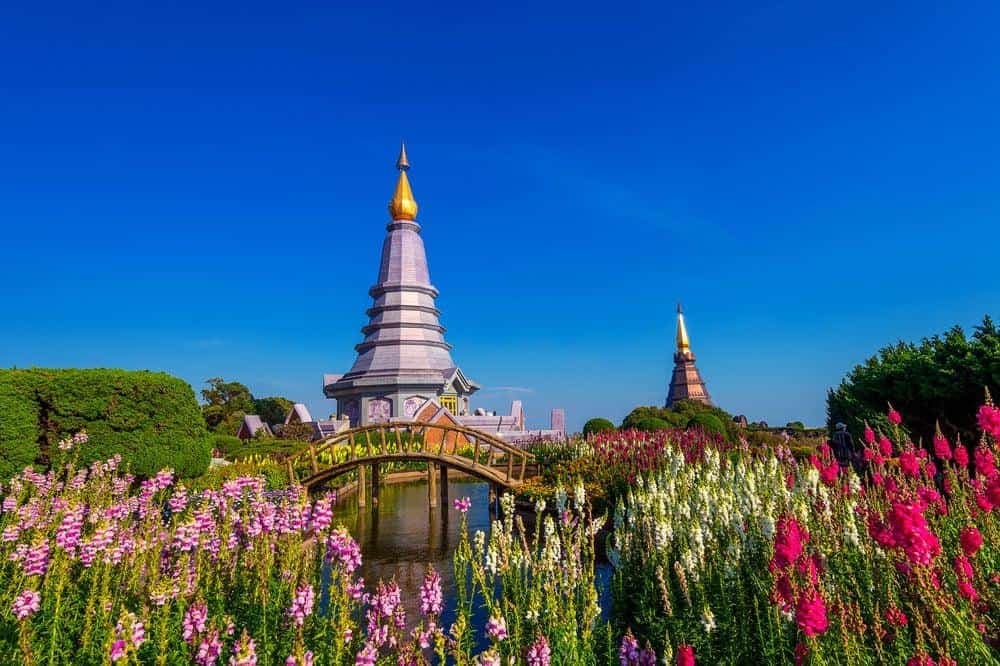
Doi Inthanon is a day inside a national park. The summit holds the King and Queen pagodas (Phra Mahathat Naphamethanidon and Naphaphonphumisiri) at 2,100m, with manicured gardens and panoramic walkways. Four major waterfalls. Hill-tribe markets at Hmong and Karen villages. A separate ecosystem — temperate cloud forest at altitude.
Which suits a first-time half-day visit?
Doi Suthep. It's 25 minutes from the Old City, takes 2–3 hours including the temple visit, and you're back for late lunch.
The standard half-day route: leave at 8am to beat the tour buses, drive up via Huay Kaew Road, climb the 309-step naga staircase (or skip via the tram for 50 baht), spend an hour at the temple, descend, optional 15-minute detour to Bhubing Palace if it's open. Back at your hotel by 11:30.
If you're tight on Chiang Mai time and want the temple-mountain experience without a full day, this is the visit. The view of the city from the temple terrace is the postcard shot most travellers take home. A guided half-day Doi Suthep temple and Hmong village tour handles the drive and the temple context if you'd rather not figure out the songthaew.
Which suits a full-day nature trip?
Doi Inthanon. The park's waterfalls, summit pagodas, and hill-tribe villages take a 9-hour day minimum. Trying to compress it under 7 hours wastes the trip.
A standard Inthanon route: 7:30am pickup from Old City, drive 90 minutes to the park entrance, first stop at Wachirathan waterfall (the photogenic one), then up to the summit pagodas and gardens (~2 hours including walks), lunch at the summit cafeteria, descend to Hmong market and a strawberry farm, optional Mae Ya waterfall on the way out, back at hotel 6–7pm. A day trip to Doi Inthanon National Park covers exactly this routing, or the Kew Mae Pan nature-trail trek if you want walking time on the summit ridge instead of a drive-by.
| Feature | Doi Suthep | Doi Inthanon |
|---|---|---|
| Driving time from Old City | 25 minutes | 90 minutes one-way |
| Time needed on site | 2–3 hours | 5–7 hours |
| Total day length | Half-day (morning) | Full day |
| Entry fee (foreigner) | 30 baht (temple) | 300 baht (park) |
| Best for | First-time temple visit, short trips | Nature, waterfalls, cold weather |
| Public transport | Red songthaew, frequent | Limited; hire transport |
Which has better waterfalls?
Doi Inthanon, by a long way. The park has four major waterfalls including Mae Ya (Thailand's tallest at ~280m) and the photogenic Wachirathan (~80m). Doi Suthep has none worth a trip.
The Inthanon waterfall hierarchy:
- Wachirathan (~80m) — the photogenic one. Wide curtain of water, viewing terraces close enough to feel spray, accessible by 5-minute paved walk from the parking lot. Best in November–February when flow is heavy.
- Mae Ya (~280m) — Thailand's tallest. A multi-tier cascade, viewable from a wooden platform after a 15-minute walk through forest. Quieter than Wachirathan because it's on a separate access road.
- Sirithan — smaller but elegant, single-drop, named after Queen Sirikit. Quick stop.
- Mae Klang — closest to the park entrance, family-friendly, multi-tier. Good for kids who want to wade.
If you're doing Inthanon for the waterfalls specifically, prioritise Wachirathan and Mae Ya. The drive between them is 30 minutes — your driver should know the routing.
What about altitude and weather?
Inthanon's summit sits at 2,565m with year-round temperatures of 8–15°C. Bring a jacket. Suthep's temple at 1,073m runs 18–26°C, comfortable in cotton.
For Doi Suthep, no special weather prep. Sandals fine, light layer in cool season (Nov–Feb) for the temple morning. Both mountains see afternoon rain showers in July–September; bring a light rain layer year-round.
What about cultural sites?
Doi Suthep wins on temple importance: Wat Phra That Doi Suthep is Chiang Mai's most sacred temple. Doi Inthanon wins on hill-tribe context: Hmong and Karen villages still operate at the mountain's lower slopes.
The Doi Suthep temple itself is the headline. Founded in 1383, houses a relic said to be from the Buddha's shoulder, hosts major Buddhist holidays with thousand-person processions up the naga staircase. The white elephant legend that sited the temple here is one of Lanna's foundation myths and gets retold on every guided visit.
On Doi Inthanon, the headline cultural stops are the summit pagodas (built 1987 and 1992 to honour the King and Queen), the Hmong market near the summit (handwoven textiles, strawberries, embroidered bags), and the Karen weaving villages on the lower western slopes. The hill-tribe stops are more interesting when guided — an unguided drive-by feels exploitative; a real visit involves the cooperative shops where weavers explain the work.
Which is better for kids?
Doi Suthep for under-6s (shorter, simpler). Doi Inthanon for 7+ (more variety, waterfalls, cold weather is a novelty).
The 309-step naga staircase at Doi Suthep is the only physical demand and it's optional (the tram bypasses it). Younger kids will need carrying for the last 100 steps. The temple itself has space to wander but the courtyard is small.
Doi Inthanon is more rewarding for older kids because there's variety — waterfall splashing at Mae Klang, gardens to run through at the summit, market snacks at the Hmong stop. The long drive (90 minutes each way) is the main constraint. Bring snacks, a tablet for the kids who need one, and accept that the day is 9 hours total.
Can you skip Doi Suthep entirely?
Honestly, yes — if you've already seen the major Old City temples and don't care about the view. Wat Phra Singh and Wat Chedi Luang inside the city walls cover Chiang Mai's temple highlights, and Suthep's main draw is the elevated view of the city.
This is the contrarian take but it holds. The Doi Suthep temple is beautiful but not architecturally unique — it's a Lanna chedi atop a steep hill. The view is the unique part. If you've got limited Chiang Mai time and you've already done Phra Singh and Chedi Luang, skipping Suthep and using the half-day for a cooking class or coffee tour is defensible.
If you've got a full week and want the full Chiang Mai card stamped, do Suthep.
What about doing both in the same trip?
Standard advice: Suthep as a morning, Inthanon on a separate full day. Don't try to combine in one day — Inthanon needs the full daylight window to do properly.
The classic 4-day Chiang Mai itinerary has Suthep on Day 1 (acclimatisation morning) and Inthanon on Day 3 (after the city has been seen). The 7-day itinerary has both with a rest day in between. Combining them in one day means leaving Suthep at 9am, getting to Inthanon by 11am, racing through three stops, and being back at the hotel at 8pm with nothing properly absorbed. Skip it.
What does each cost?
Suthep: 30 baht temple entry + ~150 baht round-trip songthaew. Total ~฿200 solo. Inthanon: 300 baht park entry + ~฿1,500–฿2,000 tour or ฿2,500 private driver. Total ~฿1,800–฿2,800.
The Inthanon park fee is a 300-baht foreigner entry (50 baht for Thai nationals). Kids under 14 get a discount. A private guided tour from Chiang Mai typically costs ฿1,400–฿2,000 per person depending on group size and includes the park fee, lunch, and waterfall stops. A private driver without a guide runs ฿2,500–฿3,000 for the day.
The bottom line
Doi Suthep is the half-day temple postcard. Doi Inthanon is the full-day national park experience with waterfalls, summit pagodas, and Thailand's highest point. Most Chiang Mai trips fit both as separate days. If you can only do one, pick Suthep if you want culture-and-view in a morning, Inthanon if you want nature-and-altitude across a full day.
Book the Doi Inthanon full-day park tripWaterfalls, summit pagodas, hill-tribe market, hotel pickupFurther reading:
Outbound references:
- Department of National Parks, Thailand — Doi Inthanon
- Wikipedia — Doi Inthanon (geographic data)
- Wikipedia — Wat Phra That Doi Suthep
Frequently asked questions
Which mountain is higher — Doi Inthanon or Doi Suthep?
Doi Inthanon is dramatically higher at 2,565 metres — the highest point in Thailand. Doi Suthep tops out at 1,676 metres at the peak of the mountain, though the famous Wat Phra That Doi Suthep temple sits at 1,073 metres. The altitude difference matters in two ways: temperature (Inthanon's summit averages 8–15°C all year, Suthep 18–26°C) and views (Inthanon clears the cloud layer most mornings; Suthep often sits inside it). If you want cold weather and big sky, Inthanon. If you want a temple visit, Suthep.
Which has the better waterfalls?
Doi Inthanon, by a wide margin. The park contains Wachirathan (~80m, the photogenic one), Mae Ya (~280m, the tallest in Thailand), Sirithan, and Mae Klang. All are accessible by paved road or short hike. Doi Suthep has no major waterfalls inside the mountain itself — Huay Kaew waterfall sits at the base near Chiang Mai University but isn't really a mountain feature. For waterfall day-trips specifically, Inthanon isn't a question. Pair Wachirathan and Mae Ya in one stop if your driver knows the route.
Can you do both in one trip?
Yes, easily. Most first-time Chiang Mai visitors do Doi Suthep as a half-day morning trip (it's 25 minutes from the Old City) and Doi Inthanon as a full-day excursion on a separate day. They're geographically different — Suthep is the immediate backdrop to the city, Inthanon is 90 minutes southwest. Trying to combine them in one day is technically possible but wastes Inthanon — the round trip alone eats 4 hours, leaving you no time at Mae Ya or the summit pagodas. Treat them as two trips.
Which is harder to reach without a tour or car?
Doi Suthep is straightforward by red songthaew from Chang Phueak Gate (40–60 baht each way, every 20 minutes) or rented scooter. Doi Inthanon is harder — no scheduled public transport reaches the park interior. Options are: hire a private driver (~฿2,500 for the day), join a tour (฿1,400–฿2,000), rent a car and drive yourself, or take the Sunday minivan service from Chang Phueak market which runs once daily. For most visitors, a tour is the practical pick because the park is 92km of paved-but-winding road and the highlights are scattered.
Frequently asked questions
Which mountain is higher — Doi Inthanon or Doi Suthep?
Doi Inthanon is dramatically higher at 2,565 metres — the highest point in Thailand. Doi Suthep tops out at 1,676 metres at the peak of the mountain, though the famous Wat Phra That Doi Suthep temple sits at 1,073 metres. The altitude difference matters in two ways: temperature (Inthanon's summit averages 8–15°C all year, Suthep 18–26°C) and views (Inthanon clears the cloud layer most mornings; Suthep often sits inside it). If you want cold weather and big sky, Inthanon. If you want a temple visit, Suthep.
Which has the better waterfalls?
Doi Inthanon, by a wide margin. The park contains Wachirathan (~80m, the photogenic one), Mae Ya (~280m, the tallest in Thailand), Sirithan, and Mae Klang. All are accessible by paved road or short hike. Doi Suthep has no major waterfalls inside the mountain itself — Huay Kaew waterfall sits at the base near Chiang Mai University but isn't really a mountain feature. For waterfall day-trips specifically, Inthanon isn't a question. Pair Wachirathan and Mae Ya in one stop if your driver knows the route.
Can you do both in one trip?
Yes, easily. Most first-time Chiang Mai visitors do Doi Suthep as a half-day morning trip (it's 25 minutes from the Old City) and Doi Inthanon as a full-day excursion on a separate day. They're geographically different — Suthep is the immediate backdrop to the city, Inthanon is 90 minutes southwest. Trying to combine them in one day is technically possible but wastes Inthanon — the round trip alone eats 4 hours, leaving you no time at Mae Ya or the summit pagodas. Treat them as two trips.
Which is harder to reach without a tour or car?
Doi Suthep is straightforward by red songthaew from Chang Phueak Gate (40–60 baht each way, every 20 minutes) or rented scooter. Doi Inthanon is harder — no scheduled public transport reaches the park interior. Options are: hire a private driver (~฿2,500 for the day), join a tour (฿1,400–฿2,000), rent a car and drive yourself, or take the Sunday minivan service from Chang Phueak market which runs once daily. For most visitors, a tour is the practical pick because the park is 92km of paved-but-winding road and the highlights are scattered.