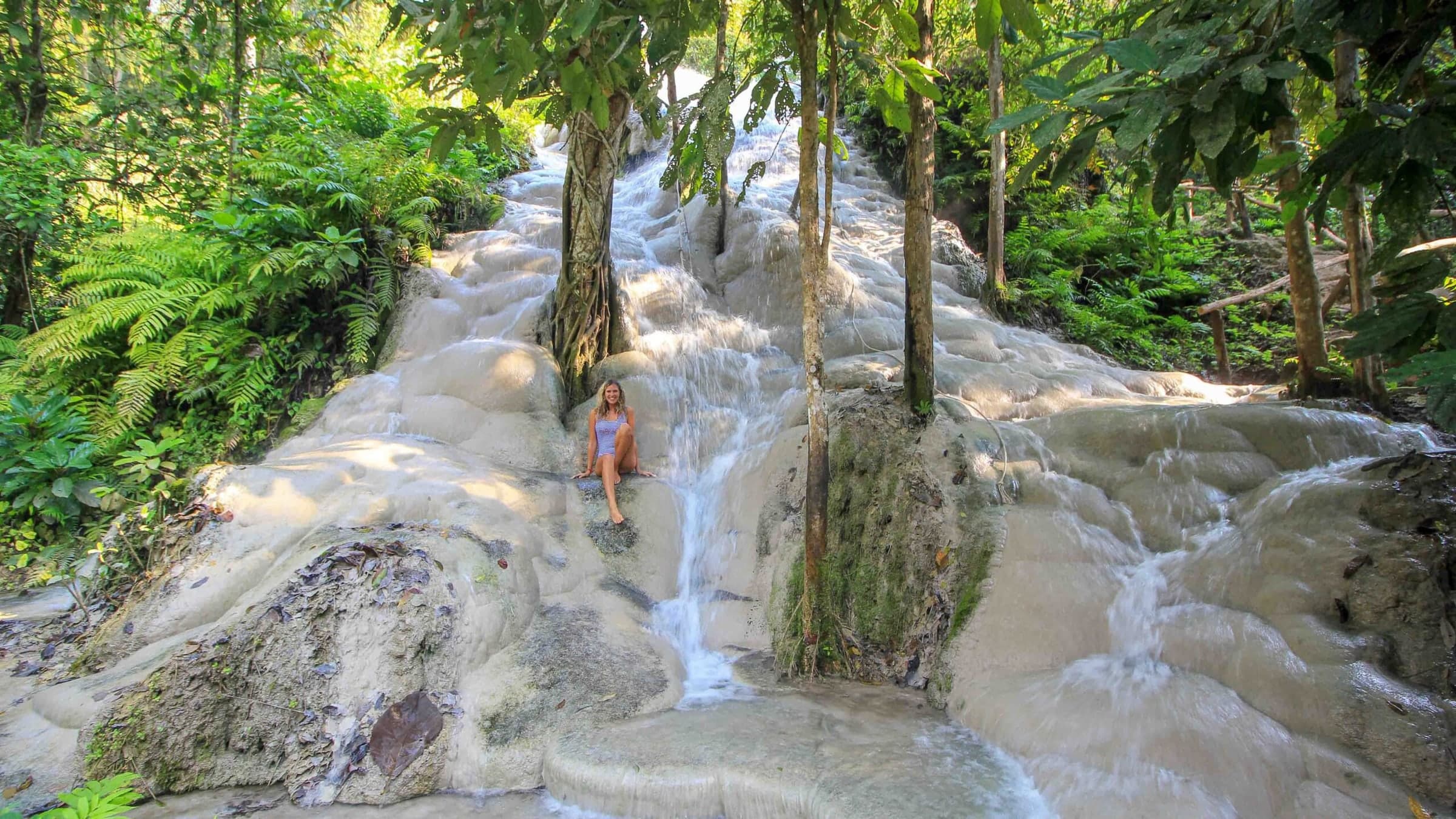
Bua Tong Sticky Waterfalls is a 100m limestone cascade 60km north of Chiang Mai where calcium-carbonate deposits coat the bedrock and create a grippy surface you can walk straight up barefoot under flowing water. It's free, runs year-round, and is the most physically engaging natural attraction within day-trip distance of the city. December to February is the sweet spot for water flow and weather.
Why can you actually walk up these waterfalls?
The bedrock is travertine — calcium-carbonate deposits left behind as the underground spring's mineral-rich water evaporates over thousands of years. The deposits are micro-pitted, algae-resistant, and provide remarkable grip even underwater.
The geology is unusual but not unique. Travertine cascades form anywhere calcium-rich groundwater hits open air and the dissolved minerals precipitate as the water cools and de-gases CO2. Pamukkale in Turkey and Plitvice in Croatia are the famous examples. Bua Tong is Thailand's main version — smaller, less photographed, but unique in being safe enough to climb.
The key property is algae resistance. Most waterfalls become death-trap slippery in tropical climates because algae colonises wet rock. Travertine's high pH and constant mineral deposition prevents that algae from establishing. The result: a rock surface that's grippier wet than most surfaces are dry.
The grip isn't infinite — wet flip-flops slip, water shoes with worn rubber slip, and any algae-coated patch slips. But on the main cascade with bare feet or fresh-rubber water shoes, the friction coefficient is roughly twice that of a typical wet limestone surface.
How do you actually get there from Chiang Mai?
Three options: guided day tour, private taxi, or rented motorbike. The route is 60km north via Highway 1001 and 1150 — 75-90 minutes each way.
| Transport option | Cost per person | Time | Best for |
|---|---|---|---|
| Guided day tour | ฿1,200-฿1,800 | 8am-4pm typically | Solo travellers, no-driving preference |
| Private taxi (split 2-4 people) | ฿450-฿1,250 | Flexible (you set the schedule) | Small group, half-day trip |
| Rental motorbike (250cc+) | ฿250-฿400 (bike rental) | Self-paced | Experienced riders only |
| Self-drive car rental | ฿800-฿1,400 (per day) | Self-paced | Families, multi-stop trips |
The guided tour is the easy default and usually pairs Sticky Falls with one or two other stops. Our Bua Thong Sticky Waterfall and cave exploration day adds a nearby cave and a Thai buffet lunch, and the Sticky Waterfall, rafting and elephant care combo builds the falls into a fuller adventure day. The downside of any guided circuit is the schedule — you're at the falls during peak crowds and you can't stay longer.
The private taxi option works well for two or three people: split four ways the per-person cost is similar to a tour but you control the schedule. Ask the driver to leave Chiang Mai by 7:30am and you'll have the falls largely empty before the tour buses arrive.
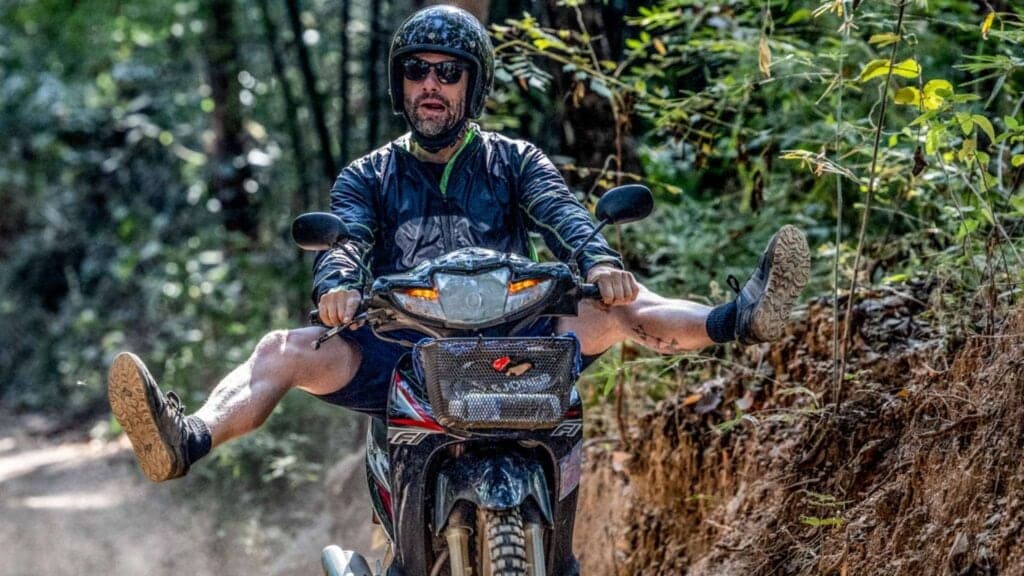
Self-drive on a motorbike is doable but the last 15km from Mae Taeng to the falls is winding two-lane mountain road. We don't recommend it for first-time Thailand riders, regardless of experience elsewhere.
When should you go?
December through February — peak water flow holds steady, daytime temperatures are 20-28°C, and the road is reliably dry.
The water source is an underground spring rather than seasonal rainfall, which means the falls run year-round even in March-April dry season. But the volume changes:
- November-February. Reliable steady flow from late-monsoon aquifer recharge. Best photo conditions. Pleasant temperatures.
- March-May. Lower flow as the aquifer drops. Hot (30-38°C) but the cascade is shaded. Best for swimming because the water is warmer.
- June-October. Rainy season. Flow is highest but the access road can flood briefly after heavy storms. Trails off the cascade are slippery with mud. Visit weather forecast before driving.
What's the actual climb like?
Three tiers, each 20-40m of climbable rock at angles from 20 to 40 degrees, separated by wading pools. The lowest tier is the easiest; each successive tier is steeper.
Starting from the parking area, a short paved path leads to the base pool. From there:
-
Lower tier. Gentle slope (20-25 degrees), ankle-to-knee-deep water, easy walking. Suitable for kids age 4+ with supervision. Reaches a deeper pool where most casual visitors stop.
-
Middle tier. Steeper (30 degrees), more vertical chunks, hand-and-foot climbing in places. Most adults manage without difficulty. The grip is most noticeable here — your feet stick to the wet rock in a way that feels almost cartoonish.
-
Upper tier. Steepest section (35-40 degrees in places), requires both hands and committing to the grip. Easier going up than coming down. There's a forest-path bypass at the top for descent.
The total climb takes 30-45 minutes if you're not rushing. Most visitors do up-and-down in 60-90 minutes including swimming pauses.
Are there safety concerns?
Three real risks: slipping on algae-coated patches, falling on the descent, and underestimating the upper tier. Take the descent path, watch for green patches, and don't bring loose-soled shoes.
The cascade is safer than its photos suggest, but it's still moving water on a slope. Real risk factors:
- Algae patches. Some shaded zones away from the main flow accumulate algae and lose the grip. They look greenish rather than the cream-grey of fresh travertine. Don't step on green patches.
- Loose footwear. Flip-flops, Tevas with worn rubber, and Crocs all slip. Bare feet or water shoes with fresh rubber soles work. Hiking boots with hard rubber sometimes slip too — the soft-rubber water-shoe is ideal.
- Descending the upper tier. Going down is harder than going up because you can't see your feet. The bypass forest-path is on the right side of the falls (facing uphill). Use it for descent if the upper tier feels sketchy.
- Children unsupervised. The risk isn't the rock, it's the splash pools. Hold hands of kids under 6 in the wading pools at the base.
What should you bring?
Quick-dry clothes you can swim in, a small dry bag for phone/wallet, water shoes or willingness to go barefoot, water, snacks, sunscreen, and a towel for the drive back.
The packing list is short because the park is basic. The on-site shop sells cold drinks, fruit, and basic Thai noodles, but not gear. Bring:
- Swim-appropriate clothes. Quick-dry shorts and t-shirt, or swimwear under casual cover. The water is cool but not cold (~22°C).
- Dry bag. A 5-10 litre dry bag with shoulder strap is enough. Phones and wallets stay dry; you carry it as you climb.
- Water shoes (optional). Cheap Decathlon-style water shoes (฿300-฿500 in Chiang Mai) give modest grip and protect against the occasional sharp edge. Bare feet are fine for most visitors.
- Towel and dry clothes. For the drive back. Skipping the towel is a 90-minute mistake.
- Water (2L per person) and snacks. The shop is basic and overpriced.
- Sunscreen. The cascade is partly shaded but the access path and top of falls are full sun.
Skip: regular sneakers (will get wet and stay wet), bulky bags (nowhere to leave them), and valuables you don't need.
What else is in the area worth combining?
Mae Kuang Reservoir and the Mae Taeng hot springs are both en-route options. We usually don't recommend combining all three — the falls deserve more time than tour-bus schedules give.
The standard tour-bus circuit combines Sticky Falls with one or two of: Mae Kuang Reservoir (a placid dam-lake about 25km south, fine for a boat ride), the Tat Mok mountain village (a Hmong cultural-tourism stop, fairly produced), or Mae Taeng hot springs (small, basic, often quite warm).
Our take: Sticky Falls plus a slow lunch at a local Thai-northern restaurant in Mae Taeng town is better than Sticky Falls plus two padded stops. The falls reward 2-3 hours on site. Hitting them for 45 minutes between tour-bus stops shortcuts the experience.
If you do want a multi-stop day, our Doi Inthanon day trip is on a different road but covers more dramatic mountain terrain. Pair Sticky Falls with Mae Kampong village instead if you want a culture stop on the same axis.
How does Sticky Falls compare to other Chiang Mai waterfalls?
Sticky Falls is unique for the climb — no other waterfall in the region lets you walk straight up. Mae Sa, Bua Thong's smaller siblings, and the Doi Inthanon waterfalls are all view-from-the-bottom-only.
The trade-off: Sticky is smaller in absolute scale. The visual drama is in the climb, not the drop. If you want a tall classical waterfall to photograph (~100m vertical drop), Wachirathan Falls in Doi Inthanon is your target. If you want the only walkable waterfall in northern Thailand, Sticky is unique.
For a one-day Chiang Mai outdoor experience, Sticky beats the more-photographed alternatives by being more participatory. You don't just look at it; you do it.
Book a guided Sticky Waterfalls day tripPickup from your hotel, local lunch included, small groups under 8Further reading worth your time:
- Doi Inthanon day trip from Chiang Mai
- Mae Kampong village: the slow Chiang Mai escape
- Best Viator alternatives for Chiang Mai day trips
External references: Sri Lanna National Park's official listing is on the Thai Department of National Parks portal, and Wikipedia's travertine geology article gives the geological background. Both accessed 2026-02-01.
Frequently asked questions
Is it really sticky?
Not sticky in the glue sense — grippy. The limestone bedrock under the falls is covered in calcium-carbonate (travertine) deposits left behind as the spring water evaporates. The micro-pitted texture of the deposits gives bare feet and rubber-soled shoes excellent traction even on a 30-40 degree slope under flowing water. Algae would normally make this surface treacherous; here the mineral coating keeps algae from forming. The grip is genuine and surprising the first time you try it. Loose-soled flip-flops still slip — bare feet are best.
Are the falls open year-round?
Yes, the park is open daily roughly 8am-5pm year-round at no entry fee. Water flow varies by season: November-February has reliable steady flow from late monsoon storage. March-May runs lower as the dry season progresses, though there's always some water from the underground spring. June-October is rain-season — flow is highest but trails are slippery off the falls and the access road can flood briefly. The best balance of flow and weather is December-February.
What's the best time of day to visit?
Arrive before 10am or after 2pm to avoid Thai tour-bus crowds. The main mid-day tour groups from Chiang Mai (the multi-stop 'Sticky Falls plus hot springs plus temple' minivan circuit) arrive between 11am and 1pm. If you leave Chiang Mai by 8am you'll have the falls largely to yourself for the first 90 minutes. Afternoon light is also better for photos — the falls face roughly southwest and the late-morning sun is harsh overhead. Plan two to three hours on site.
Can young children climb the falls?
Kids from roughly age 4 upward, supervised, can manage the lower cascade. The whole cascade is about 100m of climbable rock divided into three tiers — the lowest tier is gentlest and reaches a wading pool. The middle and upper tiers are steeper (30-40 degrees in places) and require both hands. Below age 4, the rock is too uneven and the slip risk too high. We don't recommend it as a toddler activity but families with grade-schoolers and up rate it as the best Chiang Mai day-trip we book. Bring water shoes for kids' grip and comfort.
How far is Sticky Waterfalls from Chiang Mai?
Bua Tong is in Sri Lanna National Park, about 60km north of Chiang Mai's Old City via the 1001 and 1150 roads. Driving time is 75-90 minutes each way depending on traffic out of the city. Without a car, the options are: a guided day tour (฿1,200-฿1,800 per person, includes pickup, lunch, sometimes a hot spring stop), a private taxi (฿1,800-฿2,500 round-trip for the whole car), or a rental motorbike (the route is doable but the last 15km is winding mountain road).
Do I need to bring anything special?
Quick-dry clothes you can swim in, a small dry bag for phone and wallet, water, snacks, and ideally water shoes — though bare feet work fine. There's a basic Thai noodle stall and a vendor selling fruit at the park entrance, but no full restaurant. Bring sunscreen (the cascade is mostly shaded but you'll be on the road and at the top in the sun). Park toilets are basic but functional. No locker storage — bring a buddy to watch bags while one person climbs, or use a dry bag and take everything with you.
Frequently asked questions
Is it really sticky?
Not sticky in the glue sense — grippy. The limestone bedrock under the falls is covered in calcium-carbonate (travertine) deposits left behind as the spring water evaporates. The micro-pitted texture of the deposits gives bare feet and rubber-soled shoes excellent traction even on a 30-40 degree slope under flowing water. Algae would normally make this surface treacherous; here the mineral coating keeps algae from forming. The grip is genuine and surprising the first time you try it. Loose-soled flip-flops still slip — bare feet are best.
Are the falls open year-round?
Yes, the park is open daily roughly 8am-5pm year-round at no entry fee. Water flow varies by season: November-February has reliable steady flow from late monsoon storage. March-May runs lower as the dry season progresses, though there's always some water from the underground spring. June-October is rain-season — flow is highest but trails are slippery off the falls and the access road can flood briefly. The best balance of flow and weather is December-February.
What's the best time of day to visit?
Arrive before 10am or after 2pm to avoid Thai tour-bus crowds. The main mid-day tour groups from Chiang Mai (the multi-stop 'Sticky Falls plus hot springs plus temple' minivan circuit) arrive between 11am and 1pm. If you leave Chiang Mai by 8am you'll have the falls largely to yourself for the first 90 minutes. Afternoon light is also better for photos — the falls face roughly southwest and the late-morning sun is harsh overhead. Plan two to three hours on site.
Can young children climb the falls?
Kids from roughly age 4 upward, supervised, can manage the lower cascade. The whole cascade is about 100m of climbable rock divided into three tiers — the lowest tier is gentlest and reaches a wading pool. The middle and upper tiers are steeper (30-40 degrees in places) and require both hands. Below age 4, the rock is too uneven and the slip risk too high. We don't recommend it as a toddler activity but families with grade-schoolers and up rate it as the best Chiang Mai day-trip we book. Bring water shoes for kids' grip and comfort.
How far is Sticky Waterfalls from Chiang Mai?
Bua Tong is in Sri Lanna National Park, about 60km north of Chiang Mai's Old City via the 1001 and 1150 roads. Driving time is 75-90 minutes each way depending on traffic out of the city. Without a car, the options are: a guided day tour (฿1,200-฿1,800 per person, includes pickup, lunch, sometimes a hot spring stop), a private taxi (฿1,800-฿2,500 round-trip for the whole car), or a rental motorbike (the route is doable but the last 15km is winding mountain road).
Do I need to bring anything special?
Quick-dry clothes you can swim in, a small dry bag for phone and wallet, water, snacks, and ideally water shoes — though bare feet work fine. There's a basic Thai noodle stall and a vendor selling fruit at the park entrance, but no full restaurant. Bring sunscreen (the cascade is mostly shaded but you'll be on the road and at the top in the sun). Park toilets are basic but functional. No locker storage — bring a buddy to watch bags while one person climbs, or use a dry bag and take everything with you.