Twelve Chiang Mai photography spots that consistently produce strong frames — Doi Suthep sunrise terrace, Wat Phra That Doi Kham at golden hour, the Iron Bridge over the Ping, the Wat Pha Lat forest temple, Wat Phan Tao at Yi Peng, the Royal Project tea fields, San Kamphaeng rice paddies, the moat at Tha Phae Gate, the Sticky Waterfalls at Bua Tong, Doi Inthanon's Twin Pagodas, Mae Kampong tea slopes, and the Three Kings Monument lantern lighting. This guide pairs each with the right time of day and what to bring.
What's the best Chiang Mai sunrise spot?
Doi Suthep summit terrace, west-facing platform, 5:30am setup time. The first light hits the gold chedi while the city below is still in shadow — there is no better single Chiang Mai sunrise frame.
Doi Suthep sits at 1,676 metres. The drive up takes about 35 minutes by car or songthaew from the Old City, longer from the Riverside. The temple terrace opens around 5am, the inner chapel later. The west-facing platform on the chedi side gives you the city panorama. The east-facing platform behind the chedi is where you photograph the chedi itself catching first light.
For travellers staying near the airport or Hang Dong, the south-facing terrace also works but the view is more residential than panoramic. The classic shot is from the west platform. If you would rather have a driver handle the pre-dawn ascent in the dark, our Doi Suthep temple and Hmong village tour covers both the summit terrace and the Doi Pui viewpoint.
What to bring: a tripod for the long exposure of the city in shadow, a 24-70mm zoom for both the wide panorama and the chedi close-up, an extra layer (the summit can be 8–12C at sunrise in December), and a small torch for the pre-dawn approach.
What's the best golden-hour temple in town?
Wat Phra That Doi Kham, west side of the city, late afternoon. The chedi catches gold light an hour before sunset and the elevated location avoids the moat-loop traffic noise of central temples.
Doi Kham is a 30-minute drive from the Old City, sitting on a low hill west of the Royal Project. The hilltop chedi receives direct west light from about 4:30pm onward in winter months. The Buddha statue at the entrance is huge, photogenic, and best shot from the north walkway to avoid the parking lot in your frame.
Doi Suthep also catches golden hour but the tourist density is higher at 5pm and the chedi orientation makes a clean golden-light shot harder. Doi Kham is the better photo-tour pick if you have already done Doi Suthep at sunrise.
What's the photographic argument for Wat Pha Lat?
Wat Pha Lat is the small forest temple halfway up the Doi Suthep road. Filtered jungle light, no tour bus parking, and the moss-covered stone Buddha figures along the creek are the most underrated photo location in Chiang Mai.
The Monk's Trail (Phra Sai Lat trail) is a 1.5 km walking path from the foot of Doi Suthep up to Wat Pha Lat. The trail itself is photogenic — saffron-cloth markers tied to trees by the monks. The total walk is 40–60 minutes, easy gradient, well-shaded. Wear footwear with grip. The trail is slippery in rainy season.
Inside the temple, the small creek section with mossy Buddhas is the highlight. Bring a tripod for the slow-shutter water shots. The chapel above is also worth a frame but the creek is what makes the trip.
What about the Iron Bridge and the Ping River?
Iron Bridge at blue hour (6:30pm in winter, 6:45pm in summer) — silhouette of the bridge against the orange-blue sky, with reflections in the Ping River. 30-second exposure, tripod required.
The Iron Bridge (Saphan Lek) is a working pedestrian-and-vehicle bridge connecting the Riverside to the East Bank. The structural ironwork is what makes the silhouette. The downstream side (south of the bridge) has the better composition because it captures the Wat Ket temple roofline as a backdrop.
Setup notes: the bridge is mildly trafficked even at blue hour, so plan vibration. The riverbank path beneath the bridge is dirt — wear shoes, not sandals. The Tha Phae Walking Street vendors set up just east of the bridge at this hour, so you can shoot blue-hour then walk straight to dinner.
What are the Yi Peng photography spots?
Wat Phan Tao courtyard for the lit-lantern decoration shot, Three Kings Monument for the mass-lighting ceremony, and the Ping River bank for the krathong-on-water shot. All three on the same central Yi Peng night.
For festival dates and the broader event guide, see our Yi Peng 2026 guide. Specifically for photography:
- Wat Phan Tao — the small teak-wooden temple between Wat Phra Singh and Wat Chedi Luang. During Yi Peng the courtyard is hung with hundreds of paper lanterns. Best shot from the west side of the courtyard around 7pm, when the lanterns are lit but the sky is still blue.
- Three Kings Monument — the central Old City statue. Best shot from the south side, with the lantern-lit statue silhouetted against the festival crowd.
- Ping River bank — the krathong release at the Iron Bridge. Slow shutter to catch the floating candles.
A monopod works better than a tripod for the crowded festival nights. The festival crowds are dense enough that setting up tripod legs becomes an obstacle.
What's the rice-paddy photography option?
San Kamphaeng rice paddies east of the city, late afternoon, June through August. Green rice growing tall, mountain backdrop, working farmer figures occasionally in frame. Drive 25 minutes east on Highway 1317.
The San Kamphaeng paddies sit either side of Highway 1317 between km 7 and km 12. The most accessible viewing point is the small lay-by near km 9, where a paved side road descends into the field area. Park, walk along the field edge, do not enter the field itself unless invited.
For longer-format rural landscape work, the Mae Wang valley west of the city offers larger paddy areas with the Doi Inthanon mountain ridge as a backdrop. Mae Wang adds another 30 minutes of drive each way.
What's worth photographing at Doi Inthanon?
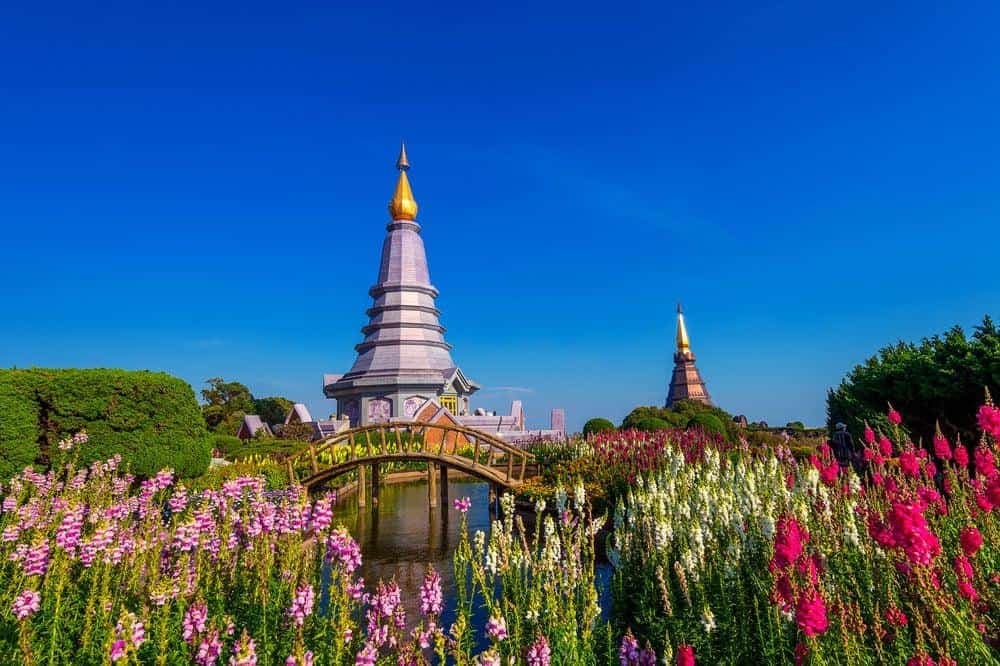
The Twin Pagodas (King and Queen Pagodas) at the summit. Mid-morning light is best because the summit clears its overnight cloud cover by 9–10am. Wide-angle for the architecture, telephoto for the manicured garden details.
Doi Inthanon is Thailand's highest peak at 2,565 metres. The Twin Pagodas sit just below the summit on a manicured platform with formal garden landscaping. The architecture is post-modern Thai, not traditional Lanna, and the photography that works best is wide-angle to capture the symmetry of the two pagodas and the surrounding gardens.
The summit itself is mostly cloud-forest and is photographically less interesting than the pagodas. The Mae Klang and Wachirathan waterfalls on the road up are both worth a stop — Wachirathan especially for the rainbow-in-spray shots that work in late morning.
For trip planning to Doi Inthanon, see our Doi Inthanon day trip guide, or let a guide handle the early summit timing on our Doi Inthanon national park day trip.
What's the deal with Mae Kampong tea-slope photography?
Mid-morning, July through October, looking down the tea slope from the village viewpoint. The mist that hangs in the valley until 10am gives the layered-ridges look that ranks well on Instagram.
Mae Kampong's tea slopes sit at about 1,250 metres on the slope below the village. The view from the village viewpoint platform faces east-southeast, which means morning light. The mist layer in monsoon months produces the layered-mountain effect that has made the spot Instagram-famous over the last 4–5 years.
The shot has been over-published. If you want something less saturated, the same village has a less-known western viewpoint accessed via a small footpath behind the homestay cluster. Same elevation, opposite direction, far fewer photographers competing for the angle.
For trip planning to Mae Kampong, see our Mae Kampong village guide.
What about the moat and the Old City walls?
Tha Phae Gate at 5pm with feeding pigeons and the moat in foreground. Chang Phueak Gate (north moat) at sunset for cleaner architecture without the tourist density. Suan Dok Gate (west moat) for the brick-wall close-ups.
The Old City moat is the most-photographed Chiang Mai subject by raw volume. The challenge is finding an angle that hasn't been over-published. Tha Phae Gate is the iconic shot. Chang Phueak Gate gives you the same brick wall and gate architecture without the crowd. Suan Dok Gate has the cleanest brick weathering for texture shots.
The moat itself is functionally a fortified ring, not a scenic waterway. Photographically it works as foreground for the gate-and-wall shots, less so as a subject in its own right.
Which spots are over-saturated and worth skipping?
The "blue temple" in Chiang Rai if you are short on time (separate city). The Wat Pa Pao for the elephant statue selfie. The cat-cafe on Nimman Soi 7. All three have been done to death and the photo never quite works as well as the social-media version suggests.
The honest skip list:
- Wat Pa Pao elephant statue. Crowded, the elephant statue is small, and the surroundings are residential. Not photographically interesting.
- The blue temple (Chiang Rai). Worth visiting if you are going to Chiang Rai anyway. Not worth a dedicated day trip from Chiang Mai just for the photo.
- The Nimman cat cafes. Photogenic in the marketing photos. In reality, dimly lit, smell faintly, and the cats are bored.
- Tham Chiang Dao caves. Photogenic in marketing, but the cave is dark, the lighting is harsh fluorescent, and the photo never works as well as it looks on Google.
Skip these and you free up 1–2 days for the actual top-tier spots above.
What gear should I actually bring?
A weather-sealed body, a 24-70mm zoom, a 70-200mm zoom for telephoto, a sturdy tripod (carbon fibre preferred for the Doi Suthep hike), a polariser for rice-paddy work, and a single fixed-focal-length 35mm or 50mm for street and food.
The full kit list as we send to guests doing dedicated photo trips:
- Body. Whatever you shoot, weather-sealed for monsoon rain and dust.
- Lenses. 24-70mm covers 80 percent of frames. 70-200mm for the mountain-paddy long shots and the temple-detail telephoto compression. 35mm or 50mm prime for street, food and casual portrait.
- Tripod. Sturdy enough for blue-hour and golden-hour long exposure. Doi Suthep at 1,676m gets windy, so light tripods need extra weight.
- Filters. Circular polariser for the green paddy work. ND filter for the waterfall slow-shutter shots.
- Storage. 128GB+ cards. A typical festival night puts 600+ exposures on a single body.
- Drone. Leave it home. Permits are slow.
Are there sticky-waterfall photos worth chasing?
Yes — Bua Tong Sticky Waterfalls. Mid-day overhead light because the limestone reflects, slower shutter for the cascade detail, walking grip on the rocks rather than tripod. 90 minutes north of Chiang Mai.
Sticky Waterfalls (also called Bua Tong) is a limestone cascade where you can actually walk up the falls because of the mineral deposit grip. Photographically, that means tourists in your frame on weekends, but the limestone-and-water combo is genuinely unusual. Best mid-week, mid-morning.
For travel planning, see our Sticky Waterfalls Chiang Mai guide, or reach the falls without renting a car on our Bua Thong sticky waterfall and cave tour.
Book the Doi Suthep and Hmong village tourSummit terrace plus the Doi Pui viewpoint, hotel pickup, half dayFrequently asked questions
What's the best sunrise spot in Chiang Mai for photography?
Doi Suthep summit terrace, viewed from the city side platform, hands-down. The 1,676-metre elevation puts you above the morning city haze in winter, and the sunrise across the Chiang Mai valley with the gold chedi catching first light is the postcard shot for a reason. The terrace opens around 5am — get there by 5:30 to set up. The Doi Pui Hmong village sunrise viewpoint a further 7 km up the mountain road is a quieter alternative if the main Doi Suthep terrace is congested. Both require driving up in the dark.
Are drones allowed at Chiang Mai temples and viewpoints?
No, with very few exceptions. Drones are banned at every major Chiang Mai temple, including Doi Suthep, Wat Phra Singh, Wat Chedi Luang and the Mae Jo festival grounds. The Civil Aviation Authority of Thailand (CAAT) requires registration of any drone over 250g, and the no-fly zones around Chiang Mai International Airport extend roughly 9 km from the runway in all directions, which covers most of the Old City. Drone permits for commercial photography exist but require pre-application through CAAT — the process takes 2–4 weeks. For casual travel photography, plan to leave the drone in your hotel.
Which month is best for photography in Chiang Mai?
Late October through early February is the photographic sweet spot. Skies are clear, humidity has dropped, golden-hour light is rich, and the burning season has not yet started. November adds Yi Peng lantern photography. December and January give the cleanest mountain shots from Doi Suthep. February closes the window — late February can still be clear but burning-season smoke starts arriving in early March. Avoid mid-March through April for landscape work — the haze blanket destroys long-distance visibility, and air quality drops below safe levels for outdoor activity.
Is a guided photography tour worth the money?
It depends what you want. A standard ฿1,800–฿2,800 photo-tour gets you a local who knows when the light hits each temple, which gates are unlocked at sunrise, and how to position around tourist groups. For first-time visitors trying to capture iconic shots in 2–3 days, that is real value. For travellers with a week, a guidebook and a willingness to do their own scouting, the same money goes further on extra activities. The exception is Yi Peng — during the festival a photo tour gets you into permitted release zones and lantern-rich vantage points that are genuinely hard to find solo.
Frequently asked questions
What's the best sunrise spot in Chiang Mai for photography?
Doi Suthep summit terrace, viewed from the city side platform, hands-down. The 1,676-metre elevation puts you above the morning city haze in winter, and the sunrise across the Chiang Mai valley with the gold chedi catching first light is the postcard shot for a reason. The terrace opens around 5am — get there by 5:30 to set up. The Doi Pui Hmong village sunrise viewpoint a further 7 km up the mountain road is a quieter alternative if the main Doi Suthep terrace is congested. Both require driving up in the dark.
Are drones allowed at Chiang Mai temples and viewpoints?
No, with very few exceptions. Drones are banned at every major Chiang Mai temple, including Doi Suthep, Wat Phra Singh, Wat Chedi Luang and the Mae Jo festival grounds. The Civil Aviation Authority of Thailand (CAAT) requires registration of any drone over 250g, and the no-fly zones around Chiang Mai International Airport extend roughly 9 km from the runway in all directions, which covers most of the Old City. Drone permits for commercial photography exist but require pre-application through CAAT — the process takes 2–4 weeks. For casual travel photography, plan to leave the drone in your hotel.
Which month is best for photography in Chiang Mai?
Late October through early February is the photographic sweet spot. Skies are clear, humidity has dropped, golden-hour light is rich, and the burning season has not yet started. November adds Yi Peng lantern photography. December and January give the cleanest mountain shots from Doi Suthep. February closes the window — late February can still be clear but burning-season smoke starts arriving in early March. Avoid mid-March through April for landscape work — the haze blanket destroys long-distance visibility, and air quality drops below safe levels for outdoor activity.
Is a guided photography tour worth the money?
It depends what you want. A standard ฿1,800–฿2,800 photo-tour gets you a local who knows when the light hits each temple, which gates are unlocked at sunrise, and how to position around tourist groups. For first-time visitors trying to capture iconic shots in 2–3 days, that is real value. For travellers with a week, a guidebook and a willingness to do their own scouting, the same money goes further on extra activities. The exception is Yi Peng — during the festival a photo tour gets you into permitted release zones and lantern-rich vantage points that are genuinely hard to find solo.