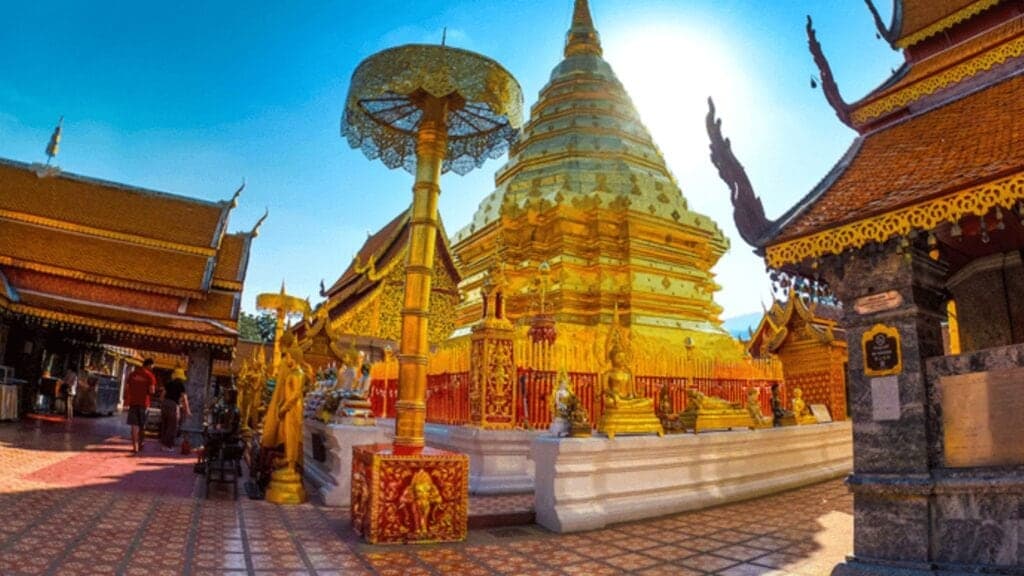
Wat Chedi Luang's broken silhouette is the point, not a problem. The chedi was 84 metres tall before a 1545 earthquake sheared off the top third, and it once housed the Emerald Buddha now in Bangkok. Most tour buses photograph it head-on and miss the side-light angle that shows the scale. Combine the visit with the monk-chat tables on the southwest side for the city's most underrated cultural hour.
Why does the broken chedi matter?
Wat Chedi Luang was the tallest building in the Lanna kingdom for 80 years, the original home of the Emerald Buddha, and the only Old City temple where you're standing inside a half-ruin by design.
Most temple visits in Chiang Mai are essentially aesthetic — polished gold, manicured grounds, well-restored Buddha images. Chedi Luang inverts that. The stupa lost its top third in 1545 and the Thai Fine Arts Department deliberately stabilised the remains rather than rebuilding the spire. You're looking at the actual structure that locals worshipped in the 1400s, with 500 years of weather written on it. The aesthetic effect is half-ruin, half-shrine. It photographs badly head-on and beautifully at 4pm side-light.
How tall was the chedi before it fell?
Roughly 84 metres — taller than the Statue of Liberty's pedestal, and the tallest building anywhere in the Lanna world from 1468 until the earthquake.
The original height is debated. Different Lanna chronicles list it at 80–86 metres. The accepted figure used by the Thai Fine Arts Department is 84m. The current standing height is about 60m, with the top sliced away cleanly enough that you can see the original brick layering at the break.
For context: the chedi was visible from anywhere inside the Old City walls and acted as the navigational landmark before street signs existed. Locals still use it that way. "I'll meet you at the temple" usually means here.
Where was the Emerald Buddha when it lived here?
In the eastern niche of the chedi, facing dawn. The niche is intact, restored, and now holds a 1995 jade replica installed for the city's 600th anniversary.
The Emerald Buddha's travel history is one of the great Southeast Asian relic stories. The original figure is jadeite, 66cm tall, and probably 15th-century Lanna in origin. It moved to Chedi Luang in 1468, stayed for 83 years, then King Setthathirath took it to Luang Prabang in 1551 when the Lao kingdom inherited the Lanna throne. Vientiane next. Then Bangkok in 1784, where it sits today in Wat Phra Kaew inside the Grand Palace.
The replica in the niche isn't trying to fool you. It's marked as a commemoration. Stand back about 8 metres on the eastern approach and you can see how the niche framing was originally designed to catch morning light on the relic's profile.
How does the monk chat at Chedi Luang work?
Tables sit on the southwest side of the compound under a covered pavilion, run by novices from Maha Chulalongkorn Buddhist University next door. Hours roughly 9am–6pm. Free.
Topics that come up well: monastery daily schedule, why you chose this trip, Buddhism basics, what's different between Thai and Western life. Topics that don't: politics, the Thai royal family, anything sexual.
Etiquette rules for monk chat:
- Sit lower than the monk. Cushions are provided. The novice sits on a slightly raised platform; you sit on the floor cushion.
- Women don't touch monks. No handshakes. No passing objects directly into hands — set the object down, the monk picks it up.
- Cover shoulders and knees. Same dress code as the rest of the temple.
- No tipping the monk. Donations go into the temple box, not to the individual.
How does Wat Chedi Luang fit into a half-day temple route?
Pair it with Wat Phra Singh (10 minutes' walk west) for a 3-hour cultural morning. Add Wat Pan Tao (next door, 5 minutes) for the teak ordination hall.
| Temple | Walking time from Chedi Luang | Entry fee | What it adds |
|---|---|---|---|
| Wat Phra Singh | 10 minutes west | 40 baht | Most important Buddha image, polished restoration |
| Wat Pan Tao | Next door (north) | Free | All-teak ordination hall, 1846 |
| Wat Inthakhin Sadue Muang | 5 minutes north | Free | City pillar shrine, locals' daily-offering site |
| Wat Suan Dok | 15 minutes by tuk-tuk | Free | Royal cremation chedis, second monk chat venue |
A clean half-day sequence: Wat Phra Singh at 9am (cool, gold catches morning light), walk east to Wat Pan Tao by 10:30, Wat Chedi Luang main visit 11am–noon, monk chat 12–1pm, lunch on Ratchadamnoen Road. Skip Suan Dok for an afternoon if your knees are still working.
If you'd rather have a guide handle the history and the transport, our Chiang Mai temple tours cover the Old City and the mountain temples, and the half-day Doi Suthep temple and Hmong village tour is the natural pairing for an afternoon once you've done the Old City on foot in the morning.
What's the entry fee and dress code reality?
40 baht for foreigners (free for Thai), shoulders and knees covered, shoes off inside the wihan, photos allowed except where signed.
Sarongs are loaned at the entrance for a 20-baht deposit if you've turned up in shorts. The deposit gets returned when you return the sarong. The temple does enforce this — guests in singlets are turned away.
Cash only. The card-payment infrastructure isn't there. A 100-baht note will cover you and a companion with change for a coconut afterwards.
When does Chedi Luang get crowded?
Tour-bus rush hits 10am–11:30am and again 2–3pm. Early morning (8–9am) and late afternoon (4:30–6pm) are quiet.
The compound is large enough that crowding isn't a problem unless you want a clean photo. For monk chat, weekday mornings are best. For photography, late afternoon. For atmosphere, sunset light on the western face is the city's underrated cultural moment.
The bottom line
Wat Chedi Luang isn't a polished postcard temple. It's a half-ruin that tells you more about Lanna history than any of the restored alternatives in the Old City, and the adjacent monk chat is the best hour of casual cultural exchange you'll find in Thailand. Visit at side-light, do the monk chat, walk over to Phra Singh after, and don't try to photograph the chedi head-on at noon.
Book the half-day Doi Suthep temple tourGuided Lanna temple visit, hotel pickup, easy add-on to an Old City morningFurther reading:
- Wat Phra Singh Chiang Mai: guide and visit-planning
- Monk chat in Chiang Mai: where, when, what to ask
Outbound references:
- Wikipedia — Wat Chedi Luang (history and dates)
- Wikipedia — Emerald Buddha (relic travel history)
- Tourism Authority of Thailand — Chiang Mai temples
Frequently asked questions
Why is the chedi at Wat Chedi Luang broken?
A major earthquake in 1545 sheared off the top third of the stupa. Before the collapse, Chedi Luang stood at roughly 84 metres — the tallest building in the old Lanna kingdom and a key landmark on the city skyline. The Department of Fine Arts stabilised the remaining structure in the 1990s with a partial restoration that kept the broken silhouette intact rather than rebuilding the spire. You're standing in front of a half-ruin by design. That's the point, and it's why it photographs better in side-light than head-on.
Is the Emerald Buddha at Wat Chedi Luang the real one?
No. The original Phra Kaew Morakot lived in the eastern niche of Wat Chedi Luang from 1468 to 1551 before being moved to Luang Prabang, then Vientiane, then finally Bangkok in 1784 where it sits today in Wat Phra Kaew. The figure in the niche now is a 1995 jade replica installed to mark the 600th anniversary of the city. The eastern niche is the original housing, restored — you're looking at the right spot, just the wrong statue. Stand back to see how the proportions work.
Does monk chat happen at Wat Chedi Luang?
Yes. Monk chat tables sit on the southwest side of the compound under a covered pavilion, run by novices from the Maha Chulalongkorn Buddhist University next door. Hours are roughly 9am to 6pm daily, though enforcement varies. The chat is free — donations to the temple are appreciated but not asked. Topics range from Buddhism basics to monastic life to 'why do you wear orange'. The novices practise English with you and you practise asking good questions. Don't touch a monk if you're a woman.
Are children allowed at Wat Chedi Luang?
Yes, with two practical caveats. The chedi base is barricaded but the surrounding stones are uneven — small kids will trip. The ordination hall (wihan) requires shoes off and a respectful silence; this is challenging for toddlers. Older children handle the visit well. There's no entry fee discount for kids but tickets are cheap (40 baht adults, free for Thai nationals, kids under 12 free for foreigners as of 2026). Pair it with a soft-serve coconut from the Sunday Walking Street market nearby for buy-in.
How does Wat Chedi Luang compare to Wat Phra Singh?
Wat Phra Singh is more polished — gold-leafed, restored, hosts the city's most important Buddha image (Phra Buddha Sihing) and is the centre of Songkran processions. Wat Chedi Luang is rougher, ruin-led, more historically interesting if you care about Lanna architecture and the Emerald Buddha story. Most first-time visitors do Phra Singh first because the photos are prettier, then realise Chedi Luang was the better visit. Doing both in one morning takes about three hours including walking time between them.
What's the dress code and entry fee for Wat Chedi Luang?
Shoulders and knees covered. No bare midriffs, no short shorts, no transparent tops. Sarongs are loaned at the entrance for 20 baht deposit if you arrive underdressed. Shoes off inside the wihan and the ordination hall. The chedi itself is outdoors and shoes-on. Entry is 40 baht for foreigners, free for Thai nationals (you'll be asked to show an ID), kids under 12 free. Cash only. Photos allowed except where signed. Don't climb on the stupa stones — fine 1,000 baht if caught.
Frequently asked questions
Why is the chedi at Wat Chedi Luang broken?
A major earthquake in 1545 sheared off the top third of the stupa. Before the collapse, Chedi Luang stood at roughly 84 metres — the tallest building in the old Lanna kingdom and a key landmark on the city skyline. The Department of Fine Arts stabilised the remaining structure in the 1990s with a partial restoration that kept the broken silhouette intact rather than rebuilding the spire. You're standing in front of a half-ruin by design. That's the point, and it's why it photographs better in side-light than head-on.
Is the Emerald Buddha at Wat Chedi Luang the real one?
No. The original Phra Kaew Morakot lived in the eastern niche of Wat Chedi Luang from 1468 to 1551 before being moved to Luang Prabang, then Vientiane, then finally Bangkok in 1784 where it sits today in Wat Phra Kaew. The figure in the niche now is a 1995 jade replica installed to mark the 600th anniversary of the city. The eastern niche is the original housing, restored — you're looking at the right spot, just the wrong statue. Stand back to see how the proportions work.
Does monk chat happen at Wat Chedi Luang?
Yes. Monk chat tables sit on the southwest side of the compound under a covered pavilion, run by novices from the Maha Chulalongkorn Buddhist University next door. Hours are roughly 9am to 6pm daily, though enforcement varies. The chat is free — donations to the temple are appreciated but not asked. Topics range from Buddhism basics to monastic life to 'why do you wear orange'. The novices practise English with you and you practise asking good questions. Don't touch a monk if you're a woman.
Are children allowed at Wat Chedi Luang?
Yes, with two practical caveats. The chedi base is barricaded but the surrounding stones are uneven — small kids will trip. The ordination hall (wihan) requires shoes off and a respectful silence; this is challenging for toddlers. Older children handle the visit well. There's no entry fee discount for kids but tickets are cheap (40 baht adults, free for Thai nationals, kids under 12 free for foreigners as of 2026). Pair it with a soft-serve coconut from the Sunday Walking Street market nearby for buy-in.
How does Wat Chedi Luang compare to Wat Phra Singh?
Wat Phra Singh is more polished — gold-leafed, restored, hosts the city's most important Buddha image (Phra Buddha Sihing) and is the centre of Songkran processions. Wat Chedi Luang is rougher, ruin-led, more historically interesting if you care about Lanna architecture and the Emerald Buddha story. Most first-time visitors do Phra Singh first because the photos are prettier, then realise Chedi Luang was the better visit. Doing both in one morning takes about three hours including walking time between them.
What's the dress code and entry fee for Wat Chedi Luang?
Shoulders and knees covered. No bare midriffs, no short shorts, no transparent tops. Sarongs are loaned at the entrance for 20 baht deposit if you arrive underdressed. Shoes off inside the wihan and the ordination hall. The chedi itself is outdoors and shoes-on. Entry is 40 baht for foreigners, free for Thai nationals (you'll be asked to show an ID), kids under 12 free. Cash only. Photos allowed except where signed. Don't climb on the stupa stones — fine 1,000 baht if caught.