Doi Suthep costs ฿50 per foreigner to enter the upper temple precinct, plus an optional ฿50 cable-car tram if you skip the 306-step Naga staircase. Most visitors spend ฿200-500 total including transport from Old City. The staircase, viewpoint, and lower courtyard are free. Below is the line-item breakdown for 2026 and the legitimate ways to avoid the worst of the tour-bus crush.
What does Doi Suthep actually cost in 2026?
฿50 foreigner entry to the upper precinct, ฿50 optional tram, ฿100-150 round-trip songthaew from Old City. Total ฿200-300 self-organized, ฿800-1,500 on a guided half-day.
The pricing has been stable since the post-pandemic reopening in 2022. The temple committee reviews the rate roughly every five years.
Why is there a foreigner price at Doi Suthep?
Doi Suthep is an active Buddhist temple as well as a tourist site, and the dual-pricing system funds upkeep without taxing Thai worshippers.
Most major Thai temples and historic sites run dual pricing: free or ฿20 for Thais, ฿50-200 for foreigners. The ฿50 at Doi Suthep is on the low end. Wat Phra Kaew in Bangkok charges ฿500. Sukhothai charges ฿100. The fee funds temple maintenance, resident monks' stipends, and the cable-car system. It does not go to commercial operators.
What's actually free at Doi Suthep?
The 306-step Naga staircase, the lower courtyard, the elephant statue, the viewpoint over Chiang Mai, the cultural museum, and the temple shop. Only the upper gold-chedi precinct charges admission.
This catches a lot of first-time visitors out. If your goal is the photo on the Naga staircase or the panoramic view of the city, you do not need to pay ฿50. The staircase is the most-photographed part of the temple anyway, and the viewpoint is on the lower terrace below the ticket booth.
What you give up by not paying:
- Close-up access to the gold chedi (the central gold-leafed stupa).
- The standing Buddha image at the back of the upper courtyard.
- The covered prayer hall with the murals.
- The bell row that visitors ring for merit.
For a 30-40 minute photo stop, free is fine. For a proper temple visit with context, pay the ฿50.
How much does the transport from Old City actually cost?
Red truck songthaew is the cheapest at ฿100-150 per person round trip. Grab is ฿400-600 one way. A guided half-day with transport is ฿800-1,500 per person.
| Transport option | Cost per person | Travel time |
|---|---|---|
| Red truck songthaew (shared) | ฿100-150 round trip | 30-40 min each way, driver waits |
| Grab car (private) | ฿400-600 one way | 25-30 min |
| Scooter rental (self-drive) | ฿250-350 per day + fuel | 30 min |
| Half-day guided tour | ฿800-1,500 all-in | Includes pickup, 1-2h at temple |
The songthaew system is shared-passenger — the driver waits at the temple until your group is ready, then drives the same passengers back. ฿150 is fair from Tha Phae Gate. For most travelers, the songthaew is the right choice.
Should I take the cable-car tram or the staircase?
Take the staircase if you can — it's the cultural experience the temple was designed around. The tram is a fine alternative for mobility-limited visitors but skips the part of the visit most worth doing.
The Naga staircase has 306 steps. The naga (serpent) balustrades run the full length. The climb takes 8-15 minutes depending on pace. It's not steep by mountain-temple standards — most travelers, including older relatives, manage it with one stop halfway.
The cable-car tram (funicular) costs ฿50 round trip for foreigners, ฿20 for Thais. It runs every 5-10 minutes from 6am to 6pm. The ride takes 90 seconds.
If you are mobility-limited, traveling with elderly relatives, or have a knee injury, the tram is the right call. If you're physically able and have 15 minutes, take the stairs going up — you can always tram down.
How do I avoid the worst of the tour-bus crowd?
Go before 8:30am or after 4:30pm. The bus-tour window is roughly 9:30am to 3:30pm. Outside that, the temple is half-empty.
Doi Suthep receives an estimated 7,000-10,000 visitors a day in high season. Roughly 60% arrive on tour buses leaving central Chiang Mai between 8:30 and 9:30am. The ticket booth opens at 6am. Use the 3-hour pre-bus window — 90 minutes at the temple, leave by 8:30, and you've seen it properly with maybe 50 other people instead of 800. The sunset visit (4:30-5:30pm) is similarly quiet and the late afternoon light is the best photograph of the day.
What dress code applies at Doi Suthep?
Shoulders covered. Knees covered. Shoes off in the upper precinct. The temple lends sarongs at the entrance if you arrive under-dressed.
This is enforced. The monks at the entrance will refuse entry to anyone in tank tops, short shorts, or short skirts. The sarong loan is free but runs out of stock on busy mornings — come dressed appropriately rather than relying on it. T-shirt with sleeves, trousers or long skirt below the knee, slip-on shoes. Dress code applies to the upper precinct only. The lower courtyard and staircase have no requirements.
Is Doi Suthep worth the ฿50?
Yes, for first-time Chiang Mai visitors. Probably not, for repeat visitors who've seen the upper precinct before.
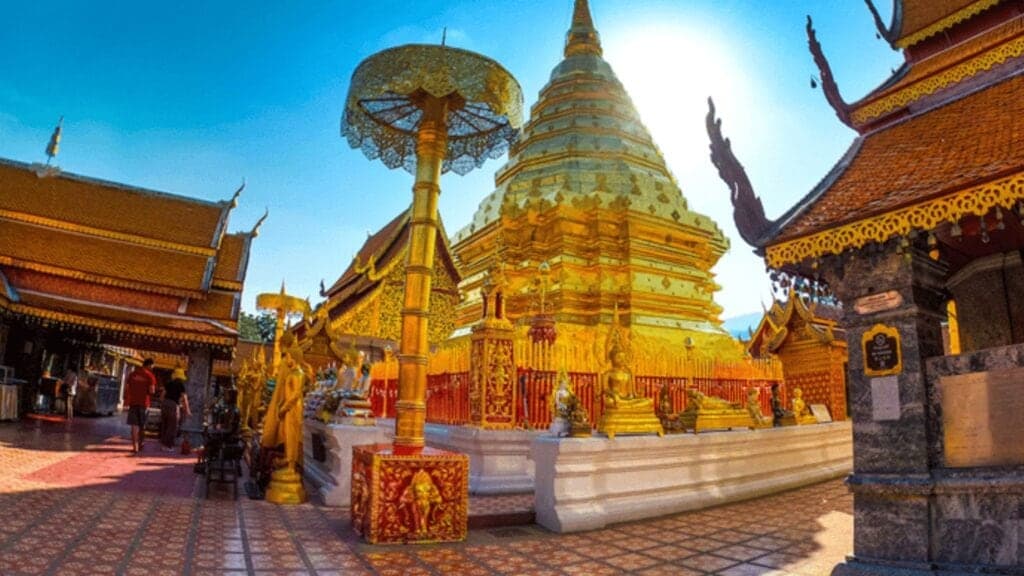
The ฿50 buys you access to one of northern Thailand's most significant Buddhist sites — the gold chedi has been a pilgrimage destination since the late 14th century, and the views of Chiang Mai from the upper platform are the best from any single point in the city.
For a returning visitor who's done the gold chedi photo, the free staircase-and-viewpoint loop covers the same vista without the ฿50. Spend that money on a proper guided half-day with cultural context instead — the guide adds more than the precinct entry does. A private Doi Suthep and Wat Pha Lat trip is worth it if you want to set your own pace and beat the bus window, or browse all Chiang Mai temple tours.
Book the half-day Doi Suthep and Hmong village tourGuided, entry included, hotel pickup, ahead of the tour-bus crowdRelated reading:
- Doi Suthep vs Doi Kham: when to pick the quieter mountain temple
- Chiang Mai temple etiquette: what to wear, what not to do
- Chiang Mai airport transfer guide: what every option costs
External references:
- Tourism Authority of Thailand temple-visit guidelines (tat.or.th).
- Wat Phra That Doi Suthep public information posted at the ticket booth, accessed 2026-05-25.
Frequently asked questions
Is there a foreigner price at Doi Suthep?
Yes. Foreigners pay ฿50 to enter the upper temple precinct (the gold-chedi platform). Thai citizens are free. The dual-pricing system is standard at major Thai temples and historic sites. The ฿50 is a flat rate regardless of nationality, age, or time of day. Children under 10 are free with a paying adult. Bring small notes — the ticket booth doesn't always have change for ฿1,000.
Are the Naga staircase and the lower temple area free?
Yes. The 306-step Naga staircase, the lower courtyard, the elephant statue, and the viewpoint over Chiang Mai are all free. You only pay the ฿50 if you want the upper precinct with the gold chedi and the standing Buddha. For a photo-stop visit, the free area is enough. For a proper temple visit with context, pay the ฿50.
Do I pay for the shuttle (tram) to the temple?
Only if you skip the staircase. The cable-car tram costs ฿50 round trip for foreigners, ฿20 for Thais. The ride takes 90 seconds. Take it if you are mobility-limited or traveling with elderly relatives. If you can manage the stairs, take them — that's the cultural experience the temple was designed around. The ฿50 upper-precinct ticket is separate.
Is parking included in the entry fee?
No. The car park at the base charges ฿20-40 depending on vehicle size. Songthaew drivers from town typically include parking in their per-passenger fare. If you drive yourself, budget the ฿20-40 on top of the ฿50 entry and ฿50 tram. The car park is rarely full except on Buddhist holy days.
What does it cost in total to visit Doi Suthep from Chiang Mai?
Most visitors spend ฿200-500 total per person. Breakdown: songthaew from Old City ฿100-150 round trip, upper-precinct entry ฿50, optional tram ฿50, optional parking ฿20-40 if self-drive. Add ฿200-400 for Grab. A guided half-day from Chiang Mai runs ฿800-1,500 per person all-in including transport, guide, water, and entry.
How do locals skip the queue at Doi Suthep?
Three ways. Go early — ticket booth opens 6am, most buses arrive 9:30am. Visit before 8:30am and you'll have the staircase to yourself. Or go late — 5pm to closing at 5:30pm. Or visit on a weekday in shoulder season (May-June, September). There's no fast-pass ticket — anyone selling one is running a scam.
Frequently asked questions
Is there a foreigner price at Doi Suthep?
Yes. Foreigners pay ฿50 to enter the upper temple precinct (the gold-chedi platform). Thai citizens are free. The dual-pricing system is standard at major Thai temples and historic sites. The ฿50 is a flat rate regardless of nationality, age, or time of day. Children under 10 are free with a paying adult. Bring small notes — the ticket booth doesn't always have change for ฿1,000.
Are the Naga staircase and the lower temple area free?
Yes. The 306-step Naga staircase, the lower courtyard, the elephant statue, and the viewpoint over Chiang Mai are all free. You only pay the ฿50 if you want the upper precinct with the gold chedi and the standing Buddha. For a photo-stop visit, the free area is enough. For a proper temple visit with context, pay the ฿50.
Do I pay for the shuttle (tram) to the temple?
Only if you skip the staircase. The cable-car tram costs ฿50 round trip for foreigners, ฿20 for Thais. The ride takes 90 seconds. Take it if you are mobility-limited or traveling with elderly relatives. If you can manage the stairs, take them — that's the cultural experience the temple was designed around. The ฿50 upper-precinct ticket is separate.
Is parking included in the entry fee?
No. The car park at the base charges ฿20-40 depending on vehicle size. Songthaew drivers from town typically include parking in their per-passenger fare. If you drive yourself, budget the ฿20-40 on top of the ฿50 entry and ฿50 tram. The car park is rarely full except on Buddhist holy days.
What does it cost in total to visit Doi Suthep from Chiang Mai?
Most visitors spend ฿200-500 total per person. Breakdown: songthaew from Old City ฿100-150 round trip, upper-precinct entry ฿50, optional tram ฿50, optional parking ฿20-40 if self-drive. Add ฿200-400 for Grab. A guided half-day from Chiang Mai runs ฿800-1,500 per person all-in including transport, guide, water, and entry.
How do locals skip the queue at Doi Suthep?
Three ways. Go early — ticket booth opens 6am, most buses arrive 9:30am. Visit before 8:30am and you'll have the staircase to yourself. Or go late — 5pm to closing at 5:30pm. Or visit on a weekday in shoulder season (May-June, September). There's no fast-pass ticket — anyone selling one is running a scam.