Monk chat is the most cultural-substance-per-baht activity in Chiang Mai: free, drop-in, and run by three Buddhist universities specifically so foreign visitors and Thai monks can practice English together. The three locations are Wat Chedi Luang (daily, most foreigner-friendly), Wat Suan Dok (Mon/Wed/Fri evenings, deeper conversations), and Mahachulalongkornrajavidyalaya University (MCU, by class schedule). Pick by schedule and depth.
What is "monk chat" actually?
It's a structured English-practice programme run by Chiang Mai's Buddhist universities since the mid-1990s. Monks practice spoken English; visitors learn about Theravada Buddhist practice and Thai monastic life.
The programme exists because Thailand's Sangha (monastic community) decided in the 1990s that monks should be more accessible to foreign visitors, and that English fluency would help with the country's tourism economy. The original site was at Wat Chedi Luang under the supervision of Mahachulalongkornrajavidyalaya University.
It's not a tour. It's not paid. It's not "the monk gives a talk and you listen." It's a one-on-one or small-group conversation, usually 20-40 minutes, where the monk asks you questions and you ask him questions. The monk is typically a student-monk, aged 16-30, learning English as part of his Buddhist university coursework.
Where can I do monk chat in Chiang Mai?
Three locations: Wat Chedi Luang (Old City, daily), Wat Suan Dok (west of Old City, Mon/Wed/Fri evenings), and MCU campus (by class schedule). Wat Chedi Luang is the easiest first time; Wat Suan Dok is the deeper experience.
| Location | Schedule | Setting | Monks' English level | Best for |
|---|---|---|---|---|
| Wat Chedi Luang | Daily ~9am-6pm | Outdoor pavilion, central Old City | Beginner to intermediate | First timers, drop-in convenience |
| Wat Suan Dok | Mon/Wed/Fri ~5pm-7pm | Indoor meeting hall | Intermediate to advanced | Deeper conversations, less crowded |
| MCU University | By class schedule (check on arrival) | University classroom | Intermediate (university students) | Academic curiosity, longer talks |
If you only have time for one, Wat Chedi Luang is the right pick — it's centrally located, the schedule is forgiving, and the monks there have the most experience with first-time foreign visitors. Wat Suan Dok rewards visitors who can come on the right evening and want a less touristy setting.
How does monk chat at Wat Chedi Luang work?
Walk in any day between roughly 9am and 6pm, look for the "Monk Chat" sign in the central pavilion area near the main chedi, sit at one of the tables, and wait briefly.
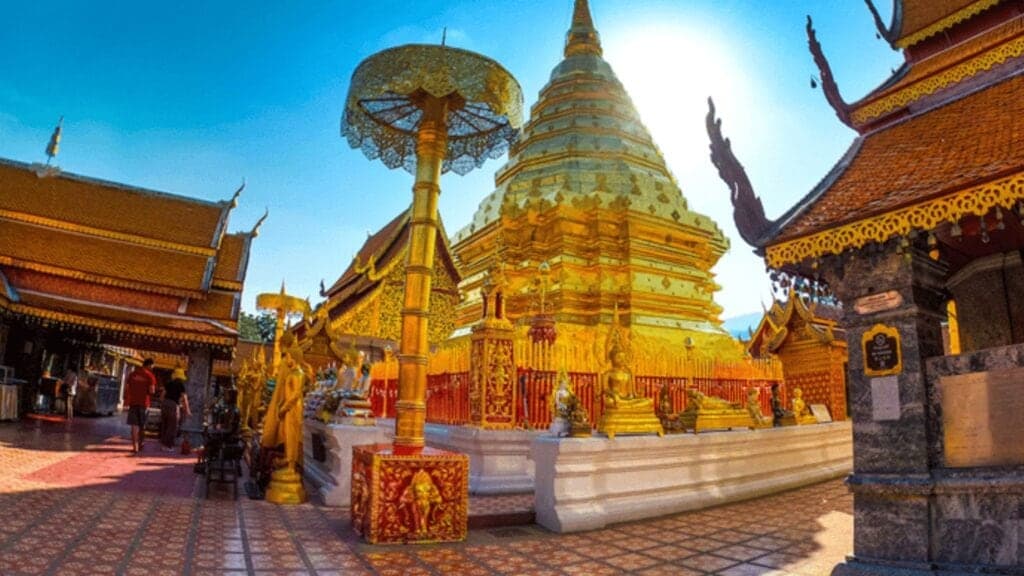
The tables are in a covered outdoor area to the right of the main chedi (the giant ruined stupa in the centre of the temple complex). There's usually a sign in English and the tables have small plastic chairs. A novice monk or layperson coordinator will pair you with an available monk within 5-10 minutes during normal hours.
Conversations are open-ended. The monk will usually start with "Where are you from? Is this your first time in Thailand?" and lead from there. If conversation lags, you have permission to ask anything in the appropriate-topics list.
The Wat Chedi Luang setting is touristy in the best sense — the monks here are practised at chatting with foreigners, the bar to entry is low, and there's no expectation of religious knowledge.
What's different about Wat Suan Dok?
Wat Suan Dok runs three evenings a week in a more formal indoor setting, with longer sessions and monks who are typically further along in their English studies.
Wat Suan Dok is the campus temple for Mahachulalongkornrajavidyalaya University's Chiang Mai branch — the same university that runs Wat Chedi Luang's programme, just a different location. The evening timing (typically 5pm to 7pm on Monday, Wednesday, and Friday) draws fewer drop-ins than the daytime Chedi Luang sessions, which means smaller groups and longer conversations.
The setting is also more academic. The room is indoors, there are notes and books on the tables, and you're more likely to get into substantive Buddhist philosophy questions. If you've read anything about Theravada Buddhism or have specific questions about meditation practice, Wat Suan Dok is the better fit.
The catch is the schedule — you have to come on the right evening, and Buddhist holidays can shift or cancel sessions. Check the noticeboard at the temple entrance or call ahead if you can.
What questions do monks actually like to answer?
Specific questions about practice, daily life, and ordination motivation. The monks have heard "what's your favourite food" a thousand times — they appreciate questions that ask them to think.
Questions monks enjoy:
- Daily routine. "What time do you wake up? What do you do first?" (Most monks rise at 4-5am for chanting, meditate, and go on alms round between 6 and 7am.)
- Ordination motivation. "How did you decide to ordain? Was it your choice or your family's?" (Many Thai men ordain temporarily for 1-3 months as a son's duty to his mother; permanent ordination is a deeper commitment.)
- Comparative Buddhism. "How is Thai Buddhism different from what they practice in Japan or Tibet?" (Most student monks know enough Theravada vs Mahayana basics to give a useful answer.)
- Meditation specifics. "What meditation technique do you practice? How long do you sit?" (Vipassana and samatha are the two main Theravada approaches.)
- Modern life questions. "Do you use a smartphone? Are monks allowed to use the internet?" (Yes, most have phones; rules vary by lineage.)
Questions to avoid:
- Anything about the Thai monarchy or politics.
- Anything implying the monk is wasting his life ("don't you want a normal job?").
- Sex, dating, or "have you ever broken your vows?"
- Detailed questions about other religions' superiority or inferiority.
How should I dress and what's the etiquette?
Modest clothing — shoulders and knees covered, no transparent or graphic prints. Shoes off in temple buildings. No physical contact between women and monks.
The dress code is the same for entering any major Chiang Mai temple. Practical rules:
- Tops: shoulders fully covered, no spaghetti straps, no sheer fabric over skin.
- Bottoms: knees covered. Long shorts (mid-calf) are fine; mid-thigh shorts are not. Skirts and dresses need to be at least knee-length.
- Footwear: removable. You'll take shoes off entering any indoor temple space, so wear sandals or slip-ons rather than laces.
- Hats: off when entering temple buildings.
- Sunglasses: off when speaking with a monk directly. It's about eye contact.
What's monk chat NOT good for?
Three things: deep meditation instruction, formal Buddhist teaching, and Buddhist scripture study. For those, sign up for a meditation retreat at a forest monastery or Wat Suan Dok's residential courses.
Monk chat is a conversation, not a teaching session. The monks are students, not senior teachers. If you're serious about learning meditation, a 3-day or 7-day course at Wat Suan Dok's Monk Chat Centre or Wat Phra Dhammakaya's retreat programme is the right path. Those courses cost ฿0-฿3,000 depending on the centre and run on fixed schedules.
For scripture, Mahachulalongkornrajavidyalaya University runs proper short courses (1-2 weeks) on Pali, Abhidhamma, and basic Theravada doctrine. Those require registration and aren't drop-in.
How does this fit into a Chiang Mai day?
Plan monk chat as a 1-2 hour standalone activity. Wat Chedi Luang plus monk chat is a natural pairing; pair Wat Suan Dok's evening session with a dinner in the Suthep area afterwards.
A morning at Wat Chedi Luang typically looks like: arrive at the temple by 10am, walk the temple grounds for 30-45 minutes (the ruined chedi is the main draw), then sit down for monk chat for 30-45 minutes, leave by lunchtime. The temple entry is ฿40 for foreigners; monk chat is free. If you want guided context for the mountain temple as well, our Doi Suthep temple and Hmong village tour pairs well with a self-guided monk chat in the Old City.
An evening at Wat Suan Dok looks like: arrive at the temple by 4:30pm to wander, sit down for monk chat at 5pm sharp (the queue forms quickly), finish by 6:30, and walk five minutes to a Nimman or Suthep area dinner.
If you want to do all three locations, spread across the trip — they're similar enough that doing two in one day is repetitive. Travellers who want to go deeper on temples beyond Chiang Mai often add a White and Blue Temples day trip to Chiang Rai later in the same trip.
Is there a respectful way to take photos?
Ask first. Most monks are fine with portrait photos in the temple setting. Selfies with the monk are sometimes okay if you're male, awkward if you're female. Never photograph alms-round or chanting without explicit permission.
The Buddha statues, temple architecture, and grounds are all freely photographable. Photographing a specific monk requires permission. The mental model: think of the monk as someone in a professional role, like a lecturer. You wouldn't take a selfie with a lecturer mid-class.
For Wat Chedi Luang specifically, the post-chat photo is common and the monks are used to it. A respectful distance (table between you) maintains the appropriate boundary.
Book the Doi Suthep temple and Hmong village tourGuided temple visit with context, pair it with a self-guided monk chatFurther reading worth your time:
- Wat Chedi Luang complete visitor guide
- Chiang Mai temple etiquette: the rules that aren't on the sign
- Best Viator alternatives for Chiang Mai temple tours
External references: Mahachulalongkornrajavidyalaya University Chiang Mai campus is the academic body that coordinates the monk chat programme, and the Thai Office of National Buddhism maintains the official monastic census numbers cited above. Both accessed 2026-01-13.
Frequently asked questions
Is monk chat free?
Yes. Monk chat is officially a free programme run by Buddhist universities to give monks practice speaking English with foreigners. No donation is expected or asked for, though leaving a small contribution (฿20-฿100) in the donation box at the temple is appreciated and customary. Avoid handing money directly to the monk — Theravada monastic rules prohibit monks from handling money. Drop it in the box at the temple entrance if you want to give. The conversation itself never has a fee.
Can women approach monks?
Yes, women can have monk chats freely — the conversation is the entire point of the programme. The cultural rule to know is physical contact: a Theravada monk cannot touch a woman, and a woman should not touch a monk or hand objects directly to him. If you need to give him a book or pen, place it on a surface (table, cloth) for him to pick up. Sit at a respectful distance, dress modestly (covered shoulders, knee-length or longer). The monks are used to mixed-gender groups.
What questions are appropriate to ask?
Anything genuinely curious about Buddhist practice, daily monastery life, or how the monk came to ordain. Good examples: 'What time do you wake up?', 'Why did you ordain?', 'What's the hardest part of monastic life?', 'How is Thai Buddhism different from Japanese or Tibetan?'. Avoid: questions about Thai politics, the monarchy, sex/dating, or anything intentionally provocative. Don't ask 'Do you miss your family?' or 'Don't you want to get married?' — these come across as trying to make the monk doubt his vocation.
Are appointments needed for monk chat?
No, all three Chiang Mai locations operate drop-in during posted hours. Wat Chedi Luang runs daily from approximately 9am to 6pm. Wat Suan Dok runs Monday, Wednesday, and Friday from approximately 5pm to 7pm. Mahachulalongkornrajavidyalaya University (MCU) runs by class schedule rather than daily — check their notice board on arrival. There can be queues during peak season (December-February), so arriving early in the session window helps. No need to call ahead.
How long does a typical monk chat last?
Usually 20-40 minutes, sometimes longer if both sides are engaged. The monks are practising English, so they're often happy to talk for an hour with a patient visitor. If a queue is forming behind you, be conscious of others waiting. The right way to end is to thank the monk, give a wai (palms together at chest level, slight bow), and step back — no handshake. If you've had a good conversation, dropping a donation in the temple box on the way out is the customary acknowledgment.
What should I wear?
Temple-appropriate clothing: shoulders covered, knees covered, no transparent fabric, no graphic-violent or sexually-suggestive prints. Loose trousers or long skirts work better than shorts. Tank tops, crop tops, very short shorts, or sheer fabrics will get you turned away at the temple entrance. Most temples will lend a wrap-skirt or shawl if you're under-dressed, but it's slow and embarrassing. Bring a light scarf or wrap that you can throw over shoulders before entering. Take shoes off before entering any indoor temple space.
Frequently asked questions
Is monk chat free?
Yes. Monk chat is officially a free programme run by Buddhist universities to give monks practice speaking English with foreigners. No donation is expected or asked for, though leaving a small contribution (฿20-฿100) in the donation box at the temple is appreciated and customary. Avoid handing money directly to the monk — Theravada monastic rules prohibit monks from handling money. Drop it in the box at the temple entrance if you want to give. The conversation itself never has a fee.
Can women approach monks?
Yes, women can have monk chats freely — the conversation is the entire point of the programme. The cultural rule to know is physical contact: a Theravada monk cannot touch a woman, and a woman should not touch a monk or hand objects directly to him. If you need to give him a book or pen, place it on a surface (table, cloth) for him to pick up. Sit at a respectful distance, dress modestly (covered shoulders, knee-length or longer). The monks are used to mixed-gender groups.
What questions are appropriate to ask?
Anything genuinely curious about Buddhist practice, daily monastery life, or how the monk came to ordain. Good examples: 'What time do you wake up?', 'Why did you ordain?', 'What's the hardest part of monastic life?', 'How is Thai Buddhism different from Japanese or Tibetan?'. Avoid: questions about Thai politics, the monarchy, sex/dating, or anything intentionally provocative. Don't ask 'Do you miss your family?' or 'Don't you want to get married?' — these come across as trying to make the monk doubt his vocation.
Are appointments needed for monk chat?
No, all three Chiang Mai locations operate drop-in during posted hours. Wat Chedi Luang runs daily from approximately 9am to 6pm. Wat Suan Dok runs Monday, Wednesday, and Friday from approximately 5pm to 7pm. Mahachulalongkornrajavidyalaya University (MCU) runs by class schedule rather than daily — check their notice board on arrival. There can be queues during peak season (December-February), so arriving early in the session window helps. No need to call ahead.
How long does a typical monk chat last?
Usually 20-40 minutes, sometimes longer if both sides are engaged. The monks are practising English, so they're often happy to talk for an hour with a patient visitor. If a queue is forming behind you, be conscious of others waiting. The right way to end is to thank the monk, give a wai (palms together at chest level, slight bow), and step back — no handshake. If you've had a good conversation, dropping a donation in the temple box on the way out is the customary acknowledgment.
What should I wear?
Temple-appropriate clothing: shoulders covered, knees covered, no transparent fabric, no graphic-violent or sexually-suggestive prints. Loose trousers or long skirts work better than shorts. Tank tops, crop tops, very short shorts, or sheer fabrics will get you turned away at the temple entrance. Most temples will lend a wrap-skirt or shawl if you're under-dressed, but it's slow and embarrassing. Bring a light scarf or wrap that you can throw over shoulders before entering. Take shoes off before entering any indoor temple space.