Disclosure: We publish chiangmaigotours.com. We don't sell ticketed entry to either temple — both are free, and the camp comparison below is editorial. We've cross-checked entry fees and pilgrim numbers against the National Office of Buddhism and Tourism Authority of Thailand data as of 2026-01-07.
TL;DR — Doi Suthep is the iconic Chiang Mai mountain temple with the panoramic city view, the naga staircase and 4,000+ daily visitors in peak season. Doi Kham is the quieter, lower mountain temple south-west of the city, famous among Thai pilgrims for its 17-metre seated Buddha and the wish-granting Luang Pho Tan Jai shrine. If you can only do one, pick Doi Suthep for the view and the experience. If you have a full day, do both — Suthep at dawn, Kham in the afternoon.
Which temple should I pick if I only have time for one?
Pick Doi Suthep if it's your first Chiang Mai trip — the naga staircase, the panoramic view and the gold chedi are the iconic Chiang Mai temple experience and worth the crowds.
Doi Suthep (full name: Wat Phra That Doi Suthep) is the obvious pick for first-timers. It's the temple that shows up on every Chiang Mai postcard, it has the most famous Lanna chedi in Northern Thailand, and the 306-step naga staircase is one of those things you do once and remember. The crowds are real, but a 06:00 arrival gets you in before the buses.
Pick Doi Kham instead if you've already done Suthep on a previous trip, if you specifically want the giant Buddha and the wish-granting shrine, or if you want a temple experience without 2,000 other people sharing it.
What does each temple actually look like?
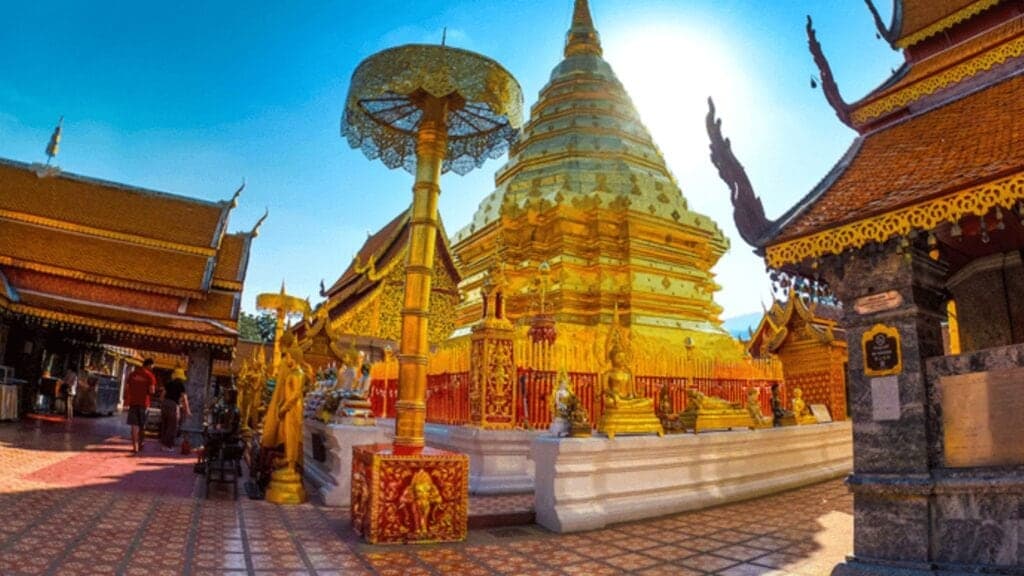
Doi Suthep is a hilltop Lanna complex centred on a 22-metre gold chedi; Doi Kham is a lower Lanna site dominated by a colossal 17-metre seated Buddha visible from kilometres away.
The visual experience is different enough that the comparison isn't really "two similar temples." They're closer to "two completely different sites that happen to both be on mountains south-west of Chiang Mai."
Doi Suthep is the classic Lanna-style temple: a central gold-clad chedi, four cardinal-direction shrines, ornate phoenix and naga sculptures, monks chanting in the early morning. The naga staircase up to the temple is itself the photo opportunity. The viewing terrace east of the chedi is where the panoramic Chiang Mai view lives.
Doi Kham is dominated by its outdoor seated Buddha — 17 metres tall, hands in a gesture of meditation, painted gold, visible from the foot of the mountain. The temple itself is more modest than Suthep's chedi, but the Luang Pho Tan Jai shrine inside draws a steady flow of Thai pilgrims asking for wishes (and returning to give thanks with garlands of jasmine when the wishes come true — there's a literal jasmine-strewn altar full of returned offerings).
How do they compare on the practical stuff?
| Factor | Doi Suthep | Doi Kham |
|---|---|---|
| Elevation | 1,073m | 540m |
| Drive from Old City | 30–40 min | 20–30 min |
| Songthaew (red truck) price | ฿100–฿150/pax | ฿80–฿120/pax |
| Grab one-way | ฿250–฿400 | ฿180–฿280 |
| Entry fee (foreigners) | ฿30/pax | Free |
| Cable car (Suthep only) | ฿20/pax | — |
| Daily visitors (peak) | 2,500–4,000 | 400–800 |
| Best time to arrive | 06:00–07:30 | Anytime except Sun PM |
| Iconic feature | Naga staircase + panoramic view | 17m seated Buddha + wish shrine |
| Time needed on-site | 1.5–2 hrs | 45 min–1 hr |
When should I go to each one?
Doi Suthep before 07:30 or after 16:00 — the middle of the day is busloads. Doi Kham anytime except Sunday afternoon, when local pilgrims peak.
For Doi Suthep, the early start matters more than people think. Between 08:30 and 14:00 in peak season, the temple plaza is packed with tour groups, and the staircase becomes a slow-moving queue rather than a contemplative climb. Arrive at 06:00 and you get the monks finishing morning chanting, the mist still on the chedi, and a near-empty viewing terrace.
For Doi Kham, the only crowded slot is Sunday afternoon when Thai families come up for the wish shrine. Tuesday or Wednesday morning, you'll have the place to yourself.
What about the cultural significance?
Doi Suthep is the major pilgrimage destination in Northern Thailand, founded in 1383 around a relic of the Buddha. Doi Kham is older and arguably more locally significant for Thai Buddhists, with foundations dating to roughly the 7th century.
The history is more interesting than the marketing copy suggests. Doi Suthep's founding myth involves a white elephant carrying a Buddha relic up the mountain and dying at the spot where the chedi was built — a story you'll hear repeated on every guided tour, including our half-day Doi Suthep temple and Hmong village tour. Doi Kham's founding pre-dates Suthep by roughly seven centuries and ties into the Hariphunchai kingdom that preceded Lanna.
For most international visitors, the historical depth doesn't dramatically change the experience. But if you're temple-fatigued after a week in Thailand, the older-and-quieter framing of Doi Kham can feel like a meaningful contrast to Suthep's polished tourist site.
What about access and accessibility?
Doi Suthep has a 306-step naga staircase or a ฿20 cable car for those who can't manage stairs. Doi Kham is flat-access from the car park — no stairs.
If mobility is a factor, Doi Kham wins clearly. The temple complex is roughly at car-park level, the giant Buddha is visible from where you park, and the only short stair section is into the main wihan (which is optional). Doi Suthep's cable car solves the climb but the upper plaza still involves some stairs and uneven Lanna paving.
Strollers and wheelchairs are workable at Doi Kham. At Doi Suthep, the cable car helps but the upper terraces involve cobblestone and steps that limit accessibility.
What's the honest order of operations?
For a first Chiang Mai trip with one temple day budgeted: Doi Suthep at dawn, lunch in Nimman, afternoon at a flat-access Old City temple like Wat Phra Singh or Wat Chedi Luang. Doi Kham becomes worth fitting in if you have a second temple day, you want the wish shrine specifically, or you've done Doi Suthep on a previous trip.
If you're a repeat Chiang Mai visitor and you've done Suthep three times, doing a Doi Kham morning paired with a Sunday Walking Street evening is a stronger day than a fourth Suthep visit.
The bottom line
Doi Suthep is the iconic Chiang Mai temple and earns the cliché — the staircase, the chedi, the view, the morning chanting. The crowds are real but a 06:00 arrival solves most of them. Doi Kham is the quieter sibling that most international itineraries skip, which is exactly why it's worth knowing about. If you have a full day and a private driver, do both in one go. If you have a half-day, do Doi Suthep at dawn and save Doi Kham for the next trip.
Book the half-day Doi Suthep temple tourTAT-licensed guide, transparent inclusions, no hidden feesBrowse more options on our Chiang Mai temple tours page.
Internal reading worth your time:
- Doi Suthep entry fee, hours and dress code
- Chiang Mai temple etiquette: what you need to know before you go
Outbound references:
- Tourism Authority of Thailand — Doi Suthep visitor data (tatnews.org, accessed 2026-01-07)
- Wikipedia — Wat Phra That Doi Suthep history (en.wikipedia.org, accessed 2026-01-07)
- Wikipedia — Wat Phra That Doi Kham history (en.wikipedia.org, accessed 2026-01-07)
Frequently asked questions
Which has fewer crowds — Doi Suthep or Doi Kham?
Doi Kham, by a wide margin. Doi Suthep draws roughly 2,500–4,000 visitors per day in peak season (December–February) and rarely drops below 1,000/day in low season. Doi Kham gets 400–800/day at its busiest — mostly Thai pilgrims rather than international tour groups. If you go to Doi Suthep at 06:00 you'll beat 80% of the crowd; at Doi Kham, anytime except Sunday afternoon is quiet. For photography or quiet reflection, Doi Kham wins by a clear margin.
Are the views different at the two temples?
Yes, meaningfully. Doi Suthep sits at 1,073m and looks east over the Chiang Mai valley — the airport, the moat, the city sprawl. The viewing terrace is the iconic 'Chiang Mai panorama' photo. Doi Kham is 540m on a shorter mountain south-west of the city, and the views look back toward Chiang Mai from a different angle — more of the agricultural plains, less of the city core. Suthep's view is more dramatic; Kham's is more peaceful but less postcard.
Is Doi Kham worth the trip if I'm doing Doi Suthep?
Yes, if you have a full day or you specifically want the giant 17-metre seated Buddha and the wish-granting Luang Pho Tan Jai shrine that Doi Kham is famous for among Thai pilgrims. Most international itineraries skip Doi Kham, which is exactly why it's quiet. The drive between the two is 40–50 minutes — doable as a morning-and-afternoon combo if you start early. If you only have a half-day, pick one and commit to it.
Can you do both Doi Suthep and Doi Kham in one day?
Yes, if you start by 07:30 and accept it as a half-day at each. The realistic order is Doi Suthep first (peak coolness, best morning light, fewer crowds before 09:00), lunch in town or near Wat Phra Singh, then Doi Kham in the afternoon when most temples are quieter. Total drive time is roughly 90 minutes across the day. The downside is you'll be temple-fatigued by 16:00 — consider whether you'd rather spend that afternoon on a Sunday Walking Street or a cooking class instead.
Frequently asked questions
Which has fewer crowds — Doi Suthep or Doi Kham?
Doi Kham, by a wide margin. Doi Suthep draws roughly 2,500–4,000 visitors per day in peak season (December–February) and rarely drops below 1,000/day in low season. Doi Kham gets 400–800/day at its busiest — mostly Thai pilgrims rather than international tour groups. If you go to Doi Suthep at 06:00 you'll beat 80% of the crowd; at Doi Kham, anytime except Sunday afternoon is quiet. For photography or quiet reflection, Doi Kham wins by a clear margin.
Are the views different at the two temples?
Yes, meaningfully. Doi Suthep sits at 1,073m and looks east over the Chiang Mai valley — the airport, the moat, the city sprawl. The viewing terrace is the iconic 'Chiang Mai panorama' photo. Doi Kham is 540m on a shorter mountain south-west of the city, and the views look back toward Chiang Mai from a different angle — more of the agricultural plains, less of the city core. Suthep's view is more dramatic; Kham's is more peaceful but less postcard.
Is Doi Kham worth the trip if I'm doing Doi Suthep?
Yes, if you have a full day or you specifically want the giant 17-metre seated Buddha and the wish-granting Luang Pho Tan Jai shrine that Doi Kham is famous for among Thai pilgrims. Most international itineraries skip Doi Kham, which is exactly why it's quiet. The drive between the two is 40–50 minutes — doable as a morning-and-afternoon combo if you start early. If you only have a half-day, pick one and commit to it.
Can you do both Doi Suthep and Doi Kham in one day?
Yes, if you start by 07:30 and accept it as a half-day at each. The realistic order is Doi Suthep first (peak coolness, best morning light, fewer crowds before 09:00), lunch in town or near Wat Phra Singh, then Doi Kham in the afternoon when most temples are quieter. Total drive time is roughly 90 minutes across the day. The downside is you'll be temple-fatigued by 16:00 — consider whether you'd rather spend that afternoon on a Sunday Walking Street or a cooking class instead.