Pay deposits by card, pay the rest in cash drawn from a Thai ATM with a no-foreign-fee bank card. On a ฿20,000 trip that costs roughly ฿690 in fees vs ฿1,000–฿1,200 for all-card. The 5% surcharge that most Chiang Mai operators add to card payments is the deciding number. Below: the math, the exceptions, and the one rate trick that catches every traveller at least once.
Why do Chiang Mai operators charge 5% on cards but accept cash at face value?
Thai card-acquiring fees run 2.5–3.5%. Small-margin operators pass that cost through, rounded up to 5%, because their per-tour profit can't absorb it.
A typical ฿1,500 day-tour clears roughly ฿200–฿350 of operator margin after vehicles, driver, fuel, food, camp fees and admin. Eat a 3% card fee on that and you've shaved 5–10% off the operator's take-home. The 5% surcharge is how the industry stays viable on card. It is not a markup or a tip extractor — it is the actual cost of the rails being passed through.
Tourists from countries where merchants are required to absorb card fees (the UK since 2018, most of the EU under PSD2) sometimes assume the surcharge is a scam. It is not. Thailand's Bank of Thailand merchant rules (accessed 2026-01-04) allow merchants to pass through interchange and acquiring fees, and most travel operators do.
When does paying cash actually save you the most?
On anything under ฿5,000 where the operator offers a cash-on-arrival option. The 5% surcharge is real, and so is the cost of converting cash to card.
The cleanest cash wins:
- Restaurants and night markets. Roughly 70% of Chiang Mai's good food sits at vendors that don't take card at all. Carry ฿20, ฿50, ฿100, ฿500 notes.
- Songthaews and tuk-tuks. Cash only. Negotiate before you get in.
- Day-tour balances. Pay the deposit by card, pay the rest in cash on the day.
- Markets. Sunday Walking Street, Saturday Night Market, the Warorot day market — all functionally cash-only.
When does paying card actually save you the most?
Three specific cases: chargeback protection on a large booking, the no-foreign-fee credit card with strong points, or a card-only promo from the merchant.
If you're booking a ฿15,000+ multi-day tour and want the 120-day chargeback window that Visa and Mastercard provide on consumer-card transactions, paying by card is worth the surcharge. The protection only applies if the operator fails to deliver — not "I changed my mind". For everything cheaper than that, cash is the cleaner play.
The points-card case is narrower than most travellers think. A 2% cashback card minus the 5% surcharge is still a 3% loss. You'd need a 5%+ category card running on a category that covers Thai travel, which is rare. Chase Sapphire Reserve at 3x points on travel = roughly 4.5% effective return, still negative against a 5% surcharge.
How do ATM fees compare to money changers?
| Method | Fee per ฿10,000 | Best-case cost | Worst-case cost |
|---|---|---|---|
| Thai ATM (no-foreign-fee debit card) | ฿220 flat | ~2.2% | ~2.2% |
| Thai ATM (3% foreign-fee card) | ฿220 + ~฿300 (3%) | ~5.2% | ~5.2% |
| SuperRich money changer (Tha Phae) | ~1.5% margin | ~1.5% | ~2.0% |
| Airport money changer (CNX) | ~3.5% margin | ~3.5% | ~5.0% |
| Hotel money changer | ~4–6% margin | ~4% | ~7% |
| Card payment at merchant (with 5% surcharge) | ฿500 surcharge + ~1% card spread | ~6% | ~6% |
| Card payment with DCC enabled | ฿500 surcharge + ~5% DCC margin | ~10% | ~12% |
How should I split cash and card across a typical trip?
Use the 70/30 rule: 70% cash for street-level spending, 30% card for deposits, hotels above ฿3,000 a night, and any single charge over ฿8,000.
A worked example for a 5-day trip with ฿20,000 spending budget:
- Day 0 (arrival). Withdraw ฿15,000 from a Thai ATM with a no-foreign-fee debit card. One withdrawal = ฿220 in fees. That covers food, songthaews, markets, day-tour balances.
- Day 1. Pay your first booked tour's deposit by card (e.g. ฿1,500 deposit × 1.05 = ฿1,575). Card surcharge cost: ฿75.
- Days 2–4. Pay tour balances in cash on the morning of each tour. Pay restaurants in cash. Use Grab on cash-mode for songthaew rides.
- Day 5 (departure). Pay the hotel in cash if you have it; otherwise card. A ฿4,500 hotel paid by card with surcharge = ฿4,725; cash skips the ฿225 surcharge.
Total fee load on the ฿20,000 trip: ฿690 (3.4%). All-card equivalent: ~฿1,000 surcharge + ฿100 card-spread = ~฿1,100 (5.5%). Cash savings: ~฿410.
What about TrueMoney, PromptPay and other Thai e-wallets?
Worth setting up only if you're staying 2+ weeks. Day-trip visitors can ignore them.
PromptPay is Thailand's QR-code instant transfer system, run by the Bank of Thailand. Locals use it everywhere. Foreign visitors can access it through TrueMoney Wallet, which requires a Thai SIM card and a one-week activation period. For a 5-day visit, the setup cost outweighs the convenience. For a 3-week visit, you'll skip card surcharges everywhere PromptPay is accepted (most cafes, many restaurants, some small operators).
The Chiang Mai elephant tours price breakdown goes deeper on the deposit-vs-balance math for the most-booked elephant tour category. The trip budget calculator lets you plug in your own card surcharge tolerance and see total trip cost.
Are there scams to watch for at ATMs and money changers?
Two main ones: ATM skimmers in low-trust areas, and "great rate" boards at money changers that quietly add a 2–4% commission at the till.
ATM skimming in Chiang Mai is concentrated in tourist-heavy areas — Tha Phae Gate, Nimman, the Night Bazaar. Stick to ATMs inside bank branches or attached to convenience stores (7-Eleven, FamilyMart) during business hours, where the camera coverage and foot traffic make tampering harder. The Thai Tourist Police publishes a guide on common scams (accessed 2026-01-04) including ATM-related ones.
For money changers, the trick is the "posted rate" vs the "transaction rate". The big board outside might show 36.20 THB/USD, but the rate when you actually exchange will be 35.80 because the changer adds a "commission" between the board and the till. SuperRich and Vasu are the two changers most travellers trust because their posted = transaction rate. If you're not sure, ask "how many baht for $100" before handing over money, and confirm the count back.
What's the exact card-surcharge policy on Chiang Mai Go Tours?
5% on Omise and Stripe card payments. Zero on cash. Tours ฿5,000+ require a 25% deposit on card; the balance can be paid in cash on the tour day.
Concretely:
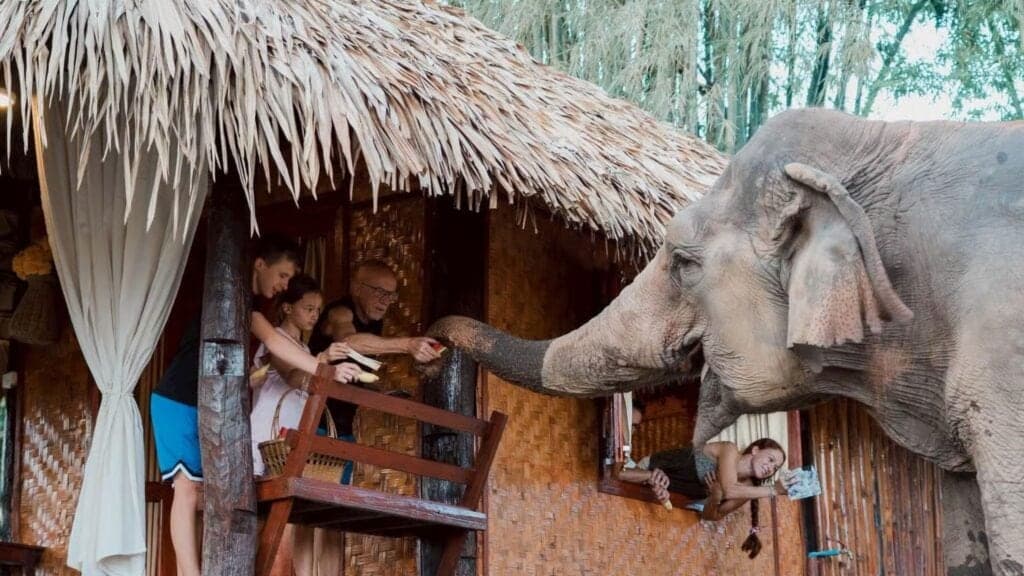
- A ฿2,100 elephant sanctuary day: pay the full ฿2,100 in cash on the day, or ฿2,205 by card upfront (5% surcharge).
- A ฿6,000 private full-day tour: ฿1,500 deposit on card (surcharged to ฿1,575) plus ฿4,500 cash on the day. Total: ฿6,075. All-card equivalent: ฿6,300.
- A ฿15,000 multi-day Mae Hong Son loop: ฿3,750 deposit on card (surcharged to ฿3,937.50) plus ฿11,250 cash. Total: ฿15,187.50. All-card equivalent: ฿15,750.
The deposit-and-cash-balance structure keeps the slot reserved (operator can pay camp fees, schedule the van, prep the meals) while letting you skip the surcharge on the bigger half of the price. It's the same structure most ethical operators in northern Thailand use, and it's the one we've found cleanest for both sides.
Book the Karen elephant sanctuary dayDeposit-on-card, balance-in-cash on the day, no surprise surchargesRelated reading:
- Chiang Mai elephant tours: real price breakdown
- Trip budget calculator — what does five days actually cost?
- Chiang Mai scams to avoid: the eight that catch first-timers
Frequently asked questions
Do all Chiang Mai operators charge a 5% card surcharge?
Most do. Thai card-acquiring fees run roughly 2.5–3.5% for Visa/Mastercard, and operators pass the full cost (rounded up to 5%) to the customer because their margin on a ฿1,500 tour can't absorb it. Hotels above ฿3,000 a night sometimes skip the surcharge because their margin is healthier. Restaurants, markets and street stalls are cash-only. Always ask before paying — Thai law requires operators to disclose surcharges, but smaller shops sometimes don't until the receipt prints. Our internal policy: 5% card surcharge on Omise and Stripe, zero surcharge on cash.
Is the ATM cheaper than a money changer?
Depends on your home bank. Thai ATMs charge a flat ฿220 foreign-card fee per withdrawal (set by the Bank of Thailand, applies to almost every Thai bank's ATM). On a ฿20,000 withdrawal, that's 1.1% — usually cheaper than the 1.5–3% margin a money changer takes. The catch is your home bank's foreign-transaction fee, which can add another 1–3%. If your card is a no-foreign-fee card (Charles Schwab, Wise, Revolut), ATMs win cleanly. If your card charges 3% foreign fees, money changers like SuperRich on Tha Phae Road become competitive.
Does Grab take cash in Chiang Mai?
Yes, but you have to select 'Cash' as the payment method in the app before requesting the ride. Default is card-on-file if you've added one. Cash rides are the same metered fare; no surcharge. The downside is that drivers carry limited float, so settling a ฿180 ride with a ฿1,000 note will sometimes get you a confused-look. Carry a mix of ฿20, ฿50 and ฿100 notes if you're going cash-only. Grab also accepts TrueMoney Wallet and PromptPay QR, which are useful if you've set up a Thai e-wallet during a longer stay.
Are tour deposits always required by card?
For us, yes — and for most operators we work with. Deposits hold the booking for the operator and pay for any pre-trip costs (camp entry fees, food provisioning, driver scheduling). Card deposits are how marketplaces lock in inventory globally. The structure on Chiang Mai Go Tours: any tour ฿5,000 or more requires a 25% deposit on card; the balance can be paid in cash on the tour day. That keeps the cash-discount option open for the bigger half of the price tag. Tours under ฿5,000 can be paid in full by card with the 5% surcharge, or in full in cash on the day if you've reserved the slot.
What's the cheapest way to pay for a ฿20,000 trip?
Roughly: pay tour deposits by card (25% × ฿20,000 = ฿5,000, surcharged to ฿5,250), then pay the balance and all incidentals (food, songthaew, markets) in cash drawn from an ATM with a no-foreign-fee card. Total card surcharge cost: ฿250. Total ATM cost on the remaining ฿15,000: ฿220 × 2 withdrawals = ฿440. Total fee load: ฿690, or 3.4% of the trip. Paying the entire trip on a surcharged card would be ฿1,000+. Worst case (currency-converted at point-of-sale, also called DCC): ฿1,200+.
When does paying by card actually win?
Three cases. One, when you want chargeback protection on a large booking (Visa/Mastercard rules give you 120 days to dispute). Two, when the exchange rate at the merchant beats your local cash rate (rare, but happens with some travel-rewards cards). Three, when the operator offers a card-only promo. Otherwise — for restaurants, markets, songthaews, day-tour balances and street food — cash is cheaper, faster, and avoids the 5% surcharge entirely.
Frequently asked questions
Do all Chiang Mai operators charge a 5% card surcharge?
Most do. Thai card-acquiring fees run roughly 2.5–3.5% for Visa/Mastercard, and operators pass the full cost (rounded up to 5%) to the customer because their margin on a ฿1,500 tour can't absorb it. Hotels above ฿3,000 a night sometimes skip the surcharge because their margin is healthier. Restaurants, markets and street stalls are cash-only. Always ask before paying — Thai law requires operators to disclose surcharges, but smaller shops sometimes don't until the receipt prints. Our internal policy: 5% card surcharge on Omise and Stripe, zero surcharge on cash.
Is the ATM cheaper than a money changer?
Depends on your home bank. Thai ATMs charge a flat ฿220 foreign-card fee per withdrawal (set by the Bank of Thailand, applies to almost every Thai bank's ATM). On a ฿20,000 withdrawal, that's 1.1% — usually cheaper than the 1.5–3% margin a money changer takes. The catch is your home bank's foreign-transaction fee, which can add another 1–3%. If your card is a no-foreign-fee card (Charles Schwab, Wise, Revolut), ATMs win cleanly. If your card charges 3% foreign fees, money changers like SuperRich on Tha Phae Road become competitive.
Does Grab take cash in Chiang Mai?
Yes, but you have to select 'Cash' as the payment method in the app before requesting the ride. Default is card-on-file if you've added one. Cash rides are the same metered fare; no surcharge. The downside is that drivers carry limited float, so settling a ฿180 ride with a ฿1,000 note will sometimes get you a confused-look. Carry a mix of ฿20, ฿50 and ฿100 notes if you're going cash-only. Grab also accepts TrueMoney Wallet and PromptPay QR, which are useful if you've set up a Thai e-wallet during a longer stay.
Are tour deposits always required by card?
For us, yes — and for most operators we work with. Deposits hold the booking for the operator and pay for any pre-trip costs (camp entry fees, food provisioning, driver scheduling). Card deposits are how marketplaces lock in inventory globally. The structure on Chiang Mai Go Tours: any tour ฿5,000 or more requires a 25% deposit on card; the balance can be paid in cash on the tour day. That keeps the cash-discount option open for the bigger half of the price tag. Tours under ฿5,000 can be paid in full by card with the 5% surcharge, or in full in cash on the day if you've reserved the slot.
What's the cheapest way to pay for a ฿20,000 trip?
Roughly: pay tour deposits by card (25% × ฿20,000 = ฿5,000, surcharged to ฿5,250), then pay the balance and all incidentals (food, songthaew, markets) in cash drawn from an ATM with a no-foreign-fee card. Total card surcharge cost: ฿250. Total ATM cost on the remaining ฿15,000: ฿220 × 2 withdrawals = ฿440. Total fee load: ฿690, or 3.4% of the trip. Paying the entire trip on a surcharged card would be ฿1,000+. Worst case (currency-converted at point-of-sale, also called DCC): ฿1,200+.
When does paying by card actually win?
Three cases. One, when you want chargeback protection on a large booking (Visa/Mastercard rules give you 120 days to dispute). Two, when the exchange rate at the merchant beats your local cash rate (rare, but happens with some travel-rewards cards). Three, when the operator offers a card-only promo. Otherwise — for restaurants, markets, songthaews, day-tour balances and street food — cash is cheaper, faster, and avoids the 5% surcharge entirely.