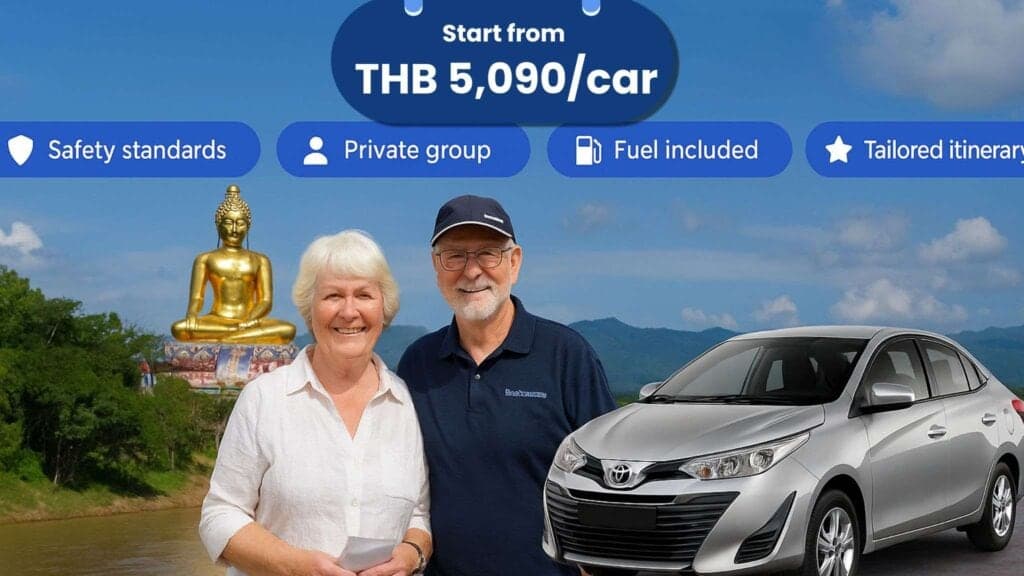
Private guides in Chiang Mai run ฿2,500-5,000 per day depending on vehicle, language, and itinerary complexity. English is widely available, Mandarin is the second most common, Korean and Japanese cover the major Asian markets, and rare-language guides exist for most European languages with 7-14 days notice. The mid-tier (฿3,500-4,500, guide + sedan + driver) is the sweet spot for most travelers. Below is the rate card, the language coverage, the licensing reality, and how to book without getting overcharged.
What does a private guide in Chiang Mai actually cost?
฿2,500-5,000 per full day in 2026, with most travelers landing at ฿3,500-4,500. That covers guide, vehicle with driver, fuel, water, and most entry fees.
The ฿3,500-4,500 mid-tier covers what most travelers actually want: a knowledgeable guide who speaks fluent English (or your preferred language), a comfortable air-conditioned vehicle, water and snacks, and a guide who handles all the small stuff (entry fees, ticket queues, lunch recommendations) so you don't.
The cheaper ฿2,500-3,000 tier is real but comes with trade-offs — you'll typically transport yourself by Grab between sites and the guide meets you at each stop, which adds friction.
What's the difference between a guide and a tour leader?
A guide is licensed by the Thai Department of Tourism and trained to interpret sites with cultural context. A tour leader is unlicensed and effectively just an English-speaking helper. The price difference is roughly 30-50%.
The licensing system matters more than tourists realize. Thailand's Tourist Business and Guide Act of B.E. 2535 (1992, with amendments) requires anyone leading commercial tour groups at public attractions to hold a guide license. The license is issued by the Department of Tourism after a multi-month training program covering Thai history, religion, regional culture, first aid, and the relevant languages.
A licensed guide carries a yellow ID card. The card lists their license number, photo, expiry date, and approved languages.
What an unlicensed tour leader can legitimately do:
- Walk a small private group around an area.
- Translate at restaurants and shops.
- Handle logistics like taxi booking and hotel check-in.
What they can't do (or shouldn't, anyway):
- Lead tours at official national parks (rangers may refuse entry).
- Interpret historical or religious sites with authority.
- Operate as the licensed guide-of-record on a multi-day trip.
The cheaper "guide" listings on some platforms (especially budget marketplaces) are often unlicensed tour leaders. Confirm the license before booking, not on the day.
Which languages are available beyond English?
Mandarin is widely available, Korean is growing fast, Japanese has a smaller dedicated tier, European languages exist with notice.
| Language | Approx % of CM guide pool | Booking lead time | Day rate range |
|---|---|---|---|
| English | ~65% | Same day to 3 days | ฿3,500-5,000 |
| Mandarin | ~20% | 1-3 days | ฿4,000-6,000 |
| Korean | ~8% | 3-7 days | ฿4,500-6,500 |
| Japanese | ~5% | 3-7 days | ฿4,500-6,500 |
| Russian | ~2% | 5-10 days | ฿5,000-7,000 |
| German / French / Spanish | <2% each | 7-14 days | ฿5,000-8,000 |
| Hebrew / Italian / Dutch | Single-digit guides each | 10-21 days | ฿6,000-10,000 |
For English, French, German, and Spanish, you can almost always find a guide within a couple of days notice in high season. For Hebrew or Italian, book 2-3 weeks ahead or accept that the available guides may not be the strongest in the language pool.
Mandarin guides cluster in the higher-end private market because the Chinese tourism segment to Chiang Mai is well-served. Korean is the most rapidly growing language — agencies have been expanding capacity since 2023.
How do I know if a guide is any good?
Three signals: licensed (yellow card visible), reviews from real trips on Google or Tripadvisor, and a clear specialism (food, temples, hill tribes, photography).
A guide saying "I do everything" is a yellow flag. The good guides specialize. The best Chiang Mai guides we work with each have a clear area: one specializes in royal-era Lanna history, one in northern Thai cooking traditions, one in hill-tribe villages and trekking, one in temple architecture and Buddhist symbolism.
When the topic matters to you, asking for a guide who specializes is the single best move you can make.
What's included in the day rate vs extra?
Standard inclusions: guide, vehicle, driver, fuel, water, hotel pickup and drop-off. Standard exclusions: entry fees at some sites, lunch, tips, personal purchases.
| Item | Typically included? | Typical cost if extra |
|---|---|---|
| Guide (licensed, full-day) | Yes | — |
| Vehicle + driver | Yes in mid+ tier | ฿1,200-2,000 if separate |
| Fuel | Yes | Built into vehicle cost |
| Bottled water | Yes | Negligible |
| Hotel pickup/drop-off | Yes (Old City, Nimman, airport hotels) | ฿100-200 if outlying area |
| Major entry fees (Doi Suthep, Inthanon) | Sometimes — confirm | ฿50-300 per person per site |
| Lunch | No, usually | ฿200-500 per person |
| Tip for guide | No | 10-15% of day rate |
| Tip for driver (if separate) | No | ฿100-200 |
The "entry fees included vs not" question is where most disputes arise. Always confirm in writing which fees are inside the day rate and which are paid separately on the day.
Lunch is the second most common confusion. The convention is: lunch is not in the day rate, but the guide will recommend or take you to a local restaurant where prices are reasonable. Pay for the guide and driver's lunch — it's customary and adds ฿150-300 to the day.
Half-day vs full-day: which actually makes sense?
Full-day for any real itinerary. Half-day for narrow specific tasks — airport stopover, one temple, one cooking class transfer.
Half-day rates run 65-75% of full-day rates for half the time. The math means full-day is much better value per hour because guide pickup, vehicle dispatch, and lunch coordination are mostly fixed costs.
When half-day works:
- Airport-to-hotel sightseeing detour with a 3-hour layover.
- One specific temple plus a market stop.
- Photography session at a specific site.
- Cooking class drop-off and pickup with one stop in between.
When full-day is the only option:
- Doi Inthanon (90-min drive each way).
- Chiang Rai day trip (3.5-hour drive each way).
- Multi-temple Old City + Doi Suthep loop.
- Hill-tribe village visits.
- Anything that involves lunch at a destination away from the city.
When should I hire a private guide versus join a group tour?
Private guide when you have specific interests, mobility constraints, fewer than 4 travelers needing flexibility, or you don't want to share a minivan with strangers. Group tour when you're solo on a budget, you want to meet other travelers, or the itinerary is fixed (like a Doi Inthanon group bus).
Group tours run ฿800-2,500 per person depending on destination, which works out cheaper than private if you have 1-2 travelers. For 3+ travelers, private typically matches or beats the per-person group rate.
The non-financial reasons people pick private:
- Stop where you want, leave when you want.
- Skip stops that don't interest you.
- Special interests (food, photography, religion) that get diluted in a group.
- Family with kids who need bathroom and snack flexibility.
- Mobility constraints requiring a slower pace.
- Specific language needs.
The reasons people pick group:
- Solo travel with a social budget.
- Genuinely interested in the standard itinerary, no customization needed.
- Cost-sensitive, prepared to share a vehicle.
For most temple-tour visitors, group works fine. For specialist interests, private wins.
How far ahead should I book a private guide?
Three days minimum in low season, 7-14 days in high season (November-February), 14-21 days for major holidays (Chinese New Year, Songkran, Loy Krathong).
The strongest 100-150 of the roughly 800 licensed Chiang Mai guides get booked solid in high season. Booking earlier matters for senior guides with specialism (food, photography, hill tribes), less-common languages, multi-day trips with a single guide, and festival dates. Same-day bookings get the residue. If you have any flexibility, give the agency 5-7 days to assign the right person.
Where should I book — direct, agency, or marketplace?
Direct from a Chiang Mai-based operator or a known agency. Avoid marketplaces (Viator, GetYourGuide, Klook) for private guides — the markup is steep and the assignment process is opaque.
Direct booking (us, ToursByLocals, Withlocals' Chiang Mai network):
- Guide assigned by name. You can request a specific person.
- 20-30% cheaper than the same tour on a marketplace.
- Direct contact with the guide before the day for itinerary adjustments.
Marketplace booking:
- Listing shows "professional licensed guide" with no name.
- Guide assigned 24-48 hours before the tour.
- Some bookings get reassigned to whoever is free.
- 20-30% commission baked into the price.
For a private guide where the person matters, direct is the right call. For a generic "I want a temple tour" with no specific guide preference, marketplaces work but cost more.
What's the call for most travelers?
Mid-tier private (฿3,500-4,500 per day), licensed English-speaking guide, sedan or SUV with driver, booked 5-7 days ahead direct with a Chiang Mai operator. Mandarin or Korean as needed.
That covers the realistic preferences of most visitors. Above that, premium positioning. Below it, real trade-offs.
Book a private Doi Suthep and Wat Pha Lat dayLicensed guide, hotel pickup, your pace. No marketplace markup.Related reading:
- Chiang Mai private tour cost: what each tier actually buys
- Chiang Mai with kids: family-friendly itinerary and tips
- Best Viator alternatives for Chiang Mai tours
External references:
- Department of Tourism Thailand guide licensing pages (dot.go.th).
- Tourism Authority of Thailand guide hire information, accessed 2026-05-25.
Frequently asked questions
Are private guides in Chiang Mai licensed?
Commercially-operating guides should hold a Department of Tourism (DOT) license — a yellow ID card with photo, license number, and approved language list. The license is mandatory under the Tourist Business and Guide Act. Unlicensed guides are cheaper but you have no recourse, and licensed sites (national parks, some temples) can refuse entry. Ask any guide to show their card before paying.
Is Mandarin available, and what other languages?
Yes. Chiang Mai has roughly 800 licensed guides — about 65% English, 20% Mandarin, 8% Korean, 5% Japanese, plus smaller numbers in Russian, German, French, Spanish, and Italian. Korean is the fastest-growing tier — arrivals grew sharply in 2023-2025. For less-common languages (Hebrew, Dutch), book 7-14 days ahead — supply is thin.
Is the tip included in the day rate?
No. Guide day rates exclude tip. A 10-15% tip is standard for a full-day private tour where the guide performed well, paid in cash at the end of the day. For half-days, ฿200-400 is common. The guide will not ask. If you booked through an agency, tip the guide directly. Drivers (if separate) get ฿100-200 per day.
Half-day vs full-day — which is better value?
Full-day, in most cases. Fixed costs (pickup, dispatch, lunch coordination) are similar regardless of duration. Half-day rates are 65-75% of full-day for half the time. Half-day works for narrow tasks (one temple, airport stopover). For real touring — Doi Suthep + Old City, Doi Inthanon, or a Chiang Rai run — full-day is the only option that fits.
What does ฿2,500-5,000 per day actually buy?
The ฿2,500 floor buys a licensed English-speaking guide with their own scooter, no vehicle — you organize transport. ฿3,500-4,000 buys guide plus sedan or SUV with driver, fuel, water, entry fees. ฿5,000+ buys all that plus a higher-end vehicle and senior guides with deeper specialism. Above ฿5,000 you're paying for premium positioning. Most travelers do well in ฿3,500-4,500.
Frequently asked questions
Are private guides in Chiang Mai licensed?
Commercially-operating guides should hold a Department of Tourism (DOT) license — a yellow ID card with photo, license number, and approved language list. The license is mandatory under the Tourist Business and Guide Act. Unlicensed guides are cheaper but you have no recourse, and licensed sites (national parks, some temples) can refuse entry. Ask any guide to show their card before paying.
Is Mandarin available, and what other languages?
Yes. Chiang Mai has roughly 800 licensed guides — about 65% English, 20% Mandarin, 8% Korean, 5% Japanese, plus smaller numbers in Russian, German, French, Spanish, and Italian. Korean is the fastest-growing tier — arrivals grew sharply in 2023-2025. For less-common languages (Hebrew, Dutch), book 7-14 days ahead — supply is thin.
Is the tip included in the day rate?
No. Guide day rates exclude tip. A 10-15% tip is standard for a full-day private tour where the guide performed well, paid in cash at the end of the day. For half-days, ฿200-400 is common. The guide will not ask. If you booked through an agency, tip the guide directly. Drivers (if separate) get ฿100-200 per day.
Half-day vs full-day — which is better value?
Full-day, in most cases. Fixed costs (pickup, dispatch, lunch coordination) are similar regardless of duration. Half-day rates are 65-75% of full-day for half the time. Half-day works for narrow tasks (one temple, airport stopover). For real touring — Doi Suthep + Old City, Doi Inthanon, or a Chiang Rai run — full-day is the only option that fits.
What does ฿2,500-5,000 per day actually buy?
The ฿2,500 floor buys a licensed English-speaking guide with their own scooter, no vehicle — you organize transport. ฿3,500-4,000 buys guide plus sedan or SUV with driver, fuel, water, entry fees. ฿5,000+ buys all that plus a higher-end vehicle and senior guides with deeper specialism. Above ฿5,000 you're paying for premium positioning. Most travelers do well in ฿3,500-4,500.